A Clean Break from C++: Inside Rust 1.97’s New Default v0 Symbol Mangling
The upcoming Rust 1.97.0 release is officially switching to the native "v0" symbol mangling scheme by default. This monumental compiler-level shift, coupled with the rollout of the 2026 Project Goals under RFC #3935, marks a massive evolution for Rust's self-sovereignty, debugging ecosystem, and compilation speeds.

A Clean Break from C++: Inside Rust 1.97’s New Default v0 Symbol Mangling
Scheduled for release on July 9, 2026, the upcoming Rust 1.97.0 stable release brings one of the most significant architectural milestones in the history of the language. Under the hood of the compiler, Rust is officially graduating its native "v0" symbol mangling scheme to be the system-wide default.
This transition marks a clean break from C++ legacy infrastructure, streamlining binary debugging, improving compile-time optimizations, and cementing Rust's status as a fully self-sovereign systems programming language.
Decoding the Magic of Symbol Mangling
For systems programmers, symbol mangling is a critical compiler task. Because CPUs and linkers do not understand human-readable abstractions like nested namespaces, generic types, or traits, the compiler must map these structures into unique, flat strings of characters in the compiled binary's symbol table.
Up until now, rustc defaulted to a "legacy" mangling format heavily derived from C++. While functional, this approach often leaked volatile compiler internals and struggled to concisely represent Rust’s highly expressive type system—resulting in bloated, unintelligible symbol names during panic backtraces or profiling sessions.
The v0 symbol mangling scheme (originally drafted in RFC 2603) fixes these foundational limits by introducing a highly structured, unambiguous, and fully reversible encoding dialect designed specifically for Rust.
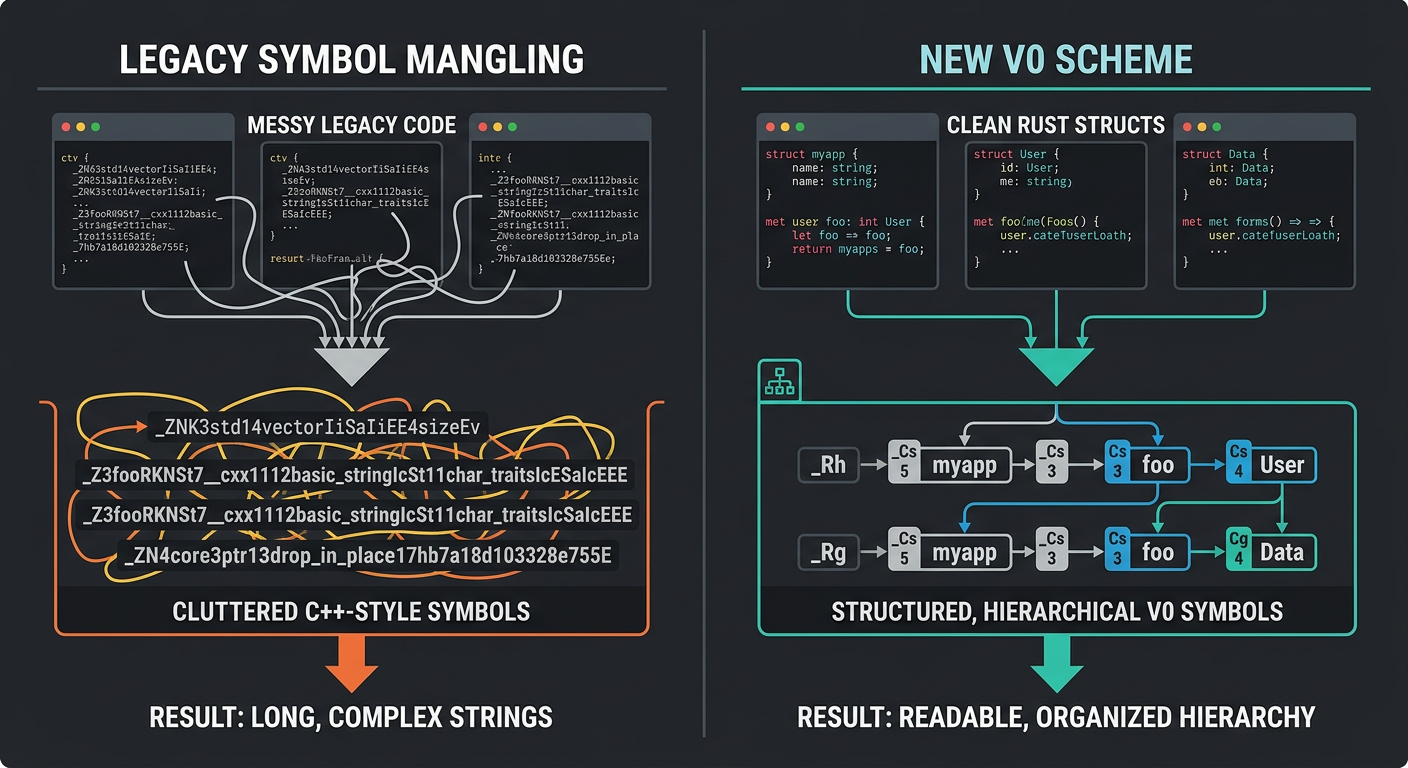
Why v0 Changes the Game
By utilizing v0 by default, developers will experience immediate, compounding benefits across their local development and CI/CD pipelines:
- Unambiguous Generic Reconstruction: Because the v0 format handles generic parameters natively, external debuggers (like
gdbandlldb), profilers, and binary analyzers can perfectly reconstruct and display concrete instances of generic functions. - Hardened Security: The v0 scheme is strictly self-contained and does not leak compiler internals. This prevents reverse-engineering tools from exploiting system-specific structures, making binaries safer in production.
- Tooling Stability: After years of collaboration across the open-source community, downstream Unix distros, profiling packages, and IDE demanglers are finally ready. Flipping the default guarantees that standard tools will work seamlessly without manual configuration.
RFC #3935: The Architecture of Rust's Multi-Year Future
This massive compiler upgrade is no isolated event. It represents a vital piece of the puzzle within RFC #3935 (established in early 2026), which completely overhauled the Rust Project's developmental roadmap.
Instead of chasing chaotic, six-month minor goals, the Rust Leadership Council has shifted to unified, annual planning cycles categorized under flagship multi-year initiatives—including "Fast Builds" and "Safety-Critical Rust". The normalization of the v0 symbol mangling format serves as a massive milestone for both, laying the technical foundation for optimized incremental builds, faster linker execution, and predictable compilation paths.


Get the wire in your inbox
Every new signal, straight from the generator. No noise, unsubscribe anytime.