B3Forge v2 and Flow Studio Beta: Visual Workflows, AI Generation, and Candid-Expr on the Internet Computer
B3Forge v2 is transforming Internet Computer dApp development with shareable canister interactions, a revamped Candid editor, and the new B3Forge Flow Studio Beta. Powered by ic-reactor v3 and the proposed "Candid-Expr" standard, developers can now build, run, and AI-generate multi-step visual workflows.

B3Forge v2 and Flow Studio Beta: Visual Workflows, AI Generation, and Candid-Expr on the Internet Computer
Interacting with canisters on the Internet Computer (IC) has historically required a fair amount of manual lifting—from navigating Candid interfaces to managing state across complex, multi-step operations.
Enter B3Forge v2, a major upgrade built as a production showcase of ic-reactor v3. This new release completely reimagines the developer experience on the IC, moving from static single-canister queries to shareable, AI-driven visual workflows.
What’s New in B3Forge v2?
At its core, B3Forge v2 optimizes the way developers explore and debug canisters. The platform features a completely redesigned landing page serving as a centralized hub for popular tokens and canister discovery. Alongside a faster, cleaner in-browser Candid playground editor, the update introduces several game-changing developer features:
- Shareable Canister Interactions: The platform's most requested feature lets you pre-fill arguments for specific canister methods and generate a shareable URL. Instead of explaining execution steps to a teammate, you can send them a direct, configured deep link.
- Powered by
ic-reactor v3: B3Forge utilizesic-reactor v3to handle dynamic Candid parsing, state management, and underlying Actor interactions on the frontend.
Introducing B3Forge Flow Studio Beta & "Candid-Expr"
Beyond single canister calls, B3Forge is shifting toward becoming a comprehensive visual App Builder. The newly released B3Forge Flow Studio Beta allows developers to visually chain multiple canister calls together using drag-and-drop nodes.
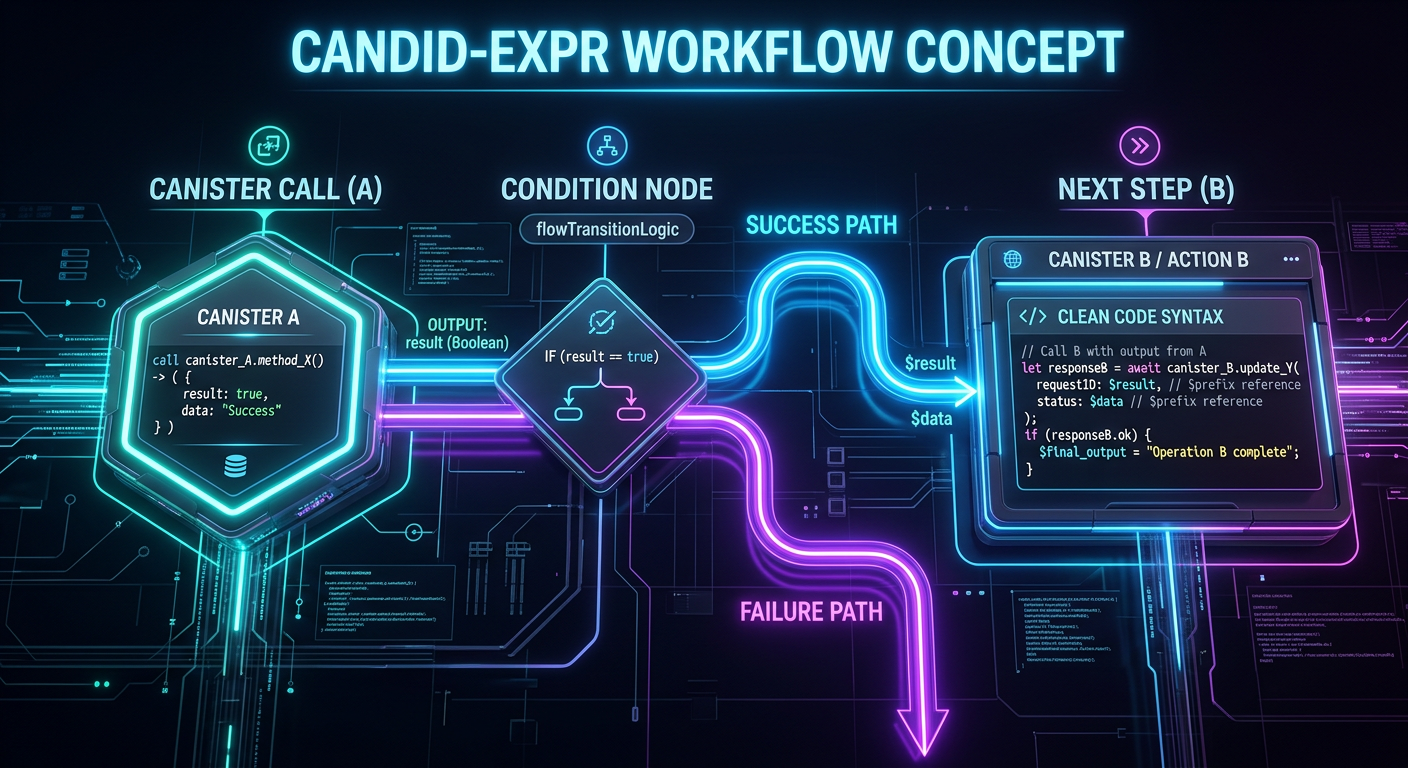
To power this visual execution model without inventing a complex separate runtime, B3Forge introduced Candid-Expr. This standard defines a Candid-native way to handle workflow inputs, transition states, and typed references to prior node results.
The Candid-Expr Execution Model
Under the Candid-Expr specification, developers write normal Candid text, but can reference outputs from previous nodes using $node_id references. To keep execution predictable and highly typed, the standard adheres to a strict set of rules:
- Explicit Traversal: To parse outputs, traversal must be explicit—records are traversed by field, variants by active arm, tuples by numeric index, and optional values only through
.some(e.g.,$transfer.Err.InsufficientFunds.balanceor$profile.some.owner). - The
retNamespace: Every node exposes a canonical return namespace. To improve ergonomics, the rootless shorthand is supported alongside the full path (e.g.,$N3.Okis equivalent to$N3.ret.Ok). - Structured Failures: Standard canister runtime errors (like traps, rejects, or timeouts) will hard-stop execution. However, normal canister
Result Errpayloads are treated as typed return values, enabling custom branching vianext_on_result_err.
The Shared Contract Schema
The workflow structure utilizes a minimal schema designed to run across browsers, local environments, and canister runtimes:
type CanisterCallConfig = record {
  canister_id : principal;
  method_name : text;
  arg_expr : text;
  method_candid : text;
  next_on_result_err : opt text;
};

type VariablesConfig = record {
  value_expr : text;
  value_type : text;
};

type DynamicCallNode = record {
  id : text;
  label : opt text;
  next_on_ok : opt text;
  config : variant {
    CanisterCall : CanisterCallConfig;
    Variables : VariablesConfig;
  };
};

type DynamicWorkflow = record {
  entry_node_id : text;
  nodes : vec DynamicCallNode;
};
Natural Language AI Orchestration
To streamline the workflow design process, Flow Studio integrates an AI orchestration layer. By interpreting Candid files as application schemas, the AI understands how various canisters interact. Developers can simply provide a natural language prompt—such as "Build me a DAO voting app with token-weighted votes"—and the AI will identify the necessary governance and ledger canisters, map the inputs, and automatically assemble the multi-step visual workflow.
Developers can now build, run, fork, and share these workflows directly in the browser by visiting forge.b3pay.net.


Get the wire in your inbox
Every new signal, straight from the generator. No noise, unsubscribe anytime.