Beyond Testing: How Sector9 (SR9) is Bringing Mathematical Proofs to Internet Computer Smart Contracts
The DFINITY developer ecosystem is buzzing over the release of Sector9 (SR9), a revolutionary Motoko-derived language and verification toolchain. By combining the actor model with the Z3 theorem prover and Viper, SR9 allows developers to mathematically prove smart contract logic, solving critical Web3 security hazards like reentrancy and async-state interference before deployment.

Beyond Testing: How Sector9 (SR9) is Bringing Mathematical Proofs to Internet Computer Smart Contracts
For Web3 developers, deploying smart contracts that secure millions of dollars in digital assets is a high-stakes, nerve-wracking process. Traditional unit testing, while essential, is fundamentally limited—it can only prove that a program behaves correctly for the specific test cases a developer can think of.
A major breakthrough has arrived in the Internet Computer (ICP) ecosystem to close this gap. Developers on the DFINITY forums are celebrating the launch of Sector9 (SR9), a Motoko-derived language and formal verification toolchain designed to mathematically prove contract correctness before a single canister is compiled.
What is Sector9 (SR9)?
Developed as a highly specialized extension of Motoko, Sector9 goes beyond static type-checking. While a traditional compiler only ensures your data types match, SR9 enables developers to write logical boundaries directly into their source code using specification keywords such as entry_requires, requires, ensures, and invariant.
For example, while Motoko can verify that a withdrawal amount is a natural number (Nat), SR9 can mathematically guarantee that the amount <= balance and that the post-state matches result == old(balance) - amount. If any code path breaks these rules, the verifier flags it as unsafe.
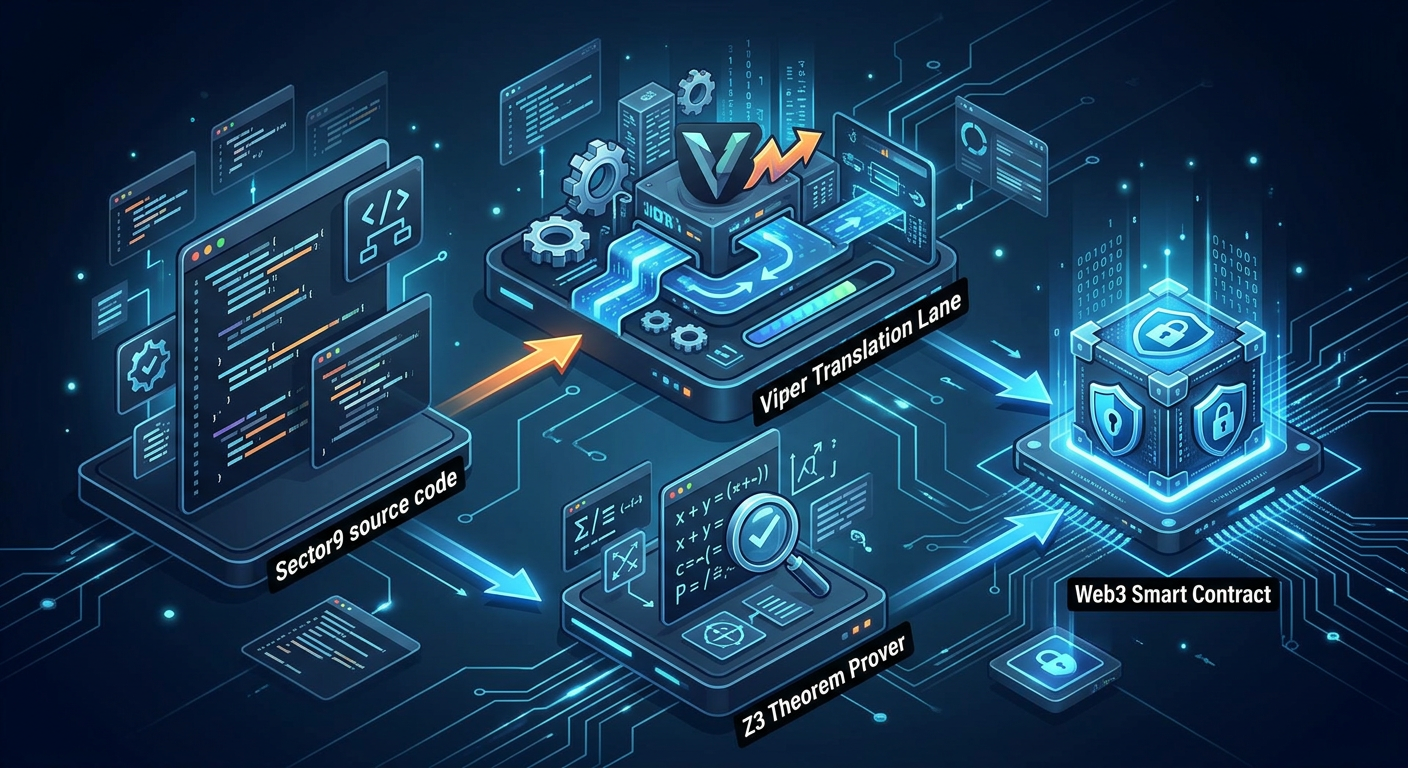
Under the Hood: The Viper and Z3 Verification Engine
Rather than relying on runtime checks or complex simulation environments, Sector9 uses formal methods:
- Viper Translation: The SR9 compiler translates the Motoko-like source code into Viper, an intermediate language designed for formal verification.
- Theorem Proving: This translated code is analyzed by the industry-standard Z3 theorem prover. Z3 scans all possible symbolic inputs and modeled execution paths to ensure that the code never violates the stated contract invariants.
Solving Web3's Hardest Challenges: Reentrancy and Async Interference
The Internet Computer’s asynchronous message-passing model introduces unique security challenges. When a canister awaits a cross-canister response, other messages can execute in the middle of that handler, opening the door to devastating reentrancy and state-interference exploits.
Sector9 tackles this head-on. The Viper lane models await interference conservatively, forcing developers to declare precisely which state invariants must hold during an asynchronous call. Furthermore, SR9 supports proof-aware cross-canister boundaries. This allows verified canisters to securely pass proof credentials directly across calls to other verified canisters, replacing opaque trust assumptions with mathematically verified logic.
With SR9 already being used to verify decentralized exchanges (DEXes) on mainnet and accessible inside localized Docker sandboxes, ICP has taken a massive step toward mathematically ironclad decentralized infrastructure.


Get the wire in your inbox
Every new signal, straight from the generator. No noise, unsubscribe anytime.