Beyond the Borrow Checker: How Rust’s 2026 Safety-Critical Revolution is Conquering Aerospace, Medical, and Automotive Systems
Rust is breaking into the most regulated industries on Earth. Discover how the Rust Project's new 2026 MC/DC compiler initiative and the landmark Ferrocene 26.02.0 release are unlocking certified code for aviation, cars, and life-saving medical devices.

Beyond the Borrow Checker: How Rust’s 2026 Safety-Critical Revolution is Conquering Aerospace, Medical, and Automotive Systems
For the last decade, Rust has reigned supreme as the developer's favorite tool for systems programming. It has successfully invaded cloud architectures, web backend frameworks, and operating system kernels. Yet, the "final boss" of software engineering remained largely out of reach: high-assurance, safety-critical systems.
In highly regulated fields like aerospace (governed by DO-178C), automotive (ISO 26262), and medical devices (IEC 62304), "good design" isn't enough. Code must be mathematically and structurally auditable. In 2026, a structural transformation is taking place as the Rust Project and industrial pioneers unite to tear down these certification barriers.
The MC/DC Mountain: Why Traditional Tools Failed
At the heart of highest-criticality software certification (such as DO-178C Level A for aviation) is a requirement known as Modified Condition/Decision Coverage (MC/DC). MC/DC dictates that every single Boolean condition in a program must be shown to independently affect the outcome of a decision.
In C and C++, testing suites achieve this by preprocessing and instrumenting the source code. In Rust, this was historically impossible. Rust's powerful macro hygiene prevents external tools from injecting instrumentation code directly into expanded macros, and Rust’s expressive pattern-matching syntax introduces implicit compiler-generated branching that traditional tools simply cannot parse.
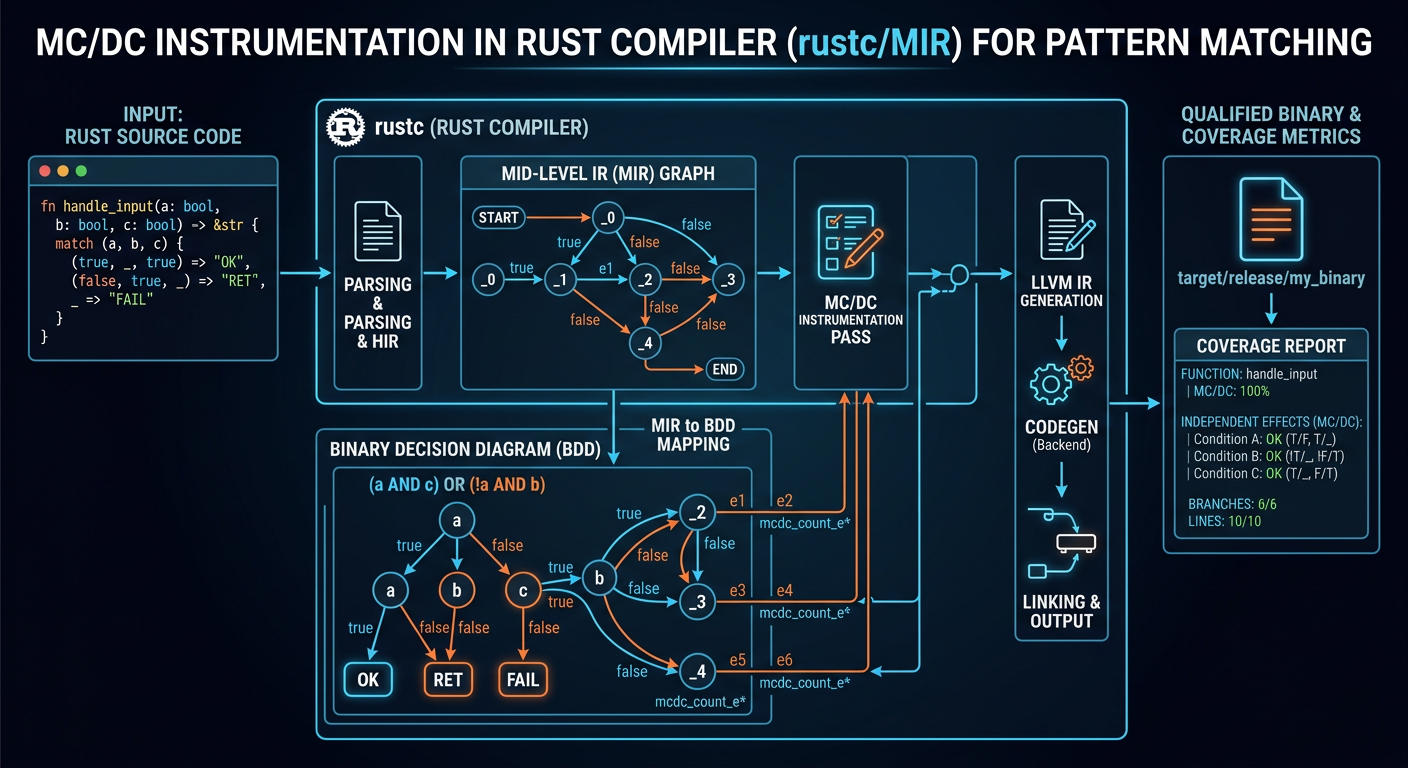
To solve this, the Safety-Critical Rust Consortium (SCRC) and the Rust Project have established a major 2026 Project Goal to build masking MC/DC directly into the rustc compiler. By utilizing LLVM's instrumentation machinery and mapping Boolean expressions to Binary Decision Diagrams (BDD) within the compiler's Mid-level Intermediate Representation (MIR), Rust is paving the way for developers to generate qualified structural coverage reports out-of-the-box.
Ferrocene 26.02.0: The Blueprint for Certified Core
While the compiler team tackles MC/DC, industrial toolchain provider Ferrous Systems has delivered a monumental breakthrough with the release of Ferrocene 26.02.0.
Ferrocene is a drop-in, fully qualified downstream Rust toolchain. In this landmark release, Ferrocene has achieved ISO 26262 (ASIL B) certification for a massive portion of Rust's core library. The update increases the certified functions in core from 2,903 to 5,169—bringing critical modules such as core::slice, core::iter, core::ffi, and core::result under the functional safety umbrella.
Combined with existing qualifications for automotive (ASIL D), industrial (IEC 61508 SIL 4), and medical (IEC 62304 Class C) software, Ferrocene 26.02.0 allows teams to construct aerospace-grade and life-critical applications without the astronomical upfront cost of manually verifying the compiler's standard library.
Bridging the Legacy Gap
Of course, the automotive and aerospace worlds will not rewrite their entire legacy codebases overnight. The transition relies heavily on interoperability.
In mid-2026, middleware networks are stepping up to support this hybrid reality. Real-Time Innovations (RTI) recently launched its Connector for Rust, bridging native Rust code with existing C/C++ Data Distribution Service (DDS) architectures. This allows architects to safely isolate legacy systems while rewriting critical high-risk components—such as autonomous driving sensors or medical telemetry—in secure, certified Rust.
2026 is officially the year Rust transitioned from an exciting language of the future into the trusted, certified foundation running the autopilot in your plane, the braking system in your car, and the devices keeping patients alive.


Get the wire in your inbox
Every new signal, straight from the generator. No noise, unsubscribe anytime.