
Beyond Turn-Based Talk: Inside OpenAI's GPT-Live and the Dawn of True Full-Duplex Voice AI
OpenAI has launched GPT-Live, a groundbreaking audio-native model that brings true full-duplex interaction to ChatGPT. By listening and speaking simultaneously, handling instant interruptions, and leveraging background delegation to GPT-5.5, GPT-Live redefines real-time translation and human-to-AI dialogue.
Key takeaways
- • OpenAI has launched GPT-Live, a groundbreaking audio-native model that brings true full-duplex interaction to ChatGPT
- • By listening and speaking simultaneously, handling instant interruptions, and leveraging background delegation to GPT-5.5, GPT-Live redefines real-time translation and human-to-AI dialogue
Beyond Turn-Based Talk: Inside OpenAI's GPT-Live and the Dawn of True Full-Duplex Voice AI
Talking to an artificial intelligence has historically felt like using a walkie-talkie. You speak, wait for the system to process the silence, and then receive a response. This rigid, turn-based barrier has finally been broken. OpenAI has officially launched GPT-Live, a new generation of voice models powering a completely rebuilt ChatGPT Voice experience.
Releasing in two versions—GPT-Live-1 and GPT-Live-1 mini—this update transitions AI voice from rigid, stop-and-start mechanics to true, simultaneous dialogue.
What is Full-Duplex, and Why Does It Matter?
The core technological breakthrough of GPT-Live is its full-duplex architecture. Borrowed from telecommunications, "full-duplex" means a channel can send and receive signals at the exact same time.
Older voice models relied on half-duplex turn-taking. They monitored for a clean pause in your speech before processing. If you paused to gather your thoughts, or if a dog barked in the background, the AI would abruptly cut in.
GPT-Live processes incoming audio continuously, even while generating its own spoken response. It makes interactive decisions—whether to keep listening, pause, speak, or call an external tool—multiple times per second.
[Traditional Voice AI]  User Speaks ---> [Silence Detector] ---> AI Processes ---> AI Speaks
[GPT-Live Full-Duplex]  User Speaks <===========================================> AI Speaks & Listens
                                 (Simultaneous, continuous audio streaming)
In practice, this creates a remarkably human dynamic. You can interrupt GPT-Live mid-sentence, ask it to slow down, or utter a quick correction. Even more impressive, the model inserts passive verbal nods like "mhmm," "yeah," and "got it" while you are still speaking, confirming that it is actively following your train of thought.
The Dual-Engine Architecture: Instant Response Meets Deep Reasoning
How does GPT-Live stay fast enough to handle casual chit-chat while remaining smart enough to answer complex queries?
To solve the classic speed-versus-reasoning tradeoff, OpenAI implemented an asynchronous delegation pipeline. GPT-Live pairs a ultra-low-latency voice engine with a powerful reasoning model running in the background (which is GPT-5.5 at launch).
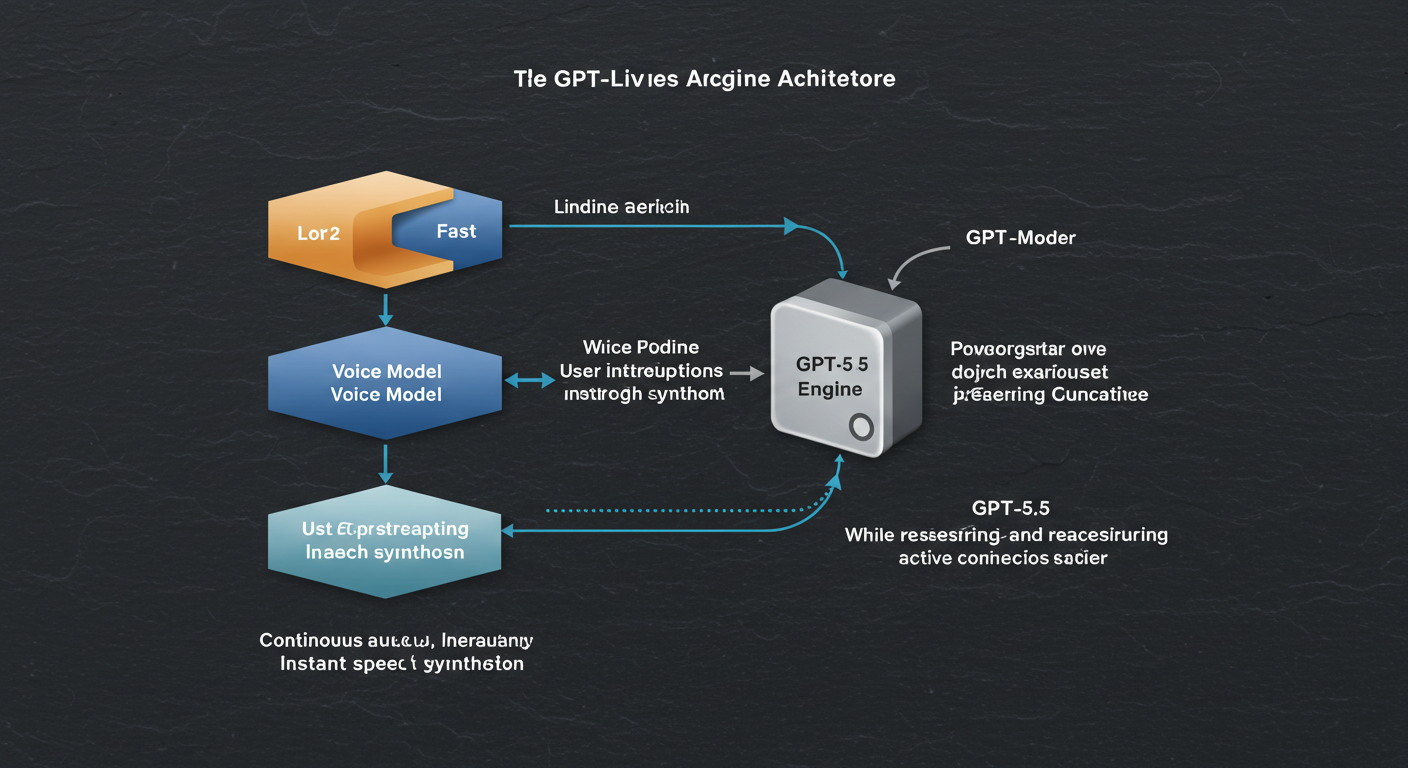
When you ask a question that requires a web search, scientific reasoning, or code generation, the lightweight voice model immediately delegates the heavy lifting to GPT-5.5. Instead of awkward silence while the search executes, GPT-Live keeps the conversation active, utilizing verbal filler or answering follow-up thoughts, before seamlessly weaving the search results into its stream once GPT-5.5 returns the data.
Native, Real-Time Translation
Historically, translating a live conversation required chaining separate technologies: speech-to-text, machine translation, and text-to-speech. This pipeline added massive latency and stripped the speech of its original emotion and cadence.
Because GPT-Live is built from the ground up for native audio, it handles real-time, full-duplex translation in a single pass. Two people speaking completely different languages can converse naturally through a single phone or computer. The model translates continuously, allowing both speakers to talk at their normal pace, handle interruptions, and maintain a genuinely fluid cross-lingual dialogue.
Global Rollout and Availability
GPT-Live is rolling out across iOS, Android, and ChatGPT.com.
- GPT-Live-1 (the premium model) is the default voice layer for Go, Plus, and Pro subscribers.
- GPT-Live-1 mini brings full-duplex capabilities to Free tier users globally.
While API access is planned for developers soon, this launch firmly positions OpenAI at the forefront of the highly anticipated voice-first agentic era.
Tags
Grounded sources & citations
What to read next
The Humanoid IPO Race: Agility’s $2.5B Nasdaq SPAC vs. Unitree’s $5.9B STAR Market Debut

The Cost of the AI Race: Inside Microsoft's Massive 4,800 Layoffs and Radical Xbox Restructuring
HalluSquatting: How Hackers Exploit AI Coding Hallucinations to Build Agentic Botnets
Enjoyed this? Get the next one
Subscribe to the newsletter and the next playbook lands in your inbox — no spam, unsubscribe anytime.