Bridgeless Fusion: How ICP’s 'Helium' Milestone and Threshold EdDSA Eliminate Solana Bridges
The DFINITY Foundation’s completed "Helium" milestone brings native, bridgeless Solana integration to the Internet Computer. By combining Threshold EdDSA signatures with decentralized HTTPS outcalls, ICP canisters can now hold SOL assets and sign Solana transactions natively, rendering vulnerable cross-chain bridges obsolete.

Bridgeless Fusion: How ICP’s 'Helium' Milestone and Threshold EdDSA Eliminate Solana Bridges
Cross-chain bridges have long been the Achilles' heel of Web3. Designed to move assets between isolated blockchains, these intermediaries have historically served as honeypots, leaking billions of dollars to exploits. The DFINITY Foundation’s Helium milestone solves this vulnerability by bringing native, bridgeless Solana integration to the Internet Computer Protocol (ICP).
Rather than wrapping tokens or relying on trusted third-party custodians, ICP smart contracts (canisters) can now read, write, and hold native assets directly on the Solana network.
The Cryptographic Magic: Threshold EdDSA
Historically, ICP’s "Chain Fusion" technology excelled at interacting with Bitcoin and Ethereum because canisters supported ECDSA—the signature scheme used by both networks. However, Solana relies on the Ed25519 signature scheme, which requires a completely different mathematical approach.
To bridge this gap without actual bridges, DFINITY developed and deployed Threshold EdDSA.
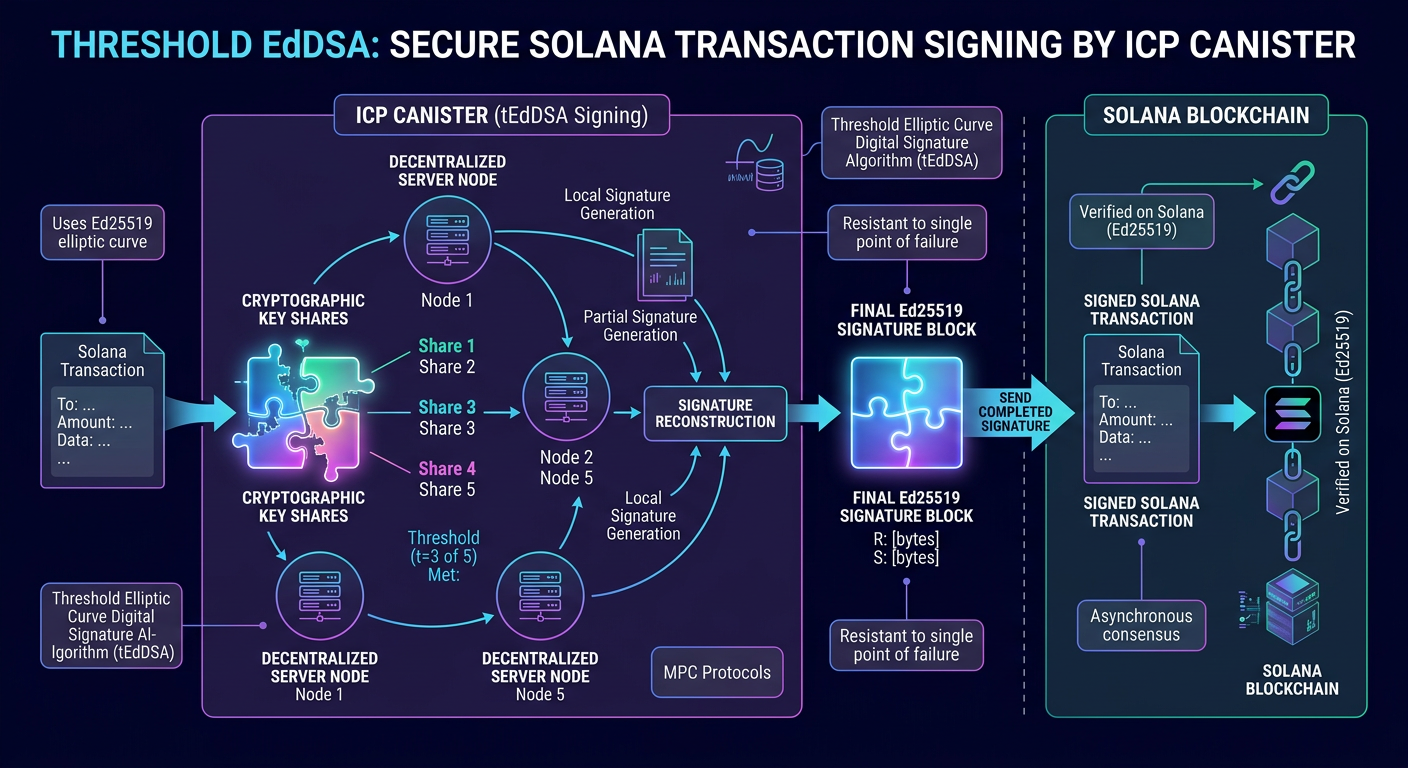
Under this protocol, a canister's private key is never compiled, stored, or known by any single entity. Instead, the key is split into "shares" distributed across independent node providers within an ICP subnet. When a canister wants to send a transaction on Solana:
- The canister triggers a threshold signature request.
- Subnet nodes coordinate using multi-party computation (MPC) to sign the transaction payload.
- The resulting signature is mathematically indistinguishable from a standard Ed25519 signature generated by a single user.
This enables canisters to natively own and control accounts directly on the Solana blockchain.
Verifying the State: The SOL RPC Canister
Generating signatures is only half the battle; canisters must also trustlessly read Solana's state. Under the Helium milestone, this is achieved through the SOL RPC canister and ICP’s secure HTTPS Outcalls.
When a canister needs to verify a Solana transaction (e.g., confirming a token deposit), it does not query a single centralized RPC provider. Instead, the SOL RPC canister queries multiple independent Solana RPC services simultaneously. The ICP nodes cross-reference the responses, ensuring the network reaches a decentralized consensus on Solana's state before executing any logic. Because this entire infrastructure is controlled by the token-holder-run Network Nervous System (NNS), there is no single point of failure.
What This Unlocks for Web3 Developers
The implications of Helium are profound for cross-chain decentralized applications:
- Pure Native Swaps: Developers can build dApps that let users swap native Bitcoin (via ICP's BTC integration) directly for SOL, entirely on-chain and bridge-free.
- Multi-Chain Liquidity Pools: A single DEX on ICP can host liquidity pools holding native BTC, ETH, and SOL simultaneously.
- Compute-Heavy Solana dApps: High-throughput Solana applications can now delegate heavy computation, file storage, and even on-chain AI workloads directly to ICP canisters.
By eliminating the necessity of insecure bridges, the Helium milestone establishes the Internet Computer as a true "World Computer" capable of orchestrating multi-chain execution seamlessly.


Get the wire in your inbox
Every new signal, straight from the generator. No noise, unsubscribe anytime.