Gaze-to-Motion: How Apple Vision Pro and 'Project DRIVE' Are Transforming Wheelchair Tech
Apple’s upcoming visionOS 27 update will allow users to steer power wheelchairs using only their eyes. Developed in partnership with Northwestern University's Project DRIVE, this technology uses the Vision Pro's high-precision eye-tracking and a new Wheelchair Digital Interface (WDI) to bypass traditional manual joysticks.

Gaze-to-Motion: How Apple Vision Pro and 'Project DRIVE' Are Transforming Wheelchair Tech
Spatial computing has long been praised for its ability to place virtual screens in our living rooms and transport us to immersive digital workspaces. However, a groundbreaking new development is shifting the focus of the Apple Vision Pro from digital entertainment to life-changing physical mobility.
Later this fall, as part of the visionOS 27 release, Apple will officially launch a power wheelchair control feature. By leveraging the Vision Pro's high-precision eye-tracking system, individuals with severe motor impairments can steer, navigate, and stop a physical power wheelchair using only their gaze.
This is not a concept; it is a fully functioning system built in collaboration with Project DRIVE, an initiative led by Professor Brenna Argall at Northwestern University.
The Problem: The Analog Bottleneck
For decades, motorized wheelchairs have relied on analog, proprietary, 9-pin connection standards. This "one-way street" setup has prevented modern digital tools—such as advanced eye-trackers, head-trackers, or mobile apps—from communicating with wheelchair control systems without costly, proprietary, and complex hardware overrides.
To bridge this gap, Project DRIVE engineered the Wheelchair Digital Interface (WDI). The WDI is an open, bi-directional API standard that acts as a universal translator, allowing modern consumer devices to feed input data directly into a wheelchair’s drive system. Rather than building a wheelchair-control system from scratch, Apple's engineers integrated directly with this open standard.
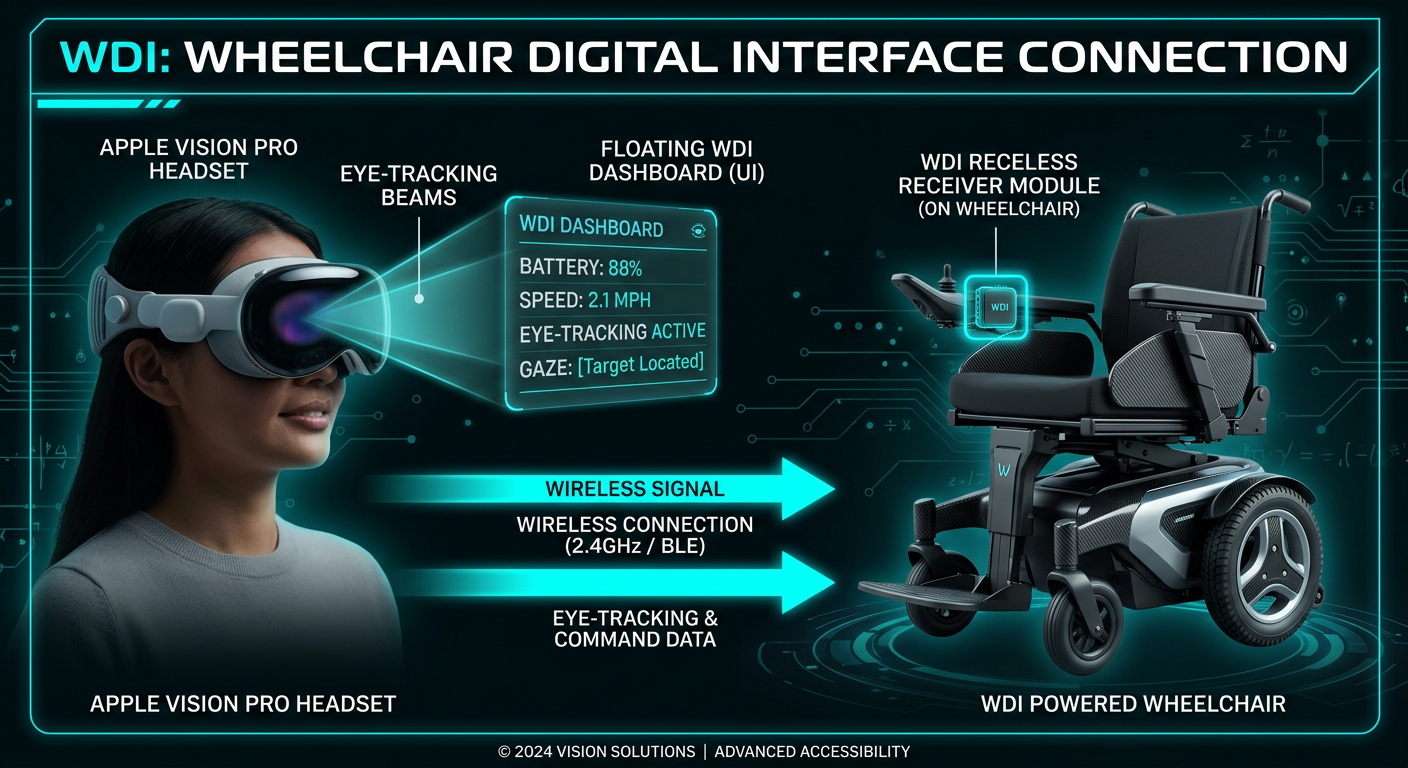
How It Works: Gaze-to-Drive
Traditional eye-gaze systems are notoriously fragile, requiring frequent, tedious calibration and failing under direct sunlight or shifting shadows. Apple’s Vision Pro solves this through its high-performance hardware array, featuring ultra-low-latency cameras and ring-shaped LED illuminators that map the eye continuously.
- Precision Eye-Tracking: The Vision Pro registers where a user is looking in their physical environment.
- Dynamic UI Overlay: The user interacts with a responsive, hands-free spatial interface that charts an eight-directional compass (forward, backward, left, right, and diagonals) alongside quick stop/pause prompts.
- The WDI Bridge: Gaze commands are packetized and beamed wirelessly over Bluetooth or via a secure wired accessory connection directly to the wheelchair's receiver module.
- Autonomous Safety Guardrails: Safety is paramount. The system launches in the United States in partnership with wheelchair safety pioneers like LUCI and Tolt Technologies. LUCI's smart sensor arrays remain active on the wheelchair, overriding eye commands if the chair detects a drop-off, a collision hazard, or unstable terrain.
Why It Matters
"Often, as a person's motor impairment increases in severity, their ability to operate the very machines designed to assist them decreases," notes Professor Argall. For individuals living with advanced ALS, muscular dystrophy, or quadriplegia, manual joysticks are simply not an option. By turning the Apple Vision Pro’s standard gaze controls into a robust physical steering wheel, Apple is expanding independent mobility to those who need it most.
The feature is expected to arrive this September alongside Apple’s wider suite of iOS 27 and visionOS 27 accessibility upgrades. It stands as a profound reminder that spatial computing's greatest triumphs might not be virtual, but physical.


Get the wire in your inbox
Every new signal, straight from the generator. No noise, unsubscribe anytime.