Hardware as a Smart Contract: Inside IoTeX’s "Yap" Upgrade and the Death of Verbose DePIN Telemetry
IoTeX's "Yap" hard fork (v2.4.1) went live on June 7, 2026, bringing full Ethereum Pectra compatibility and native account abstraction (EIP-7702) to the DePIN-focused Layer 1. Despite a rocky 21-hour launch outage, the upgrade forces a major architectural shift: hardware devices can now act as smart contracts, while a steep calldata price hike officially kills cheap on-chain data dumping.

Hardware as a Smart Contract: Inside IoTeX’s "Yap" Upgrade and the Death of Verbose DePIN Telemetry
On June 7, 2026, the IoTeX Layer 1 network successfully activated its highly anticipated "Yap" hard fork (v2.4.1) at block 48,985,561. While the launch was temporarily marred by a critical 21-hour block production halt, the technical implications of this upgrade mark a monumental shift in how physical hardware interacts with blockchain layers. By achieving full compatibility with Ethereum’s "Pectra" standards (IIP-60), IoTeX has brought native account abstraction (EIP-7702) and a punitive calldata pricing overhaul directly to Decentralized Physical Infrastructure Networks (DePIN).
Devices as Autonomous Contract Actors (EIP-7702)
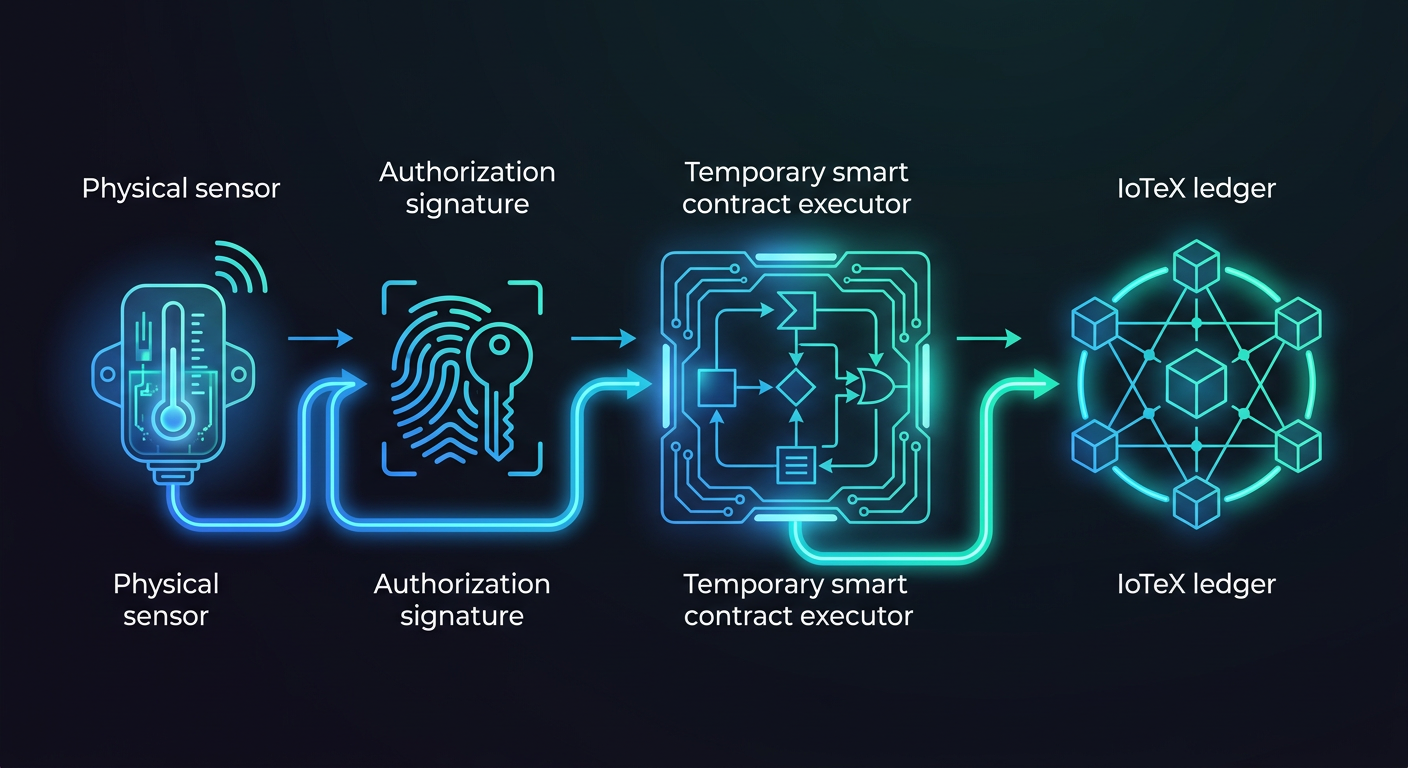
Prior to the Yap hard fork, turning a physical device (like a dashcam or cellular router) into a secure, self-signing on-chain actor was a developer's nightmare. Teams either had to manage volatile private keys on easily compromised physical chips or pay exorbitant gas fees to deploy unique smart contract wallets for every single device in their fleet.
With IoTeX's adoption of EIP-7702, a standard device Externally Owned Account (EOA) can now temporarily delegate execution to contract code. For only ~12,500 gas for authorization and ~25,000 gas for delegation, devices can execute complex transaction batching, rotate keys automatically, and utilize server-sponsored, gas-less transactions without a dedicated smart contract deployment. This brings enterprise-grade cryptographic key hygiene to the edge.
The Calldata Realignment: Compressing the Physical World
The second major pillar of v2.4.0 is a harsh economic reality check for DePIN builders who use block space as a cheap data dump. Adapting Ethereum's EIP-7623 standard, IoTeX has introduced a strict calldata cost floor (TX_COST_FLOOR_PER_TOKEN = 250) to reflect its 100 gas/byte baseline.
Verbose, raw telemetry data is now a heavy financial liability. The upgrade forces DePIN projects to abandon the practice of writing line-by-line physical measurements to the state. Instead, developers must adopt zero-knowledge commitments or publish compressed Merkle roots on-chain while keeping raw telemetry off-chain.
A Rocky Road to Real Utility
The launch wasn't without drama. The mainnet suffered a 21+ hour freeze due to bugs in the staking package's "candidate exit queue". The core team quickly deployed a mandatory hotfix (v2.4.1) to resolve the panicking archive nodes.
This friction highlights the challenges of upgrading live physical networks. However, as Multicoin's Kyle Samani noted on June 1, "Web3 is dead. All we have is DeFi and DePIN." The Yap hard fork is the blueprint for this survival—forcing the industry to move past speculative token-printing and prove real, compressed, and secure machine utility at scale.


Get the wire in your inbox
Every new signal, straight from the generator. No noise, unsubscribe anytime.