Inside the 2026 Rust Compiler Revolution: BorrowSanitizer and the Dual GCC Breakthroughs
Rust’s toolchain is undergoing a historic shift with the emergence of BorrowSanitizer (BSAN) for FFI-safe "Tree Borrows" verification and the dual GCC integrations officially landing in rustup.

Inside the 2026 Rust Compiler Revolution: BorrowSanitizer and the Dual GCC Breakthroughs
As Rust matures from a beloved systems language into the load-bearing pillar of modern infrastructure, its development community has shifted focus toward solving two of its biggest architectural challenges: validating complex unsafe/FFI boundaries and breaking the exclusive reliance on LLVM.
In mid-2026, two massive tooling breakthroughs have officially arrived to reshape how we compile and verify Rust code.
1. BorrowSanitizer (BSAN): Bridging the FFI Safety Gap
While safe Rust is guaranteed to be free of data races and memory bugs, systems code often relies on unsafe blocks and Foreign Function Interfaces (FFI) to interoperate with C and C++.
Traditionally, developers relied on Miri to detect violations of Rust's latest "Tree Borrows" aliasing model. However, Miri is heavily bottlenecked: it runs up to 1000x slower than native execution and cannot inspect compiled C/C++ binaries.
Enter BorrowSanitizer (BSAN), an LLVM-based dynamic instrumentation sanitizer designed to solve both problems.
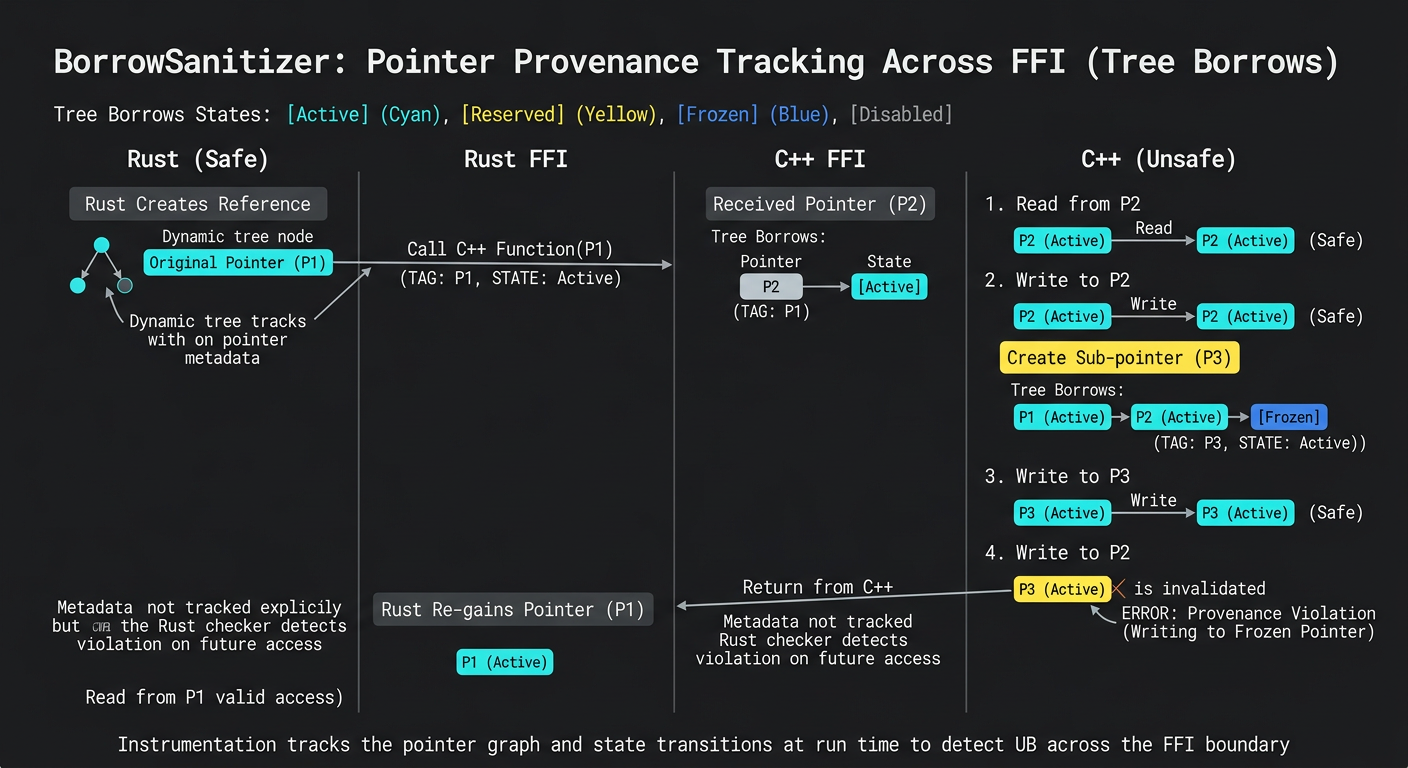
- How it works: BSAN inserts "retag" intrinsics at compilation to trace how pointers and references move through memory.
- Provenance Tracking: By utilizing a shadow stack and a disjoint two-level directory table, BSAN tracks pointer "provenance" (metadata linking a pointer to its Tree Borrows permissions) across foreign function boundaries without breaking ABI compatibility.
- Fuzzing Ready: Unlike Miri, BSAN is fast enough to run in fuzzing loops and CI pipelines.
With the formal LLVM RFC submitted in late May 2026, BSAN is poised to become an upstream standard, bringing production-level, multi-language aliasing verification directly to LLVM.
2. The Dual GCC Breakthroughs: Unshackling the Backend
For years, Rust was bound strictly to the LLVM toolchain. In 2026, the ecosystem has completed a major pivot toward GCC parity via two parallel initiatives:
rustc-codegen-gcc Lands on Rustup
Developers can now install the GCC code generation backend directly from rustup nightly:
rustup +nightly component add rustc-codegen-gcc-preview gcc-x86_64-unknown-linux-gnu-preview
This lets developers compile standard Cargo projects using GCC’s legendary optimizer and vast architectural target pool without having to compile GCC from source.
gccrs Closes In on the Linux Kernel
While the codegen backend plugs GCC into the standard rustc frontend, gccrs is a clean-room Rust frontend built from scratch for the GNU Compiler Collection.
In its mid-2026 progress report, the gccrs team highlighted key achievements on their roadmap to natively compile the Linux kernel. Having completed the "embedded Rust compiler" milestone (which only depends on core), they are actively mapping out the "Rust for Linux compiler" milestone, which includes supporting the alloc crate and inserting correct Drop call semantics for complex kernel types like mutexes.
A Redundant, Resilient Future
By giving developers the speed of BorrowSanitizer to verify hybrid codebases and the freedom of GCC to target niche embedded hardware, Rust is cementing its place as the ultimate systems programming language for the next several decades.


Get the wire in your inbox
Every new signal, straight from the generator. No noise, unsubscribe anytime.