Inside the "Tiered Canister Economy": The Bold New Proposal to Reshape Internet Computer Tokenomics
Developers on the Internet Computer are rallying behind a radical proposal called the Tiered Canister Economy (TCE). Designed to solve the network's cycle burn paradox, the 3-tier model aims to purge idle canisters, optimize node memory, and create a highly aggressive, utility-driven deflationary loop.

Inside the "Tiered Canister Economy": The Bold New Proposal to Reshape Internet Computer Tokenomics
The DFINITY developer ecosystem is currently embroiled in an intense debate. While "Mission 70"—the aggressive roadmap to slash the Internet Computer's (ICP) annual token inflation by 70%—was successfully kicked off with the passage of NNS Proposal 1408, community members are pointing out a glaring hole: supply-side emission cuts (like halving staking rewards and slashing node provider payouts) are only half the battle.
To achieve true deflation, the network needs a massive, demand-side burn accelerator. Enter a radical community proposal put forward by developer ICP_Georgia on the DFINITY Developer Forum: The Tiered Canister Economy (TCE).
The Core Problem: The Cycle Burn Paradox
Currently, the network operates on a flat pricing model where canisters (smart contracts) burn cycles at a uniform rate based on storage and computation. However, this has created a paradox: while the number of deployed projects on the Internet Computer has doubled over the past year, daily cycle burns have actually slumped—rarely exceeding $5,000, down from historic peaks of $8,000–$12,000.
Underutilized canisters clog up node memory without actively burning cycles, while enterprise-level integrations (including the rollout of private subnets and UTOPIA) operate as "black boxes" that do not directly feed the public blockchain’s deflationary loop. The TCE proposal aims to vertically disaggregate the transaction layer into three distinct, automated tiers to force efficiency.
Dismantling the 3 Tiers of the TCE
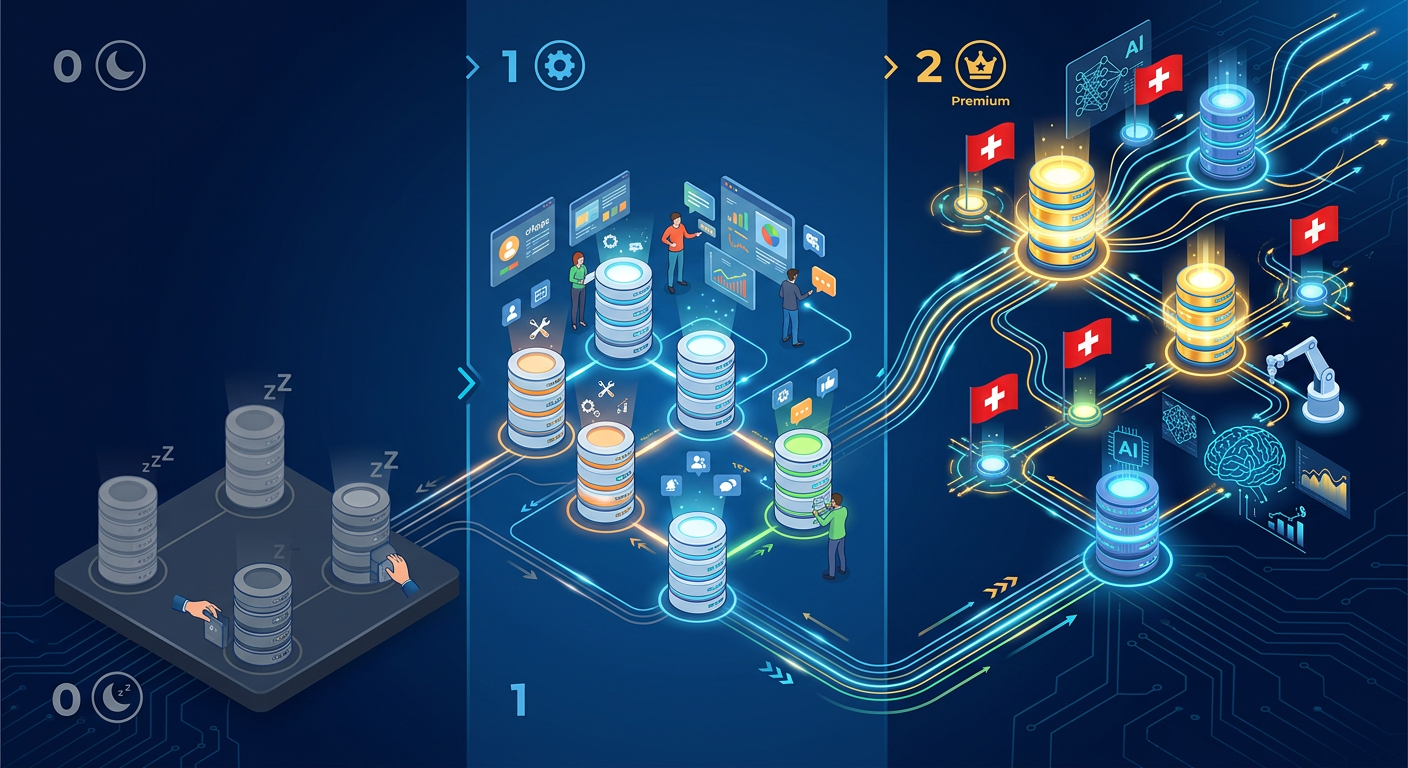
If implemented via an NNS upgrade, the Tiered Canister Economy would classify every canister into one of three operating profiles:
Tier 0: Free / Sleep Mode (Idle Pruning)
- The Target: Canisters consuming less than 0.1T (0.1 Trillion) cycles per month.
- The Mechanism: Instead of remaining permanently active in memory, these idle canisters automatically enter "Sleep Mode". If they remain inactive for three consecutive months, they are safely pruned (archived) from active node memory.
- The Impact: This immediately frees up massive physical node capacity across the global network. To reactivate a pruned canister, developers or users must pay a "wakeup fee" in cycles, creating an immediate, high-margin burn boost.
Tier 1: Standard
- The Target: Normal operating dApps, Web3 social protocols, and active developer projects.
- The Mechanism: This tier implements a revised cycles pricing model, proposed at 1.5x to 2x the current baseline rates.
- The Impact: Baseline burn grows organically in lockstep with genuine user traffic, ensuring active applications contribute proportionally to the network's tokenomics.
Tier 2: Premium (Real Burn Compounding)
- The Target: Enterprise-grade clients, high-throughput financial protocols, and intensive on-chain AI workloads running on specialized subnets (such as "Swiss Subnets" or "Cloud Engines").
- The Mechanism: Premium users pay significantly higher cycle rates in exchange for custom parameters—including larger memory boundaries, priority execution, faster consensus replication, and direct integration with high-performance hardware.
- The Impact: Turns enterprise usage into a massive deflationary pump. Because a portion of Cloud Engine revenue is slated to buy back and burn ICP, this tier creates a compounding feedback loop where institutional adoption directly translates to token scarcity.
What's Next?
The Tiered Canister Economy is still in the active RFC (Request for Comments) phase on the DFINITY Developer Forum, but it represents the kind of aggressive, utility-driven game theory that the community is craving. As the Internet Computer shifts its focus from pure technical bootstrap to sovereign enterprise scaling, aligning economic scarcity with developer scalability will be the ultimate test of its "world computer" vision.


Get the wire in your inbox
Every new signal, straight from the generator. No noise, unsubscribe anytime.