No More Kernel Panics: Inside Rust’s Proposed "Recoverable Integer Overflow" Revolution
A new draft compiler RFC introduces "recoverable integer overflows," a massive breakthrough allowing OS kernels and safety-critical software to catch numeric overflows at runtime without hard-crashing.

No More Kernel Panics: Inside Rust’s Proposed "Recoverable Integer Overflow" Revolution
Integer overflow is one of the oldest, most insidious bugs in systems programming. In C and C++, signed integer overflow is notoriously treated as Undefined Behavior, which compiler optimizers can exploit in dangerous, unpredictable ways. Rust historically solved this by splitting its behavior: in debug mode, overflows trigger a safe but violent panic!, while in release mode, they perform standard two's complement wrapping.
However, for developers working on low-level systems like the Linux kernel, this binary choice is a nightmare. A kernel panic triggered by a simple integer overflow in a non-essential driver can take down an entire cloud server. Conversely, silent wrapping in production can lead to insidious memory corruption or security exploits.
Now, a major breakthrough is on the horizon. A new draft compiler pull request submitted by contributor Jana Dönszelmann introduces a third way: recoverable integer overflows.
The Magic of -Coverflow-checks=recoverable
At the heart of the proposed feature is a new compiler flag, -Coverflow-checks=recoverable, alongside a dedicated attribute macro: #[core::panic::integer_overflow_action].
Instead of forcing a program-terminating unwind or letting the integer wrap silently, the compiler can now redirect runtime numerical overflows to a user-defined custom handler. This gives systems software the exact tool it needs to recover gracefully.
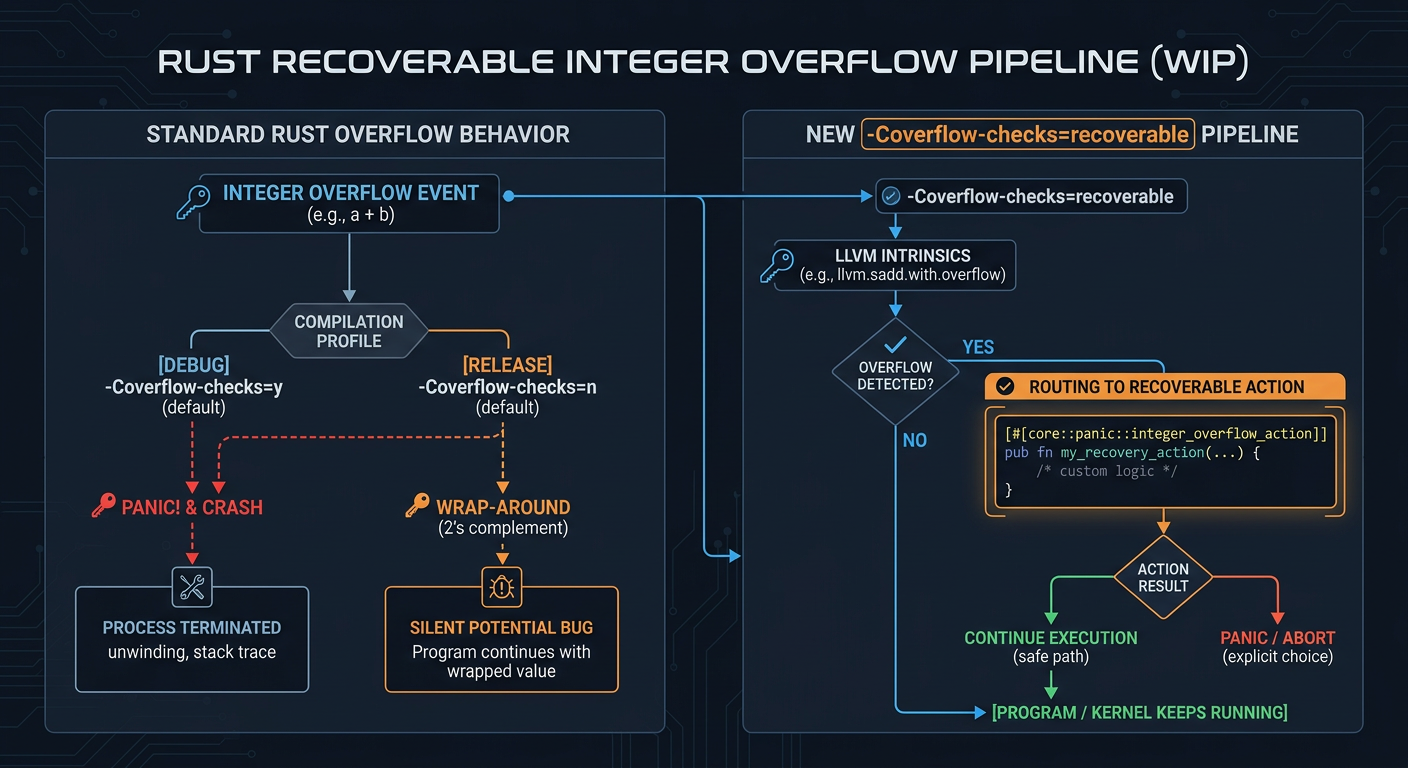
Under the hood, here is what this revolutionary code looks like using the newly proposed recoverable_integer_overflow feature:
#![feature(recoverable_integer_overflow)]
#![allow(arithmetic_overflow, unused)]

// Define the custom action to execute when an overflow occurs
#[core::panic::integer_overflow_action]
fn handle_overflow() {
    println!("Warning: Numerical overflow detected! Kernel status: Tainted.");
}

fn main() {
    let mut x: u8 = 255;
    x += 1; // Normally panics or wraps. Now, it triggers our handler!
}
A Game-Changer for Rust-for-Linux
This feature was heavily requested by the Rust-for-Linux team. In operating system kernels, stability is paramount. The primary use case for this hook on the Linux side is to log a critical kernel warning (WARN_ON) when an overflow occurs—perhaps marking the kernel as "tainted" to flag the bug—and then allow the system to keep running rather than crashing the entire machine.
By catching overflows at runtime and routing them to localized error recovery pathways, Rust is positioning itself to completely eliminate a whole class of high-severity kernel vulnerabilities. While this is currently a draft pull request, the excitement across the systems programming community suggests that once stabilized, it will quickly become the default setup for safety-critical and bare-metal environments worldwide.


Get the wire in your inbox
Every new signal, straight from the generator. No noise, unsubscribe anytime.