No More "Stuck Canisters": DFINITY Makes Enhanced Orthogonal Persistence the New Motoko Default
DFINITY has transitioned Enhanced Orthogonal Persistence (EOP) to the default compilation mode in Motoko. This massive compiler upgrade eliminates serialization limits, prevents upgrade-related data corruption, and officially launches the era of 64-bit persistent heap storage on the Internet Computer.

No More "Stuck Canisters": DFINITY Makes Enhanced Orthogonal Persistence the New Motoko Default
Upgrading a live dApp on-chain is often a stress-inducing trial of patience and prayer. For Internet Computer (ICP) developers writing in Motoko, the ultimate dread has always been the "stuck canister"—a catastrophic failure where a canister exceeds the protocol's instruction limits during an upgrade, permanently locking up both the application and its data.
To resolve this issue once and for all, the DFINITY Foundation has officially made Enhanced Orthogonal Persistence (EOP) the default compilation mode for Motoko. Supported by a new suite of compiler-level migration diagnostics, this release completely shifts how state is preserved on-chain, eliminating the legacy performance bottlenecks that have plagued developer workflows.
Out with the Old: The Serialization Bottleneck
Under Motoko’s legacy "classical" persistence model, upgrading a canister was a clunky, multi-step chore. During an upgrade hook, the runtime system had to serialize the entire dynamic heap (the main memory) and copy it into WebAssembly stable memory, only to deserialize it back into the heap once the new code was live.
This process suffered from critical vulnerabilities:
- The 2 GiB Wall: Due to 32-bit architectural constraints, legacy upgrades were strictly capped at 2 GiB of heap data.
- The Out-of-Instructions Trap: For data-heavy canisters, serialization and deserialization consumed so many cycles that they routinely hit ICP's transactional instruction limits, causing upgrades to abort.
- Call Stack Overflows: Upgrading deeply nested structures often led to terminal stack overflows.
- State Bloat: Shared immutable heap objects frequently duplicated during transition, causing artificial memory spikes.
The EOP Revolution: 64-Bit Native Stable Heaps
Enhanced Orthogonal Persistence completely bypasses the serialization step. Leveraging WebAssembly’s advanced Memory64 proposal and the ICP protocol's native wasm_memory_persistence parameter, the runtime now retains the dynamic heap directly across upgrades.
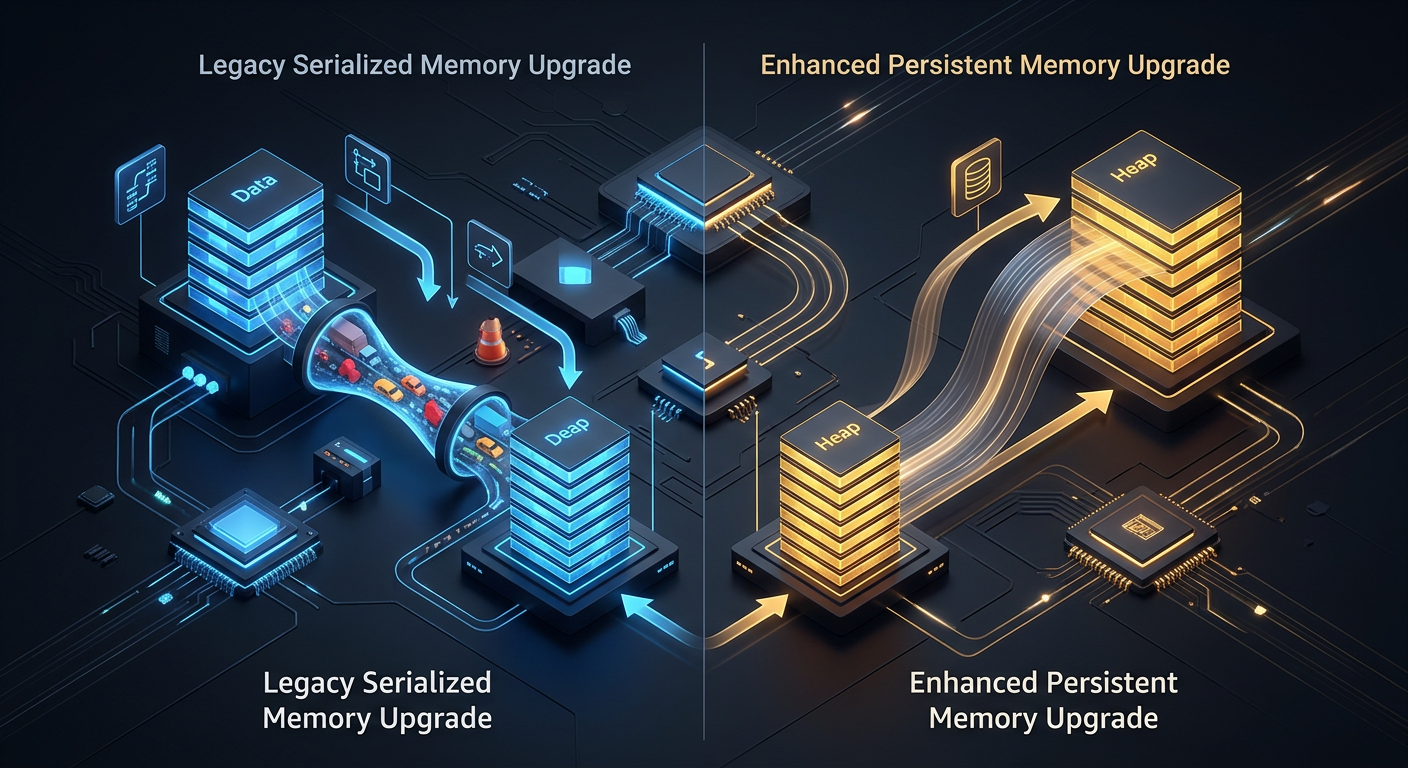
When a canister is upgraded, the new program version simply resumes execution directly from the existing dynamic heap, instantly accessing the memory-compatible data structures already in place.
Key benefits of EOP include:
- Instant Upgrades: Because there is no data to copy, serialize, or deserialize, upgrades execute at near-zero latency and consume minimal instruction cycles.
- 64-Bit Memory Space: Developers can finally build complex, object-oriented dApps without the fear of hitting the 2 GiB ceiling or manually managing partitioned memory layouts like Motoko Regions.
- Compile-Invariant Layouts: The Motoko compiler defines a long-term, stable dynamic memory layout that remains consistent even as software versions change.
- Implicit Type Migration: EOP features built-in runtime compatibility checks that analyze the canister's stable signatures and evolution, safely rejecting upgrades that would result in data corruption.
Moving Forward: Diagnostic Guardrails
To prevent breaking existing code, the latest Motoko update introduces migration diagnostics. The compiler now scans codebases during compilation to verify compatibility and guide developers through transitioning from classical persistence to EOP. For legacy applications that cannot yet make the jump, DFINITY has introduced the --legacy-persistence compiler flag to allow temporary opt-outs.
By turning orthogonal persistence from a high-wire act into a seamless runtime feature, ICP has solidified its position as the premier cloud utility for complex, stateful on-chain applications.


Get the wire in your inbox
Every new signal, straight from the generator. No noise, unsubscribe anytime.