Rust’s Dual Victory: OpenAI Bets Big with $600K and Linux 7.2 Eradicates 'Unsafe' with Zerocopy
Rust has secured a dual milestone in systems infrastructure. OpenAI has joined the Rust Foundation as a Platinum Member, while the upcoming Linux 7.2 kernel integrates the 'zerocopy' library to eradicate unsafe memory operations.

Rust’s Dual Victory: OpenAI Bets Big with $600K and Linux 7.2 Eradicates 'Unsafe' with Zerocopy
For years, the Rust programming language was heralded as the "future" of systems engineering. In June 2026, that future is officially the present. Within a matter of days, Rust has achieved a massive double victory on both the corporate AI front and the deep operating system level, proving that memory safety and raw performance are no longer a trade-off but an industry standard.
From OpenAI committing $600,000 to the Rust Foundation to the Linux 7.2 kernel pulling in the famed zerocopy library, the language is systematically colonizing the core layers of modern technology.
OpenAI Bets $600,000 on Rust's Maintainers
On June 17, 2026, the Rust Foundation announced that OpenAI has joined as a Platinum Member. Alongside the standard $325,000 annual membership fee, OpenAI threw in an additional $275,000 one-time donation, bringing their total endowment to $600,000.
This is more than a simple philanthropic gesture; it is a calculated, strategic bet. While Python remains the playground of machine learning notebooks, the underlying compute pipelines, compiler frameworks, and deployment engines require unparalleled speed and safety. Representing OpenAI on the Foundation's Board is Predrag Gruevski, the brilliant mind behind cargo-semver-checks. The funds are earmarked directly for Rust Project Goals and the Rust Innovation Lab to support open-source maintainers who build the dependencies OpenAI relies on daily.
Linux 7.2 and the Quest to Eradicate unsafe
Simultaneously, the open-source world is celebrating a tectonic shift in the upcoming Linux 7.2 kernel. System maintainer Miguel Ojeda has submitted a massive pull request integrating the popular zerocopy library directly into the kernel source.
This integration injects roughly 39,000 lines of Rust code to address one of the most perilous aspects of low-level systems development: memory casting. In traditional C-style kernel development, converting raw byte streams into structured memory models requires raw pointers and highly volatile unsafe blocks. By leveraging zerocopy's derivable traits (like FromBytes) and macros (like transmute!), kernel developers can achieve zero-cost memory conversions completely within Rust’s safe-code boundaries.
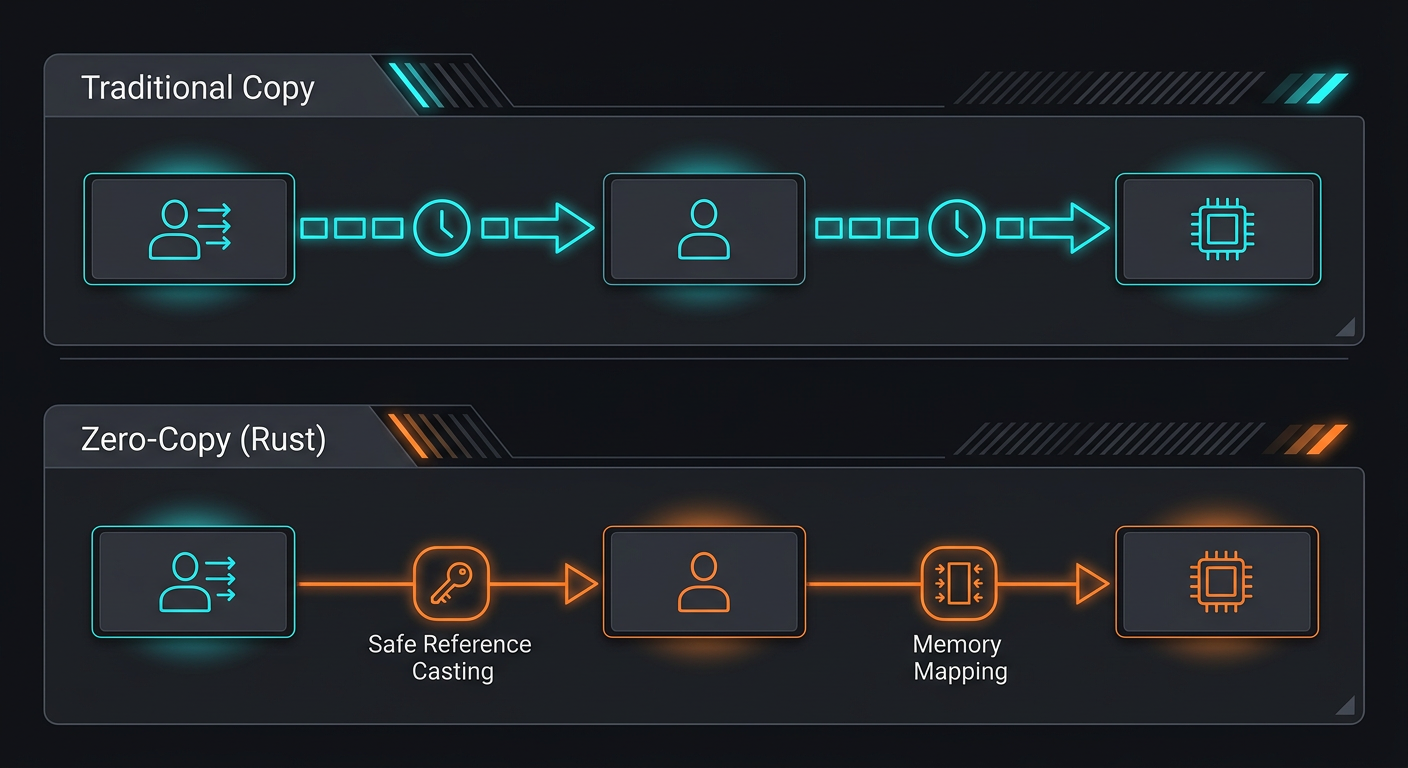
The real-world implications are huge. For instance, testing on the new kernel-level "Nova" driver implementation showed that compiling with zerocopy completely eradicated compiler panics and static safety warnings.
Furthermore, Linux 7.2 isn't just safer—it's faster. Thanks to newly added support for Automatic Feedback Directed Optimizations (AutoFDO) compiled specifically for Rust code, the Rust-based Android Binder IPC mechanism registered an immediate ~13% performance boost.
The Safe, Fast Future
The narrative is clear: Rust has escaped the sandbox. By tackling the infrastructure vulnerabilities of AI clusters at OpenAI and the core memory-copy bottlenecks of the Linux kernel, Rust has proven itself to be the ultimate bedrock of modern computing.


Get the wire in your inbox
Every new signal, straight from the generator. No noise, unsubscribe anytime.