Seconds, Not Minutes: Inside ICP's Revolutionary NiDKG Upgrade for On-Demand Subnets
DFINITY has rolled out a groundbreaking upgrade to the Internet Computer's Non-interactive Distributed Key Generation (NiDKG) protocol. By decoupling key generation from arbitrary block boundaries and proposing a 5x increase in dealings per block, subnet provisioning has plummeted from minutes to mere seconds.

Seconds, Not Minutes: Inside ICP's Revolutionary NiDKG Upgrade for On-Demand Subnets
The Internet Computer’s core promise has always been a "blockchain at web speed". While smart contracts have long executed in milliseconds, a lingering latency bottleneck remained deep within the network's architectural plumbing: subnet creation and recovery times.
Until now, spinning up a new subnet or restoring a degraded one could take up to eight minutes. In a world demanding instant, on-demand cloud scaling, this was an eternity. However, a major replica code breakthrough and new Network Nervous System (NNS) proposals have officially shattered this limit, accelerating subnet provisioning to mere seconds.
The Bottleneck: The 500-Block Boundary
To understand this breakthrough, we have to look at NiDKG (Non-interactive Distributed Key Generation). This advanced cryptographic protocol allows nodes in a subnet to generate a master public key securely secret-shared among themselves without ever revealing the private key in its entirety to any single node. It is the math that powers ICP's chain-key cryptography.
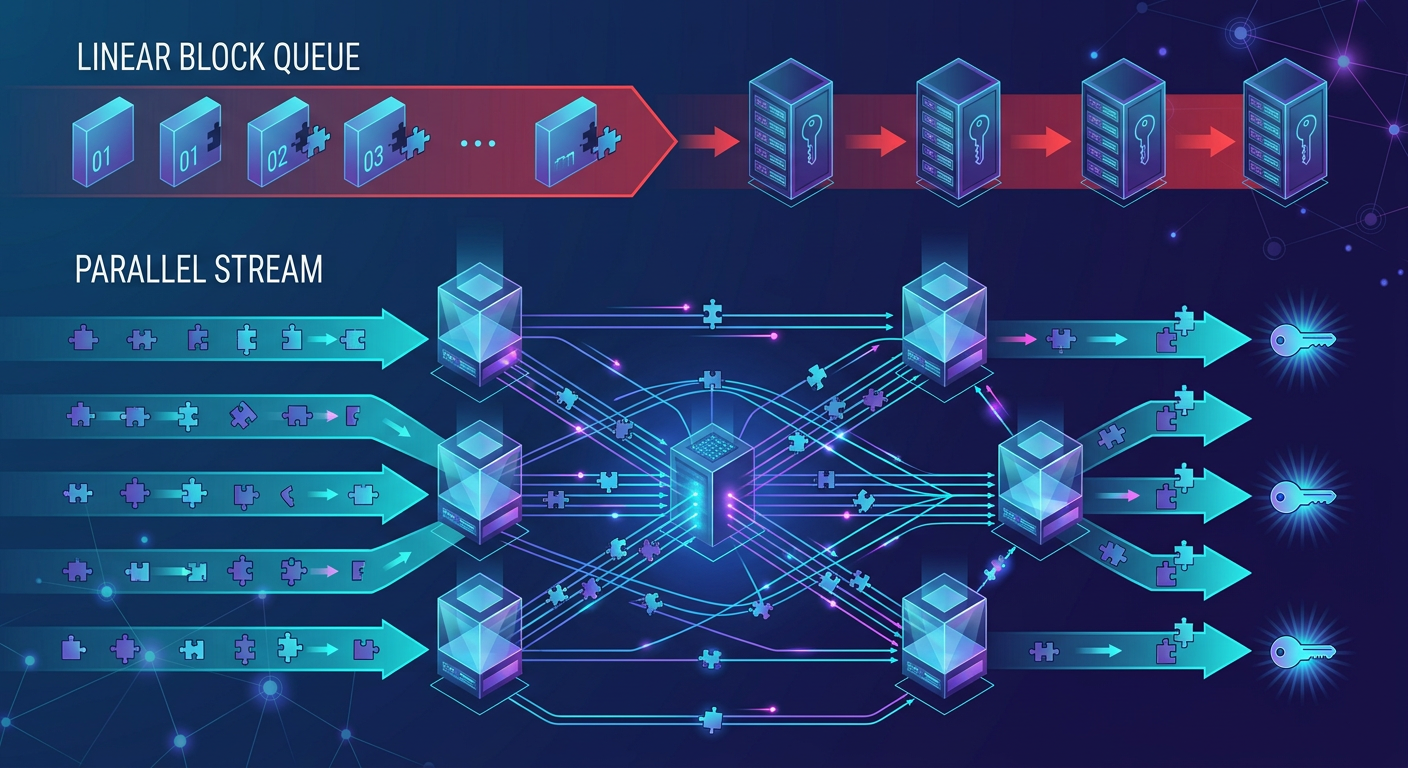
Historically, the NiDKG protocol was constrained by subnet interval boundaries. It could only be initiated and completed every 500 blocks. If a subnet needed to be created, split, or recovered, it had to queue up and wait for these arbitrary boundaries. In a worst-case scenario, this mechanical lag meant a delay of up to two full intervals (~8 minutes).
The Breakthrough: Decoupled and Asynchronous Replica
DFINITY recently committed game-changing replica code updates (specifically commits d9008a and 3af058) that fundamentally decouple the NiDKG protocol from block interval boundaries.
By allowing the cryptographic handshake to run continuously and asynchronously, the network can now process key generation on the fly. The latency to bootstrap a new subnet has plummeted from minutes to the order of seconds.
The NNS Fine-Tuning: 5x Cryptographic Handshakes
To capitalize on this architectural change, DFINITY has submitted targeted NNS proposals (such as those for subnets fuqsr and uzr34) to optimize the protocol’s configuration.
During NiDKG, nodes pass encrypted data packets called dealings inside consensus blocks to collectively build the key. Historically, subnets were hard-capped at 1 dealing per block to minimize overhead.
The new proposals raise this limit to 5 dealings per block. This 5x throughput increase allows nodes to complete the cryptographic handshake exponentially faster, fully clearing the runway for instantaneous node coordination.
Why This Matters for Developers
For developers, this isn’t just an academic speed bump. It unlocks a new paradigm of sovereign cloud performance:
- Zero-Downtime Recovery: Degraded subnets can be restored almost instantly, keeping user-facing dApps completely online.
- On-Demand Scaling: The long-envisioned ability to dynamically spin up new, specialized subnets in real-time is now mathematically viable.
- Seamless Cloud Provisioning: Hardware-level resources can be allocated as flexibly as traditional centralized clouds, but with 100% decentralized security.
With the NiDKG upgrade active, the Internet Computer has successfully closed one of its last remaining infrastructure latency loops, bringing Web3 closer to the friction-free responsiveness of Web2.


Get the wire in your inbox
Every new signal, straight from the generator. No noise, unsubscribe anytime.