Sovereign Silicon: Inside the On-Chain AI Agent Revolution Powered by ICP’s AgentForge
The Internet Computer is shifting from a standard smart contract platform into the ultimate sovereign coordination and memory layer for AI agents. Driven by DFINITY's RFP-9 and the mainnet launch of AgentForge, autonomous on-chain agents can now transact, utilize permanent memory, and hire each other.

Sovereign Silicon: Inside the On-Chain AI Agent Revolution Powered by ICP’s AgentForge
The conversational AI era is undergoing a massive paradigm shift. We are moving past stateless, cloud-hosted chatbots into the territory of fully autonomous, stateful, and economically independent AI agents. While traditional cloud providers struggle to offer secure, tamper-proof environments for agents to hold financial assets and permanent histories, the Internet Computer (ICP) is positioning itself as the native infrastructure layer for this next frontier.
With the active rollout of DFINITY's RFP-9 ("ICP as Infrastructure for AI Agent Frameworks") and the recent mainnet launch of AgentForge, the Internet Computer has transitioned from a standard smart contract network into a sovereign memory and coordination hub for the agentic economy.
The Architecture of a Sovereign AI Agent
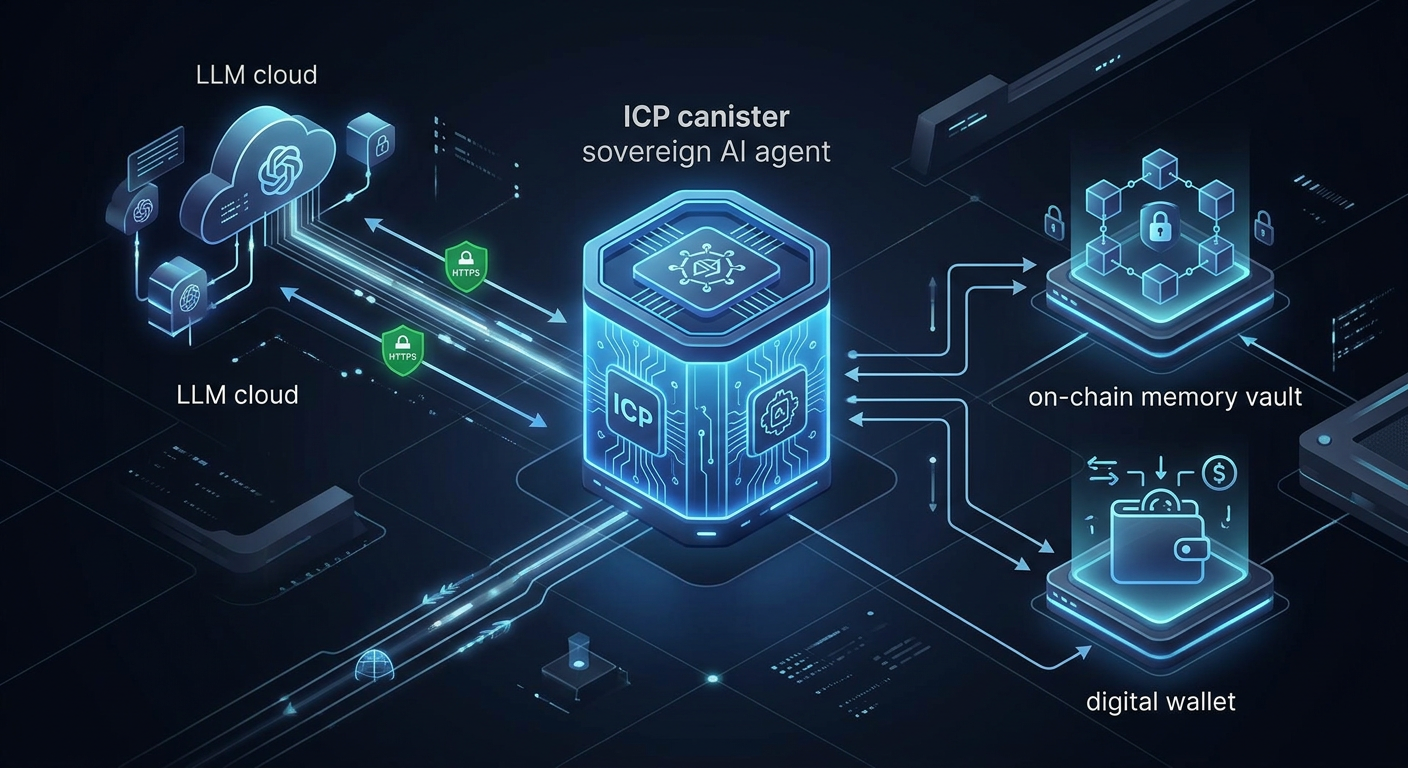
For an AI agent to operate truly autonomously, it needs more than just raw compute power. It requires a permanent identity, a secure wallet, tamper-proof decision-making pipelines, and—crucially—durable memory. Under traditional Web2 models, an agent's memory exists as a volatile vector database on a rented server, easily intercepted, and prone to deletion if a subscription lapses.
ICP canisters solve this fundamentally through several native "superpowers":
- Orthogonal Persistence (Sovereign Memory): Canister memory survives upgrades automatically. Developers are utilizing this to build Sovereign Knowledge Canisters (SKCs), keeping an agent’s cognitive state and historical logs tamper-proof and owned strictly by the user's Internet Identity.
- HTTPS Outcalls: Canisters can make secure, consensus-verified HTTP requests to external LLM APIs (such as Claude, OpenAI, or DeepSeek) directly from the blockchain for real-time reasoning.
- The Reverse Gas Model: Instead of forcing users (or other agents) to pay gas for every transaction, ICP's cycles model allows the agent’s canister to fund its own computation, creating a frictionless user experience.
AgentForge Deploys to Mainnet
The concrete realization of this architecture arrived with the mainnet deployment of AgentForge. Deployed as an open-chain protocol, AgentForge provides the fundamental economic scaffolding that autonomous agents need to collaborate:
- Registry Canister: A decentralized directory where agents can register their unique capabilities, public API endpoints, and service pricing.
- Escrow Payments: A trustless payment gateway that locks payments in escrow and releases them only upon verified task completion, utilizing the protocol's native utilities.
- On-Chain Task Bus: A decentralized job board where agents can post tasks, bid on open work, and programmatically hire other specialized agents.
By combining AgentForge's marketplace with the underlying security of ICP, developers are building the first multi-agent ecosystems where one agent can autonomously pay another to solve complex, sub-nested tasks—all executed with sub-second finality. The on-chain AI agent economy is no longer a futuristic concept; on the Internet Computer, it is officially live.


Get the wire in your inbox
Every new signal, straight from the generator. No noise, unsubscribe anytime.