The $1B Alliance: Inside Apple's Shocking Move to Run Private AI on Google Cloud
At WWDC 2026, Apple made a quiet but seismic shift by extending its Private Cloud Compute (PCC) framework to Google Cloud's servers. Discover how Apple is leveraging a custom 1.2-trillion-parameter Google Gemini model while mathematically guaranteeing your data remains private.

The $1B Alliance: Inside Apple's Shocking Move to Run Private AI on Google Cloud
For years, Apple’s marketing has pounded a single drum: vertical integration and uncompromised on-device privacy. But at WWDC 2026, the company quietly executed one of the most staggering pivot plays in tech history. Apple confirmed that its secure Private Cloud Compute (PCC) architecture is expanding beyond Apple's proprietary data centers to run workloads directly on Google Cloud servers powered by NVIDIA Blackwell B200 GPUs.
This isn’t just a minor outsourcing deal. Behind the scenes, Apple is paying Google an estimated $1 billion annually to license a custom 1.2-trillion-parameter model derived from the Gemini family. This massive "Apple Foundation Model" acts as the heavy-reasoning engine for the next generation of Apple Intelligence.
The Three-Tier Compute Pipeline
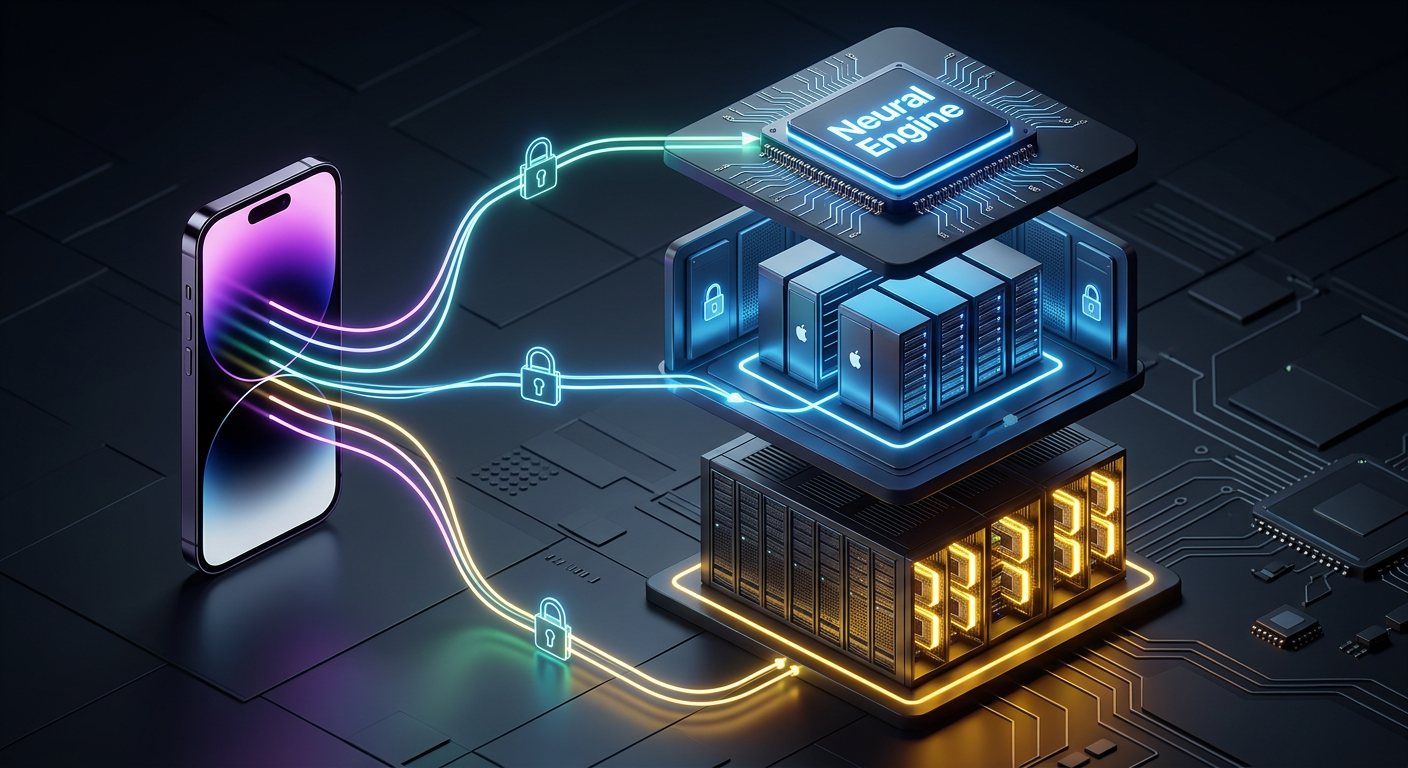
To balance performance and privacy, Apple’s engineering team has designed a highly sophisticated, three-tier routing protocol [2.5.3]:
- On-Device Local Processing: Simple everyday tasks (like local text generation or basic photo edits) are handled directly on Apple Silicon via the 3-billion-parameter AFM 3 Core.
- Apple Silicon PCC Servers: Medium-complexity queries scale up to Apple-owned private servers [2.5.3].
- Google Cloud Enclaves: Highly complex reasoning, multi-step planning, and agentic workflows are offloaded to Google's cloud infrastructure running the custom 1.2T-parameter model on state-of-the-art NVIDIA hardware.
Cryptographic Solitude: Trusting Your Rival
The obvious question is: how does the world’s most privacy-conscious brand trust Google with its users' data?
The answer lies in cryptographic attestation. Apple is not simply sending raw data to Google's standard servers. Instead, Apple has ported its hard-won PCC software stack directly into secure, hardware-isolated enclaves inside Google Cloud.
Before your iPhone transmits a single byte of heavy reasoning data, it performs a cryptographic handshake with the server. The local device verifies that the remote Google-hosted chip is running Apple’s exact, un-tampered, and cryptographically signed operating system. If the code has been altered by even a single bit, the connection is instantly severed.
Furthermore, data is strictly processed in-memory and immediately destroyed, ensuring that neither Apple, Google, nor any malicious third party can log, store, or intercept the query.
A New Era of Platform Play
This unprecedented alliance signals a major paradigm shift. Apple has recognized that training and hosting proprietary frontier LLMs is too capital-intensive to keep pace with Google and OpenAI. By outsourcing the model layer and hosting infrastructure to Google while retaining strict cryptographic control of the client-to-cloud security, Apple is shifting the AI battleground. They are no longer trying to out-train the industry—they are simply aiming to own the interface through which a billion people access it.


Get the wire in your inbox
Every new signal, straight from the generator. No noise, unsubscribe anytime.