The Agentic IDE: How Xcode 27’s Native MCP Server is Rewriting Apple Development
At WWDC 2026, Apple redefined the software development landscape by introducing Xcode 27, featuring native agentic coding. By integrating a local Model Context Protocol (MCP) server, Xcode 27 allows autonomous coding agents to plan, code, test, and visually verify applications locally.

The Agentic IDE: How Xcode 27’s Native MCP Server is Rewriting Apple Development
The era of passive autocomplete is officially dead. While the developer community spent the last two years getting comfortable with single-line code suggestions, Apple utilized WWDC 2026 to quietly orchestrate a massive software development paradigm shift. Enter Xcode 27, a release that transitions the native macOS development environment from a simple text editor into an active, autonomous engineering partner.
The Two-Tier Intelligence System
Designed specifically for Macs running Apple Silicon, Xcode 27 implements a modular, two-tier architecture:
- The Local Tier: Running entirely offline on the on-device Apple Neural Engine, this local LLM is highly optimized for Swift 6.4 and native SDK structures, serving zero-latency predictive completions while maintaining absolute source code privacy.
- The Agentic Tier: Operating via open standards, this tier allows developers to link advanced external reasoning models—such as Anthropic’s Claude Agent or OpenAI’s Codex—to act as autonomous coding agents.
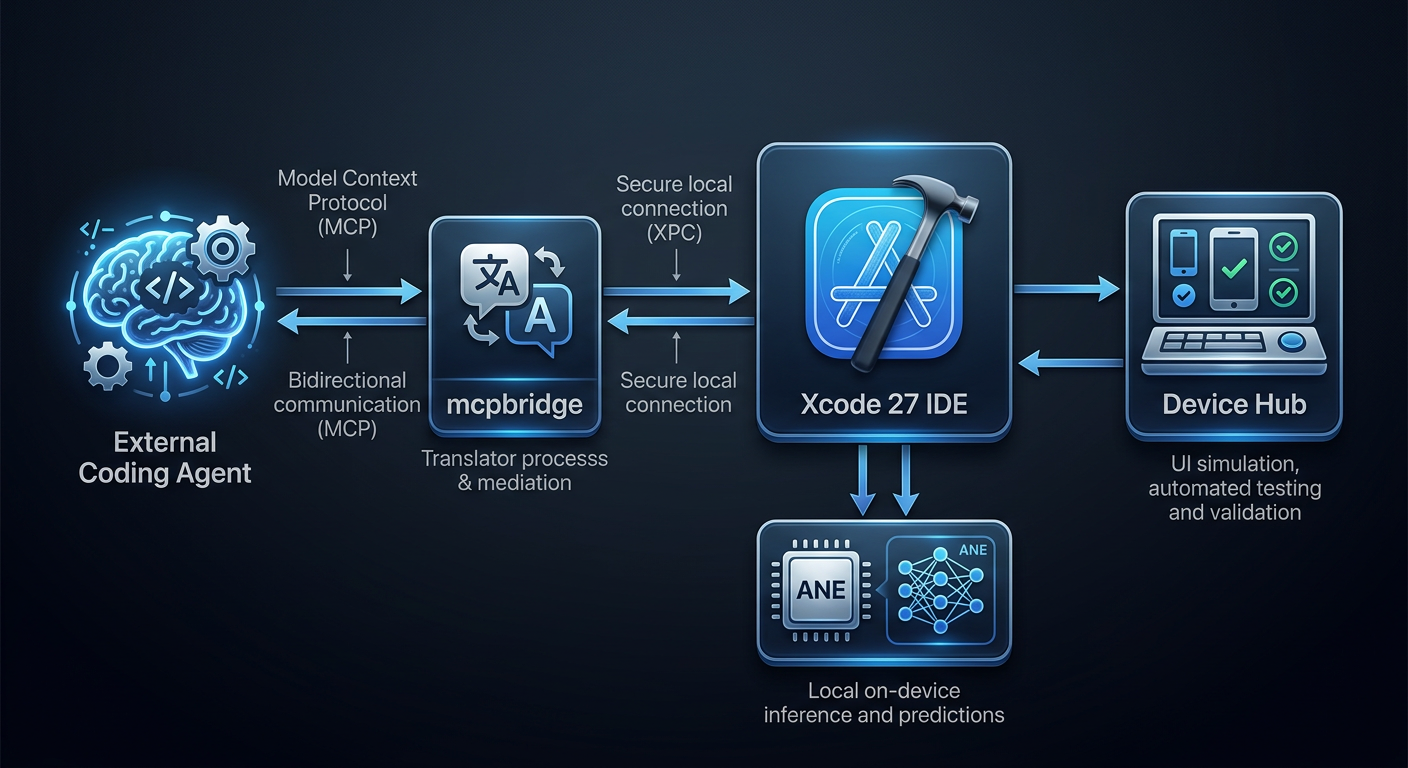
Under the Hood: mcpbridge and Local XPC
How does an external AI safely refactor an entire project directory? The architectural secret is a native utility called mcpbridge.
Instead of routing your proprietary codebase through a cloud-based middleman, Xcode 27 launches a local Model Context Protocol (MCP) server. When an external coding agent connects, mcpbridge translates standard MCP JSON-RPC commands into Apple’s native XPC (Inter-Process Communication) protocol. This secure loop exposes 20 native tools to the agent, granting it sandboxed permissions to read and write files, manipulate build settings, search local Apple documentation, and automate compiler checks without leaking API keys.
The Self-Validation Loop and Device Hub
Historically, AI coding assistants could write code but were blind to compiler failures or UI layout issues. Xcode 27 solves this by introducing a complete self-validation loop through the brand-new Device Hub.
Within this unified interface, an autonomous agent can orchestrate physical and simulated devices. The agent can trigger a build, execute unit tests, capture SwiftUI preview frames, and programmatically "see" if a layout is visually broken. If a test fails or a preview breaks, the agent uses the local compiler diagnostics to rewrite and re-test the code autonomously.
Developers can follow this entire process in the new editor-integrated "Conversations" panel, which displays side-by-side git diffs and an interactive step-by-step action plan. Xcode 27 proves that the future of iOS engineering is no longer about writing boilerplate code—it is about orchestrating the systems that do.


Get the wire in your inbox
Every new signal, straight from the generator. No noise, unsubscribe anytime.