The Double-Time Shift: Why Internet Computer's Internet Identity is Moving to a Twice-Weekly Release Cadence
DFINITY has announced a major acceleration in the development cycle of Internet Identity (II), transitioning to a twice-weekly release cadence. Driven by AI-assisted coding and structural canister splits, this shift aims to speed up Web3 onboarding but raises discussions about community reviewer fatigue.

The Double-Time Shift: Why Internet Computer's Internet Identity is Moving to a Twice-Weekly Release Cadence
For years, the Network Nervous System (NNS)—the decentralized algorithmic authority governing the Internet Computer (ICP)—has approved upgrades to critical system dApps on a predictable, weekly cycle. However, as the ecosystem scales, development velocities are outpacing legacy frameworks.
In a major technical update, the DFINITY team announced that Internet Identity (II) is permanently shifting to a twice-weekly release cadence. This move aims to deliver security fixes, performance enhancements, and user experience updates to millions of Web3 users at unprecedented speeds.
The Three Pillars of Acceleration
According to DFINITY’s lead engineers, three major factors have enabled this dramatic increase in development velocity:
- Eradicating Technical Debt: The legacy monolith of the Internet Identity canister has been officially split into separate backend and frontend canisters, and all applications have been migrated to the modern
id.aiinterface. This clean separation of concerns has dramatically improved code maintainability and testability. - AI-Accelerated Engineering: The development team has fully standardized AI-driven coding assistants. These tools streamline code generation, testing, documentation, and rapid-fire security reviews, condensing weeks of work into hours.
- Team Growth: DFINITY expanded the core II engineering group, introducing fresh talent to help manage the increased output.
The physical separation of the frontend and backend canisters is a massive architectural improvement. In the previous monolithic structure, even a minor cosmetic text change on the login screen required a complete compilation and audit of the entire backend authentication logic. By segregating the frontend dApp (id.ai) from the highly secure backend canister, developers can now deploy interface polishes rapidly without risk of destabilizing the core biometric cryptography.
Navigating the New Cadence
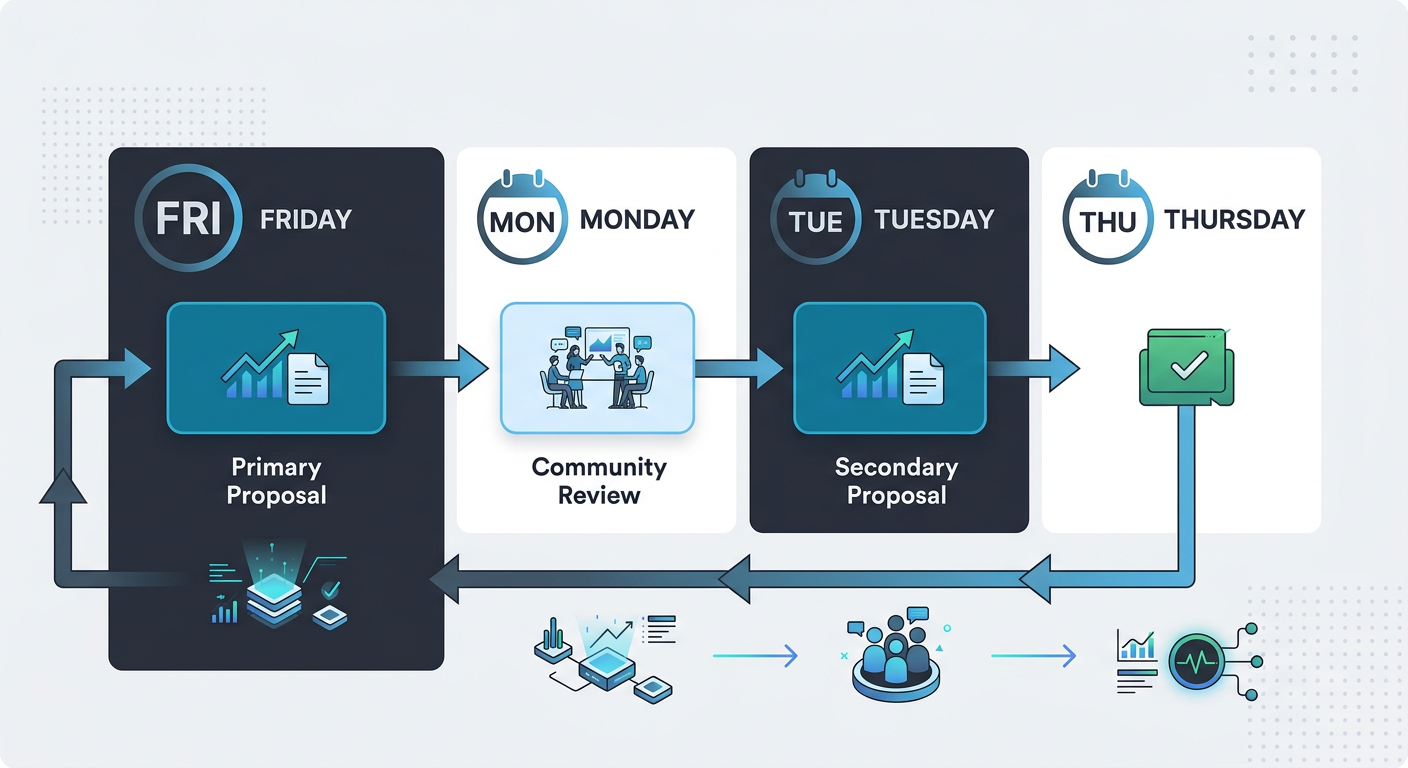
The new twice-weekly structure organizes releases into distinct "Primary" and "Secondary" tracks:
- Friday: DFINITY submits the Primary release proposal containing major feature updates.
- Monday: NNS voters finalize review and cast ballots to adopt the primary release.
- Monday/Tuesday: The team submits a Secondary release proposal featuring lower-risk UX tweaks or feature-flagged code.
- Wednesday/Thursday: Voters approve the secondary release.
The Reviewer Dilemma
While developers are thrilled by the prospect of rapid-fire deployments, the announcement has sparked a critical debate within the ICP governance community.
Because every update requires decentralized verification, independent NNS reviewers and community grantees (such as CodeGov) are now facing double the workload. Community members have raised concerns regarding reviewer burnout, arguing that compensation for ecosystem auditors must scale alongside development velocity to ensure the network's decentralized security is not compromised.
Ultimately, this rapid release cadence represents a significant milestone. It proves that the Internet Computer can match the agility of a Web2 software giant while strictly adhering to the transparent, decentralized governance model of Web3.


Get the wire in your inbox
Every new signal, straight from the generator. No noise, unsubscribe anytime.