The Maintainer in Residence Era: How RFC 3931 and the Rust Foundation’s New Fund are Securing the Language's Future
To combat the open-source sustainability crisis, the Rust Leadership Council and Rust Foundation have officially launched the Maintainers Fund. Powered by the newly accepted RFC 3931, the "Maintainer in Residence" program will provide stable, long-term salaries to core developers keeping the world's most critical systems language secure.

The Maintainer in Residence Era: How RFC 3931 and the Rust Foundation’s New Fund are Securing the Language's Future
Open-source software has long operated under a dangerous paradox: much of the world's critical infrastructure runs on software sustained entirely by unpaid, volunteer labor. Rust—now a load-bearing pillar for Android, Windows, and the Linux kernel—is no exception. To resolve this sustainability crisis, the Rust Leadership Council and the Rust Foundation have officially launched the Rust Foundation Maintainers Fund (RFMF) and the groundbreaking Maintainer in Residence (MiR) program.
Securing the Humans Behind the Compiler
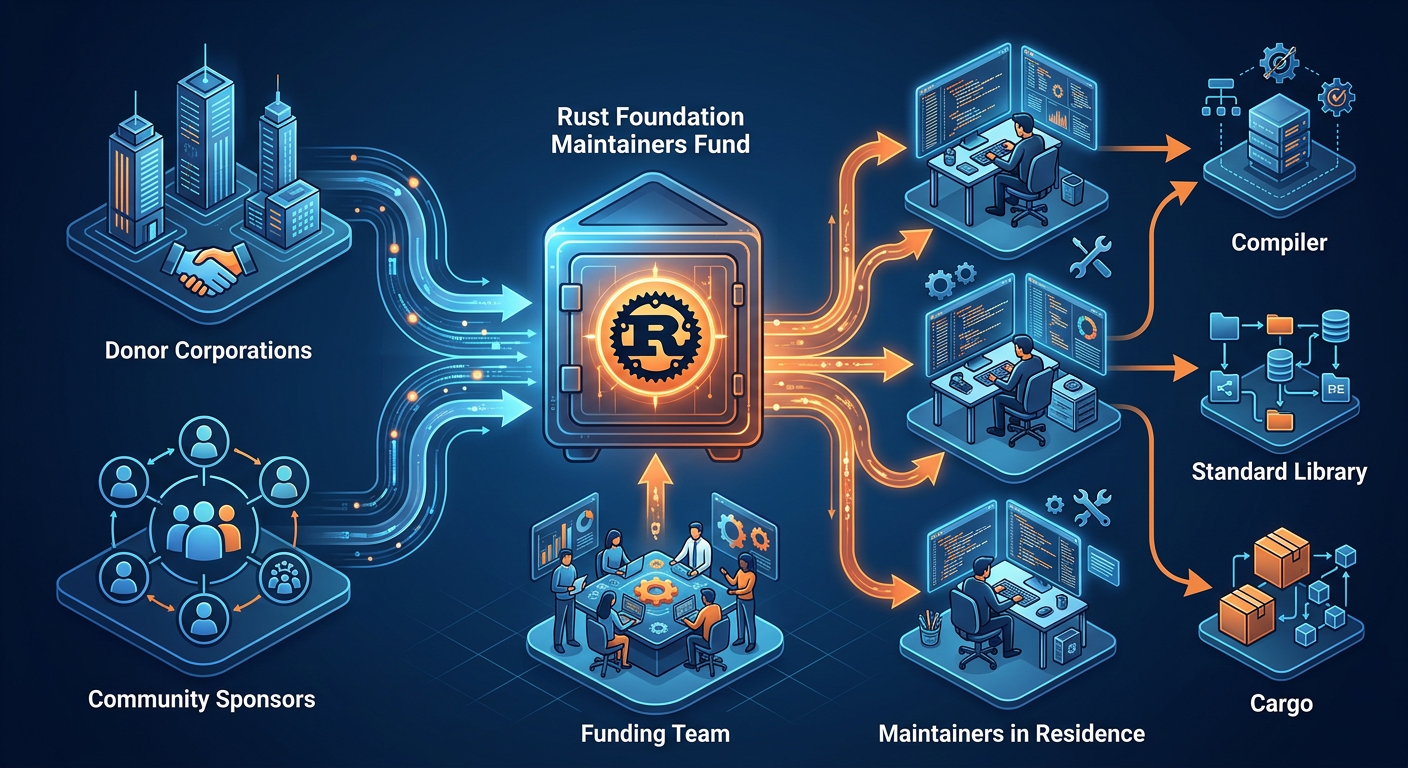
The launch represents the concrete execution of RFC #3931, which was recently accepted by the Rust community. RFC 3931 establishes two vital bodies: a dedicated Funding Team and the Maintainer in Residence program.
The program's philosophy is simple yet revolutionary for the ecosystem: rather than granting short-term micro-grants for single features, the RFMF will offer stable, near full-time, long-term salaries to core maintainers. This approach is heavily inspired by Python’s successful "Developer in Residence" initiative. It acknowledges that the most crucial work in open-source development isn't always writing shiny new features, but rather the grueling, unglamorous tasks of:
- Reviewing massive backlogs of pull requests
- Executing large-scale codebase refactorings
- Standard library, compiler-ops, and Cargo maintenance
- Mentoring new contributors and triaging bugs
By compensating developers directly for these load-bearing tasks, the Rust Project ensures that its foundational compiler and toolchain do not bottleneck under the weight of the language's rapid enterprise adoption.
A Collaborative Bridge Between Enterprise and Core Devs
The Rust Foundation is actively calling on the industry’s heavyweights—major enterprises whose internal infrastructure relies deeply on Rust—to financially back the RFMF. Simultaneously, individual developers can pitch in directly through GitHub Sponsors.
As the Maintainer in Residence program rolls out its first cohort, it marks a historic shift in open-source stewardship. By transitioning core compiler developers from part-time volunteers to stabilized "residents," the Rust ecosystem is proving that safety isn't just a property of the borrow checker—it's a commitment to the health of the community itself.


Get the wire in your inbox
Every new signal, straight from the generator. No noise, unsubscribe anytime.