The Niobium Era: Inside ICP’s vetKeys Privacy Revolution
The Internet Computer has unleashed vetKeys (vetKD) via the Niobium upgrade, solving Web3's transparency curse. This breakthrough enables on-chain end-to-end encryption, identity-based encryption, and secure threshold key derivation without relying on centralized intermediaries.

The Niobium Era: Inside ICP’s vetKeys Privacy Revolution
For years, Web3 has grappled with a fundamental paradox: blockchains are designed to make data permanently public and immutable, yet real-world applications require privacy. For developers wanting to build secure messengers, private financial systems, or GDPR-compliant medical platforms, the transparent ledger of a traditional blockchain has long been a fatal design flaw.
To solve this, the DFINITY Foundation rolled out the Niobium milestone, introducing vetKeys—or Verifiably Encrypted Threshold Keys—to the mainnet. Supported by the newly matured ic-vetkeys library, this breakthrough enables native, on-chain end-to-end encryption and decentralized key management directly on the Internet Computer Protocol (ICP).
The Cryptographic Magic of vetKD
At the heart of vetKeys is a novel cryptographic primitive known as Verifiably Encrypted Threshold Key Derivation (vetKD). Rather than depending on centralized Hardware Security Modules (HSMs) or third-party Key Management Systems (KMS), vetKD uses threshold cryptography to derive cryptographic keys on-demand without any single node in the network—or even the host canister itself—ever seeing the private key in plaintext.
The "vet" in vetKeys explains the core properties of the system:
- Verifiable: The recipient can mathematically prove that the key received is correct, untampered with, and generated by the designated subnet nodes.
- Encrypted: The key is encrypted under a client-supplied public key before leaving the subnet, meaning it is never exposed in transit.
- Threshold: Key generation is distributed. A single node cannot reconstruct the key; a consensus quorum of nodes is strictly required to cooperate.
Under the Hood: The vetKD Flow
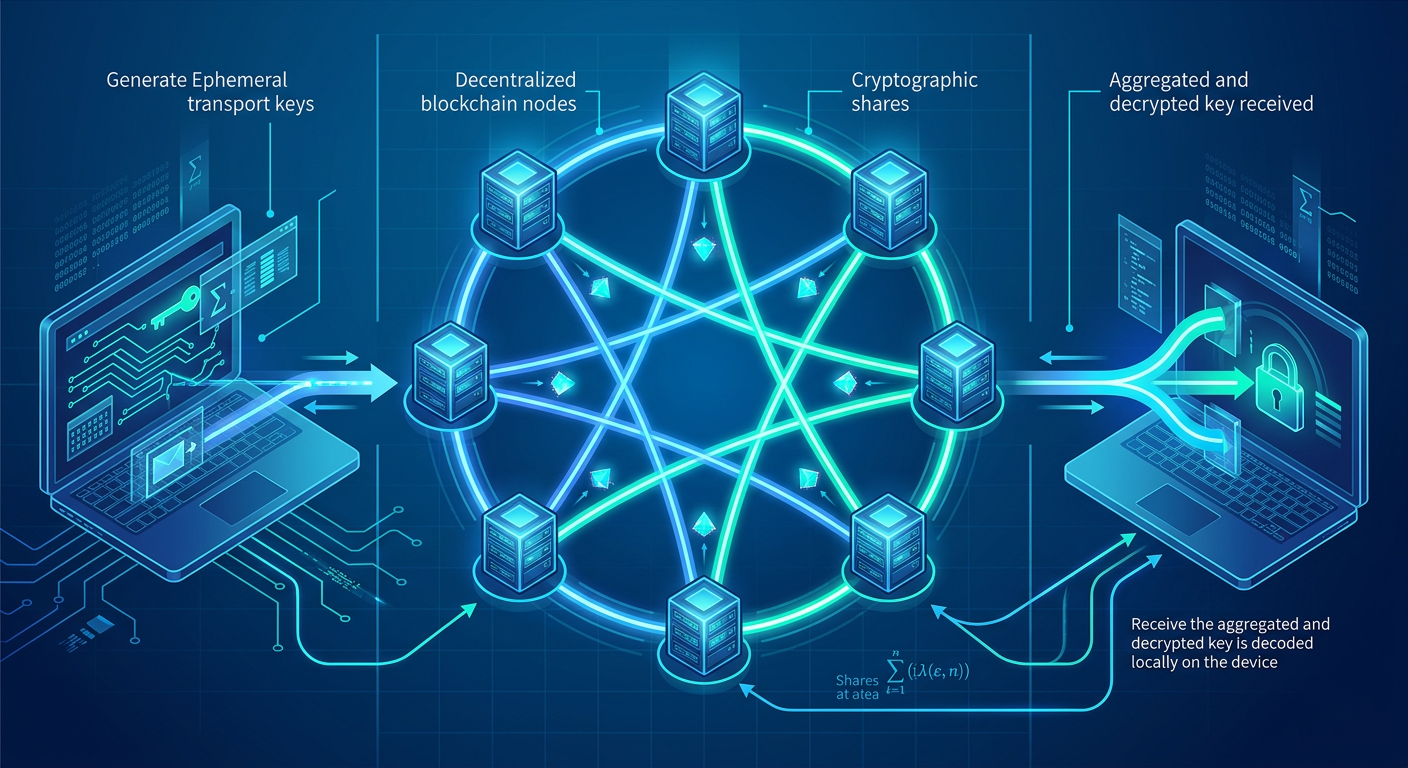
When a user requests a private key (for example, to decrypt a private note), the system executes a trustless, four-step protocol:
- Transport Key Generation: The client’s browser generates an ephemeral, single-use public/private key pair.
- Canister Invocation: The user authenticates with a canister smart contract (using Internet Identity), which checks permissions and calls the ICP management canister's raw API endpoints:
vetkd_public_keyandvetkd_derive_key. - Decentralized Derivation: The subnet nodes run the threshold derivation protocol. Each node creates a secret share of the derived key, encrypts it under the client’s transport public key, and broadcasts it.
- Local Decryption: The individual encrypted shares are aggregated into a single payload. The client receives this encrypted key and decrypts it locally in their browser using their ephemeral transport private key.
Game-Changing Use Cases
By unlocking on-chain privacy, the Niobium upgrade enables several revolutionary application architectures:
- Identity-Based Encryption (IBE): Users can encrypt data directly to an identity (such as a principal, email, or Ethereum address) even if the recipient is offline or has never used the dapp. The recipient simply authenticates later to derive their decryption key on demand.
- Timelock Encryption: Canisters can withhold decryption keys until a specific timestamp or event is triggered. This eliminates Maximal Extractable Value (MEV) in DEXs and enables completely sealed, trustless on-chain auctions.
- Verifiable Randomness (VRF): vetKeys function as a verifiable random beacon, generating unpredictable, tamper-proof, and publicly verifiable randomness for GameFi and NFT mints.
With the release of the native ic-vetkeys Rust and Motoko SDKs, ICP has officially ended the Web3 privacy compromise, proving that a public blockchain doesn't have to mean public data.


Get the wire in your inbox
Every new signal, straight from the generator. No noise, unsubscribe anytime.