
The Post-Quantum Civil War: Bitcoin’s Existential Battle Against 'Q-Day'
A sudden acceleration in quantum computing has triggered an existential crisis for Bitcoin. Inside BIP-360, BIP-361, and the highly controversial proposals to freeze over $75 billion in vulnerable coins before quantum hackers can steal them.
Key takeaways
- • A sudden acceleration in quantum computing has triggered an existential crisis for Bitcoin
- • Inside BIP-360, BIP-361, and the highly controversial proposals to freeze over $75 billion in vulnerable coins before quantum hackers can steal them

The Post-Quantum Civil War: Bitcoin’s Existential Battle Against 'Q-Day'
For over a decade, the threat of a quantum computer breaking Bitcoin’s cryptographic armor was dismissed as a problem for the distant future. That complacency shattered in 2026 when a Google Quantum AI paper revealed a breakthrough, slashing the physical qubits required to crack the Elliptic Curve Cryptography (ECC) securing Bitcoin by 20x—down to under 500,000 physical qubits. With Caltech and partner Oratomic projecting that a cryptographically relevant quantum computer (CRQC) could emerge by 2030, Bitcoin's security is officially on a countdown.
The scale of the exposure is breathtaking. According to the recently drafted Bitcoin Improvement Proposal (BIP) 361, over 34% of all circulating Bitcoin—roughly 6.9 million BTC, worth upwards of $75 billion—is quantum-vulnerable because its public key has already been exposed on-chain. This includes 1.7 million BTC trapped in ancient Pay-to-Public-Key (P2PK) addresses, including roughly 1.1 million BTC belonging to Satoshi Nakamoto.
The Post-Quantum Shields: BIP-360 and BIP-361
Bitcoin developers are actively fighting back with two core protocol-level proposals:
- BIP-360 (Pay-to-Merkle-Root / P2MR): Merged into the official Bitcoin repository as a draft, BIP-360 introduces a new, quantum-safe output type. It operates similarly to Taproot but completely strips out the quantum-vulnerable "key-path spend". By committing solely to the 32-byte Merkle root of a script tree, it shields addresses against "long exposure" attacks.
- BIP-361 (Post Quantum Migration and Legacy Signature Sunset): Drafted by prominent cypherpunk Jameson Lopp and five co-authors, this proposal outlines an aggressive, three-phase defense plan:
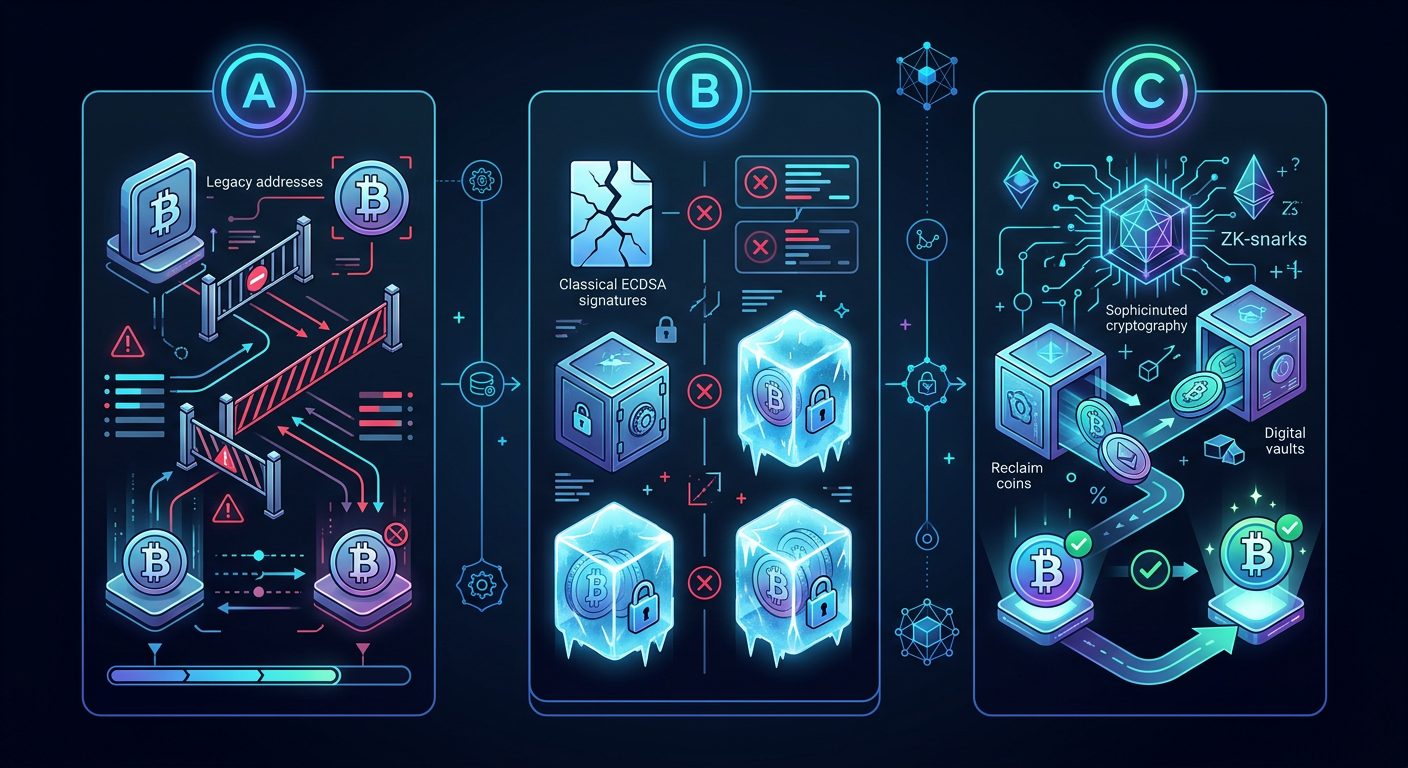
- Phase A (3 years post-activation): Blocks new incoming transactions to legacy (vulnerable) address types, compelling users to migrate to quantum-resistant outputs.
- Phase B (5 years post-activation): Fully deprecates ECDSA and Schnorr signatures, effectively freezing any unmigrated Bitcoin.
- Phase C: Establishes a relief mechanism where owners can recover frozen funds using Zero-Knowledge (ZK) proofs of key ownership.
The Philosophy and the Fury
BIP-361 has ignited a philosophical civil war. Critics argue that forcing a "signature sunset" and freezing coins violates Bitcoin’s fundamental promise of absolute property rights and uncensorable self-custody. It risks locking out users who are dead, imprisoned, offline, or simply unaware of the migration.
However, supporters point to the systemic danger. Jameson Lopp countered that allowing a quantum attacker to sweep Satoshi Nakamoto's massive 1.1 million BTC fortune would lead to a catastrophic market crash—amounting to "theft from everyone".
Adding fuel to the fire, developer Paul Sztorc is bypassing the base-layer gridlock altogether with a planned hard fork called eCash. Sztorc’s network will airdrop tokens 1:1 to BTC holders but manually reassign 500,000 of Satoshi’s dormant coins to fund early developers and investors, utilizing seven Layer 2 "drivechains" (including the quantum-resistant Photon sidechain) to solve scaling and post-quantum preparedness.
As the year progresses, the debate is no longer about whether Bitcoin has a quantum problem, but how the decentralized network can find the consensus to save itself.
Tags
Grounded sources & citations
What to read next

The Multilateral Ledger Era: How J.P. Morgan, Ripple, and Mastercard Bridged Public Blockchains to Wall Street Rails

Beyond the Physical Limit: How NEAR’s "SPICE" Upgrade Decouples Consensus to Achieve 200ms Blocks

Slicing the Treasury: Behind the Ethereum Foundation’s Radical Restructuring and New Five-Layer Architecture
Enjoyed this? Get the next one
Subscribe to the newsletter and the next playbook lands in your inbox — no spam, unsubscribe anytime.