The Range Redesign is Finally Here: Inside Rust 1.96.0’s Copyable Future
Rust 1.96.0 has officially shipped, bringing a groundbreaking solution to one of the language's longest-standing ergonomic pain points: non-copyable range types. Discover how the library portion of RFC 3550, along with new testing macros and strict WebAssembly linking, improves the Rust developer experience.

The Range Redesign is Finally Here: Inside Rust 1.96.0’s Copyable Future
The Rust Release Team has officially shipped Rust 1.96.0, delivering a highly anticipated solution to one of the language’s longest-standing design conflicts: non-copyable range types. Alongside this landmark ergonomic upgrade, the new release introduces powerful test assertions, critical WebAssembly linking safety, and security patches.
Let's dive into what makes this release a massive milestone for Rustaceans.
Why Old Ranges Couldn't Be Copy
Since the pre-1.0 days of Rust, range syntax like 0..10 has generated types (such as std::ops::Range) that implement the Iterator trait directly. In systems programming, implementing both Iterator and Copy on the same type is considered a major hazard; copying a range would duplicate its internal iteration state, leading to silent, confusing runtime bugs.
Consequently, Rust ranges were never Copy. Developers trying to store ranges in lightweight, copyable structures were forced to split them into separate start and end variables or manually clone them—a constant source of friction.
Enter RFC 3550: Separating Data from Iteration
Rust 1.96.0 solves this by stabilizing the library portion of RFC 3550, introducing three new types under the core::range namespace:
core::range::Rangecore::range::RangeFromcore::range::RangeInclusive
Unlike their predecessors, these new types do not implement Iterator directly; instead, they implement IntoIterator. By separating the static range data from the active iteration state, these types can safely implement Copy.
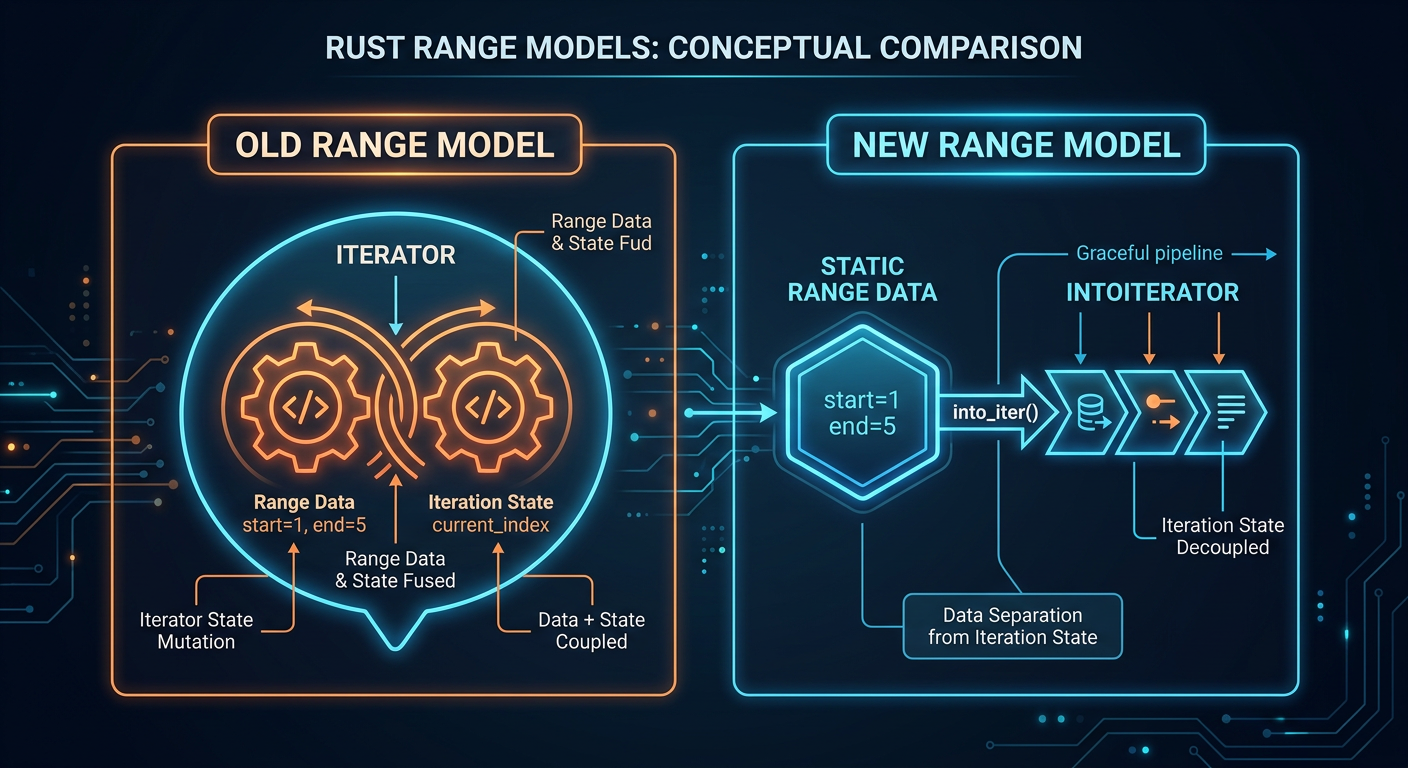
While range syntax like 0..1 will continue to emit the legacy std::ops types for backward compatibility, the language is slated to transition the syntax to the new core::range types in the upcoming Rust 2027 Edition.
Other Notable Upgrades in Rust 1.96.0
While copyable ranges are stealing the spotlight, this release packs several other developer-experience enhancements:
1. Cleaner Tests with assert_matches!
Writing unit tests that assert on pattern matching previously required using the clunky assert!(matches!(value, Pattern)) syntax. When these assertions failed, they emitted unhelpful panics without displaying the actual value.
The newly stabilized assert_matches! and debug_assert_matches! macros automatically format and print a Debug representation of the failing value, dramatically shortening debugging feedback loops.
2. Safer WebAssembly Linking
Previously, undefined WebAssembly (Wasm) symbols were silently compiled into imports from the fallback "env" module. This often hid critical misconfigurations until runtime. Rust 1.96.0 disables this default behavior; undefined symbols will now trigger a hard linker error, catching platform compatibility bugs at compile time.
Upgrading to Rust 1.96.0
To get the latest compiler improvements, update your local toolchain using rustup:
rustup update stable
With the foundational work for the 2027 Edition falling into place, Rust continues to prove that even decade-old architectural flaws can be elegantly resolved without breaking the promise of stability.


Get the wire in your inbox
Every new signal, straight from the generator. No noise, unsubscribe anytime.