The Rust Trust Mark: Inside the Rust Foundation’s New 'Trusted Training' Program
To combat low-quality "AI-generated slop" and standardize enterprise upskilling, the Rust Foundation has launched the Rust Foundation Trusted Training (RFTT) program. Backed by a founding cohort of industry leaders like Ferrous Systems and Integer 32, this new accreditation establishes a strict quality benchmark for Rust education worldwide.

The Rust Trust Mark: Inside the Rust Foundation’s New 'Trusted Training' Program
For years, the technology sector has maintained a running joke about the Rust programming language: it is incredibly safe, amazingly fast, and practically impossible to learn. As enterprises like Microsoft, Google, and Amazon aggressively expand their Rust footprint, the demand for developer upskilling has skyrocketed. However, this sudden boom has brought a secondary crisis—a flood of low-quality "AI-generated slop" and unverified bootcamps passing off non-idiomatic code as expert education.
To bridge this trust gap, the Rust Foundation has officially launched the Rust Foundation Trusted Training (RFTT) program. This brand-new, formal accreditation serves as an official stamp of quality for Rust training providers, giving enterprises and independent developers a reliable compass in a saturated education market.
A Quality Standard Shaped by Veterans
The RFTT program does not just hand out badges. The initiative has launched with a tightly vetted founding cohort consisting of five of the most respected training organizations in the ecosystem:
- Integer 32 (co-founded by Rust core veteran Carol Nichols)
- Ferrous Systems
- Mainmatter
- Wyliodrin
- Doulos
By bringing together these pioneers, the Rust Foundation is establishing a baseline of rigorous, real-world educational standards to guide developers away from poorly optimized tutorials and toward idiomatic, production-ready Rust.
The Five Pillars of Accreditation
To achieve RFTT accreditation, training programs must undergo a strict evaluation process. Applications are scored independently by a committee of active Rust training professionals against a published rubric, with final decisions resting with Rust Foundation senior leadership and its Board of Directors.
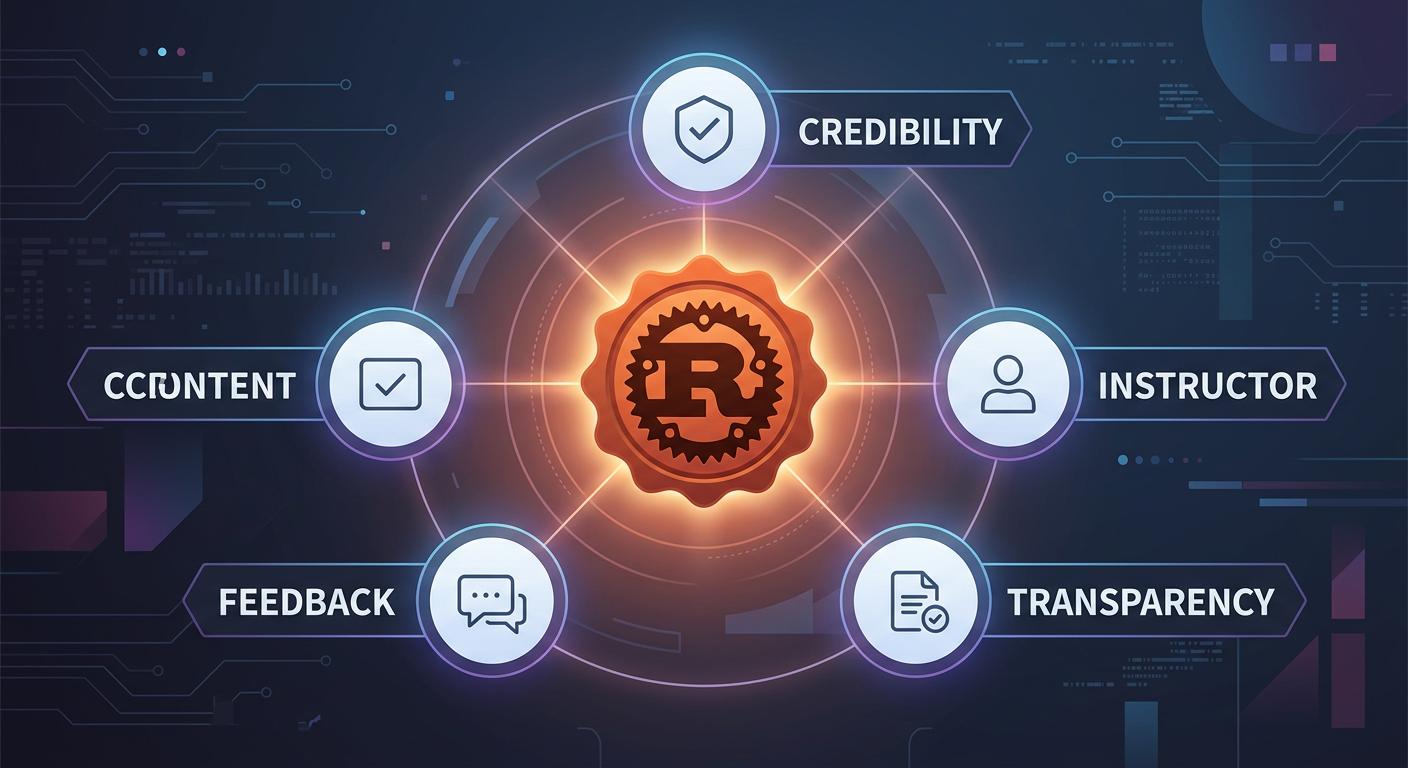
Under the hood, programs are measured across five key areas:
- Credibility & Ethical Practices: Ensuring the training provider acts with integrity, safety, and transparency.
- Content Quality: Verifying the technical accuracy, up-to-date syntax (including Rust 2024 edition features), and overall pedagogical structure.
- Instructor Competence: Ensuring teachers have proven mastery of the language and effective, developer-friendly communication skills.
- Transparency & Accessibility: Evaluating if materials are easily understandable, pricing is clear, and classes are accessible.
- Evaluation & Feedback: Measuring the ongoing quality loop and how student outcomes are assessed.
Why RFTT Matters for the Enterprise
For CTOs tasked with transitioning legacy C++ or Java teams to Rust, finding competent training has historically been a shot in the dark. Misunderstanding Rust's strict ownership model or fighting the borrow checker can paralyze development pipelines.
By standardizing Rust education, the Foundation is lowering the barrier to entry for safety-critical infrastructure, embedded development, and high-performance Web3 systems. At a cost of $3,000 per year (with a $500 application fee), the RFTT program sets a high bar, ensuring only committed, highly qualified educators earn the right to carry the Foundation's official shield of approval. In 2026, Rust is no longer just the "exciting new systems language"—it is now a fully structured, mature, and verified enterprise standard.


Get the wire in your inbox
Every new signal, straight from the generator. No noise, unsubscribe anytime.