The Splat Era is Here: How Apple Maps’ New AI Flyover Quietly Beat Google to Photorealistic 3D
At WWDC 2026, Apple quieted the critics by unveiling a completely overhauled Apple Maps Flyover powered by AI-driven 3D Gaussian Splatting. By blending aerial imagery with visual intelligence models, iOS 27 eliminates melted buildings and blobby trees in favor of hyper-realistic 3D cities.

The Splat Era is Here: How Apple Maps’ New AI Flyover Quietly Beat Google to Photorealistic 3D
While the headlines out of WWDC 2026 focused heavily on Siri AI and Apple Intelligence, Apple quietly announced a visual breakthrough that represents a massive technical leap. The iconic but long-neglected Flyover feature in Apple Maps is getting a complete photorealistic overhaul.
For years, Flyover has relied on classic 3D polygon meshes—a photogrammetry approach that resulted in the infamous "melted buildings," blobby power lines, and "broccoli trees". In iOS 27, macOS 27, and visionOS 27, that era is officially over. Apple is achieving this by deploying a cutting-edge rendering technique: 3D Gaussian Splatting.
Moving Beyond Melted Meshes
Traditional 3D mapping struggles with complex geometries, translucent materials, and fine details. When rendering a tree or a glass skyscraper, classic polygon grids fail to capture the light refraction and intricate shapes, turning them into solid, muddy blocks.
Apple’s new engine solves this by combining aerial imagery with visual intelligence models to reconstruct environments using millions of semi-transparent, colorful 3D ellipsoids (known as "Gaussians" or "splats"). Each splat contains data on its position, size, opacity, and how its color changes depending on the viewing angle (using spherical harmonics).
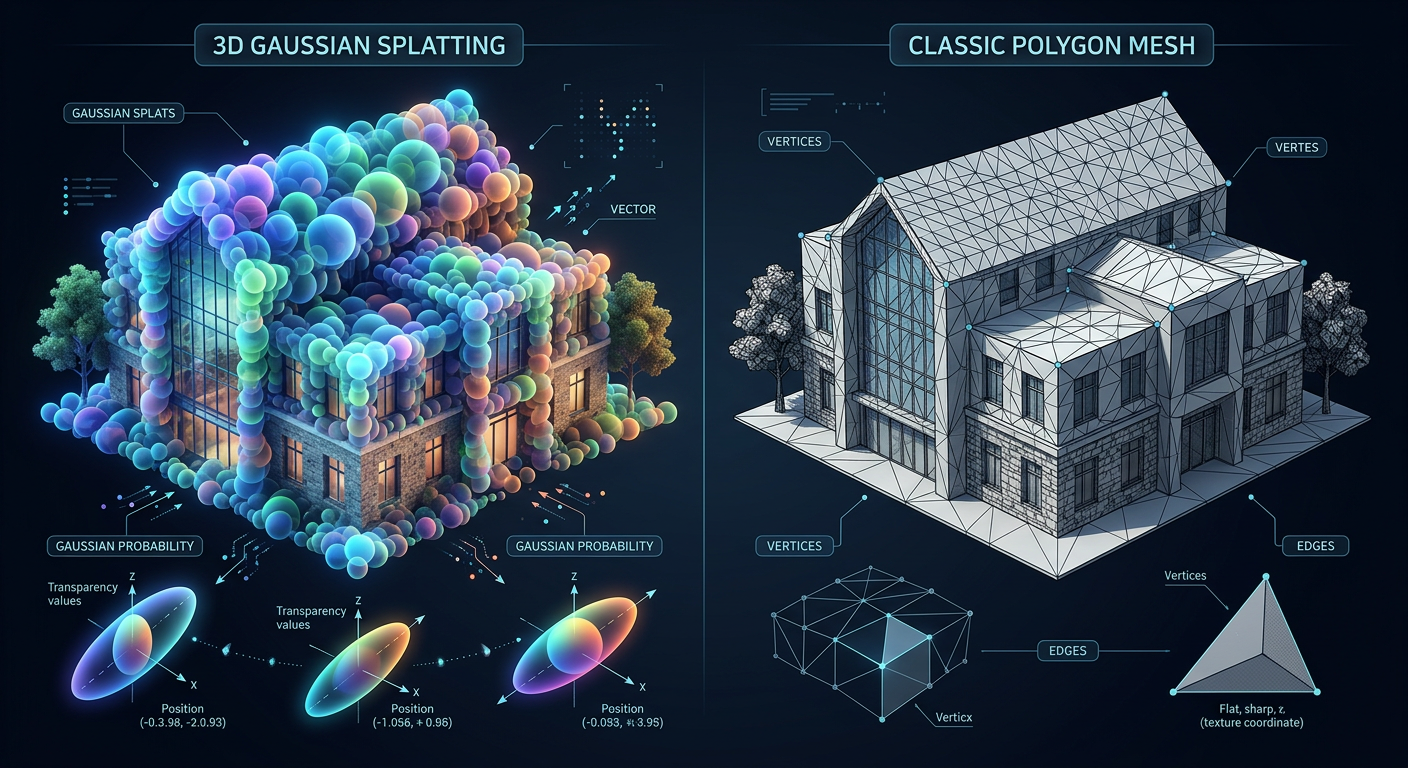
The result? Photorealistic city-scale rendering. In cities like London and New York, you can zoom down to street level and see actual light bouncing off glass facades, individual leaves on trees, and even construction cones on the pavement with jaw-dropping fidelity.
Apple Beats Google to the Consumer Splat
What makes this move particularly notable is that Apple shipped it first. While Google possesses the largest geospatial data corpus on Earth—spanning Street View, aerial LiDAR, and satellite imagery—Apple has beat them to deploying an AI-powered radiance field rendering system at consumer scale.
Apple’s hybrid approach elegantly layers Gaussian splats onto existing geographical meshes. This allows the operating system to stream incredibly detailed 3D graphics on a standard cellular connection without melting your iPhone's battery.
The Ultimate Spatial Computing Playground
While the upgrade is stunning on the iPhone 17 Pro, it truly shines on Apple Vision Pro under visionOS 27. Utilizing Flyover in VR transforms maps from a 2D scouting tool into a fully immersive, photorealistic flight simulator. Users can fly through historic landmarks and experience natural lighting and shadows that dynamically shift as they move their heads.
Though Apple didn't explicitly utter the phrase "Gaussian Splatting" on the WWDC stage—instead opting to call it "AI-enhanced Flyover"—the underlying technology is a triumph for computer vision. It has successfully bridged the gap from academic papers to a mass-market operating system in record time.
The updated Flyover is currently rolling out to developers in the iOS 27 beta, with a public release slated for this fall.


Get the wire in your inbox
Every new signal, straight from the generator. No noise, unsubscribe anytime.