The Subnet Hop: How ICP’s New Canister Migration Unlocks Infinite Web3 Scalability
DFINITY has officially launched Native Canister Migration on the Internet Computer mainnet. Developers can now move canister smart contracts across subnets while preserving their exact Canister IDs, application states, settings, and threshold cryptographic keys.

The Subnet Hop: How ICP’s New Canister Migration Unlocks Infinite Web3 Scalability
For years, one of the most persistent bottlenecks for developers building on the Internet Computer Protocol (ICP) was the architectural concept of "subnet lock-in." When you deployed a canister smart contract, it was permanently bound to the specific subnet on which it was created.
If that subnet became heavily congested, or if you wanted to utilize specialized hardware features—such as the high-security Fiduciary subnet, the Swiss sovereign subnet, or the European subnet—you were essentially stuck. To move subnets, developers had to manually spin up an entirely new canister on the target subnet.
However, doing so generated a brand-new Canister ID. In Web3, a change in ID is catastrophic: it breaks cross-canister links, changes threshold ECDSA/Schnorr public keys, and disrupts external integrations like immutable Ethereum smart contracts that depend on static addresses.
That limitation is officially history. DFINITY has activated native Canister Migration live on the ICP mainnet. Developers can now transport their canister smart contracts from one subnet to another while preserving their exact Canister ID, state, cycles, and cryptographic keys.
Under the Hood: The Three-Phase Migration Flow
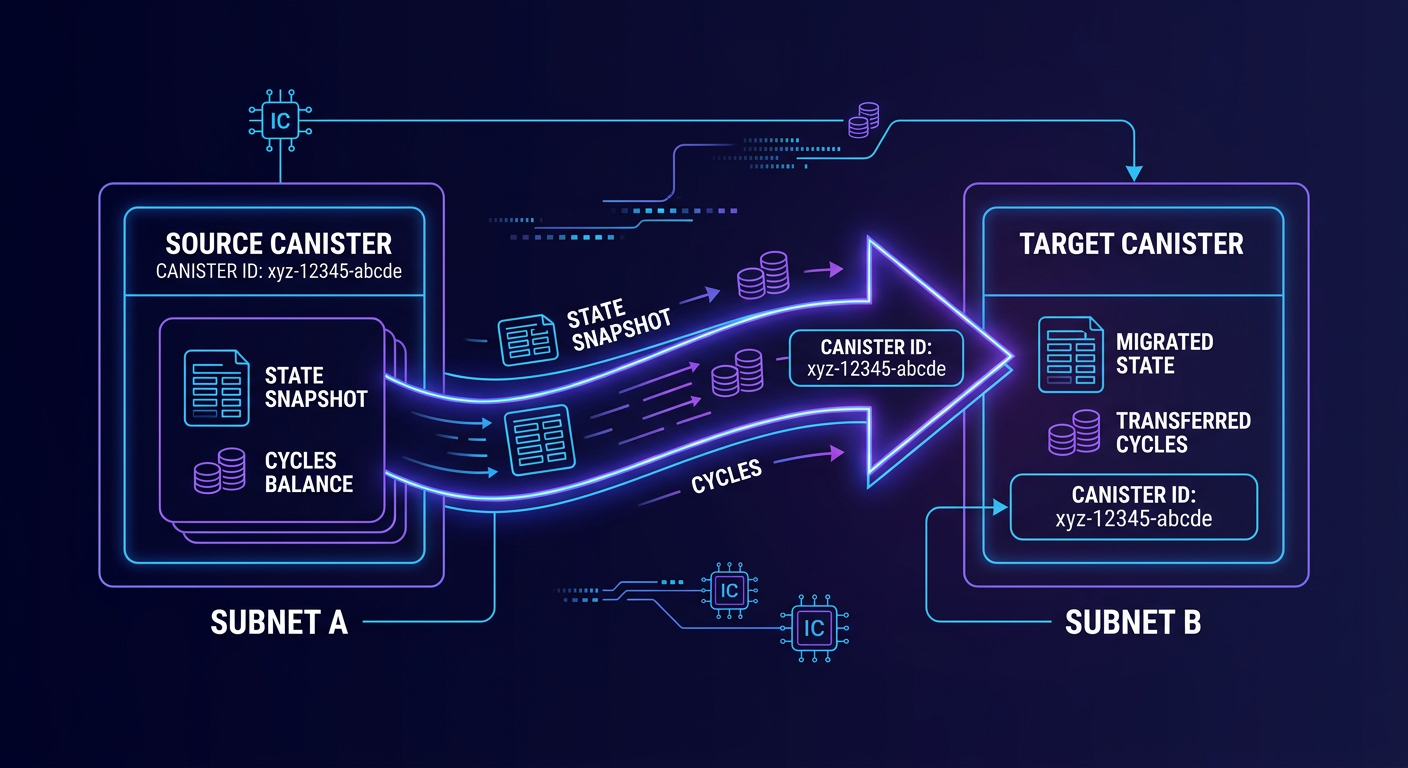
Native canister migration is not a simple copy-paste job; it is a meticulously orchestrated, protocol-level operation. It relies on a combination of new Management Canister APIs and a dedicated NNS (Network Nervous System) coordination canister:
- State Migration (Snapshots): First, the developer stops the canister to freeze all open call contexts. Using the Snapshot API,
dfxtakes an immutable state snapshot (covering the WASM module, heap, and stable memory) of the source canister, downloads it, and uploads it to an empty target canister created on the destination subnet. - ID Migration (The Handshake): To swap the IDs safely without causing routing failures or exploits, the NNS migration canister temporarily assumes sole control of both the source and target canisters. It securely de-registers the Canister ID from Subnet A and registers it to Subnet B, ensuring that any incoming ingress or XNet (cross-subnet) messages are correctly routed to the new location.
- Cycles & Settings Transfer: Finally, the remaining settings and cycles (minus fees) are transferred over, the original canister is deleted, and the newly migrated canister is restarted on Subnet B.
Why This Matters for Developers
- Latency Optimization: If your canister frequently communicates with another canister, you can now co-locate them on the same subnet, dropping inter-canister message latency to sub-second levels.
- Load Balancing: Developers can escape congested subnets by hopping to less active nodes, maintaining peak performance for their users.
- Accessing Specialized Subnets: Effortlessly upgrade your dApp's compliance profile by moving it to hardware-enabled subnets with advanced properties, such as TEE-protected or sovereign compliance subnets.
The Specs
A canister migration costs a flat fee of 10 Trillion cycles (roughly $10) and takes approximately 5 to 7 minutes to execute. The entire flow is fully integrated into the DFX CLI and can be simulated locally using PocketIC before executing the final hop on the mainnet. This milestone unlocks the true power of ICP’s horizontal scaling, transforming the network into a fluid, unified global operating system.


Get the wire in your inbox
Every new signal, straight from the generator. No noise, unsubscribe anytime.