The WebAssembly Divorce: Why Rust Finally Killed `--allow-undefined`
Rust has permanently removed the `--allow-undefined` linker flag from all WebAssembly targets. This monumental breaking change eliminates silent runtime failures, bringing native-level safety to cloud-native, edge, and browser-side Wasm development.

The WebAssembly Divorce: Why Rust Finally Killed --allow-undefined
WebAssembly (Wasm) has long promised a sandboxed, high-performance future for code running anywhere from browser tabs to edge clouds like Cloudflare Workers. But for years, Rust’s WebAssembly compiling process carried a dirty secret—a historical workaround that quietly bypassed the compile-time safety Rust is famous for.
With the stable release of Rust 1.96.0, the Rust compiler team officially severed ties with this legacy, permanently removing the --allow-undefined linker flag from all WebAssembly targets. It is a massive breaking change that marks a major turning point for WebAssembly's architectural maturity.
The Legacy of Silent Imports
To understand why this change matters, we have to look back at how WebAssembly compiles. Unlike native systems (like Linux or Windows), which fail to compile if you reference a function that does not exist, Rust's early Wasm targets took a shortcut. It automatically passed the --allow-undefined argument to the underlying linker, wasm-ld.
If you declared an external host function in your Rust code, like this:
unsafe extern "C" {
    fn my_host_function();
}
And forgot to link a library defining it, the compiler wouldn't complain. Instead, it silently generated a WebAssembly binary that declared an import from a generic "env" module:
(module
  (import "env" "my_host_function" (func $my_host_function))
)
The compiler kicked the symbol resolution can down the road, leaving it for the host environment to resolve at runtime.
The Hazard of the "Kicked Can"
While this was convenient for bootstrapping the ecosystem, it introduced serious bugs. The most prominent was silent runtime failures. If you made a simple typo—such as writing mylibraryinit instead of mylibrary_init—the code would compile successfully. But the moment the code ran in production, the application would crash with a cryptic "missing import" error.
Furthermore, downstream tools like wasm-bindgen or wasm-tools would often choke on these unexpected unresolved imports, throwing highly confusing errors that were incredibly difficult to trace back to the original Rust source.
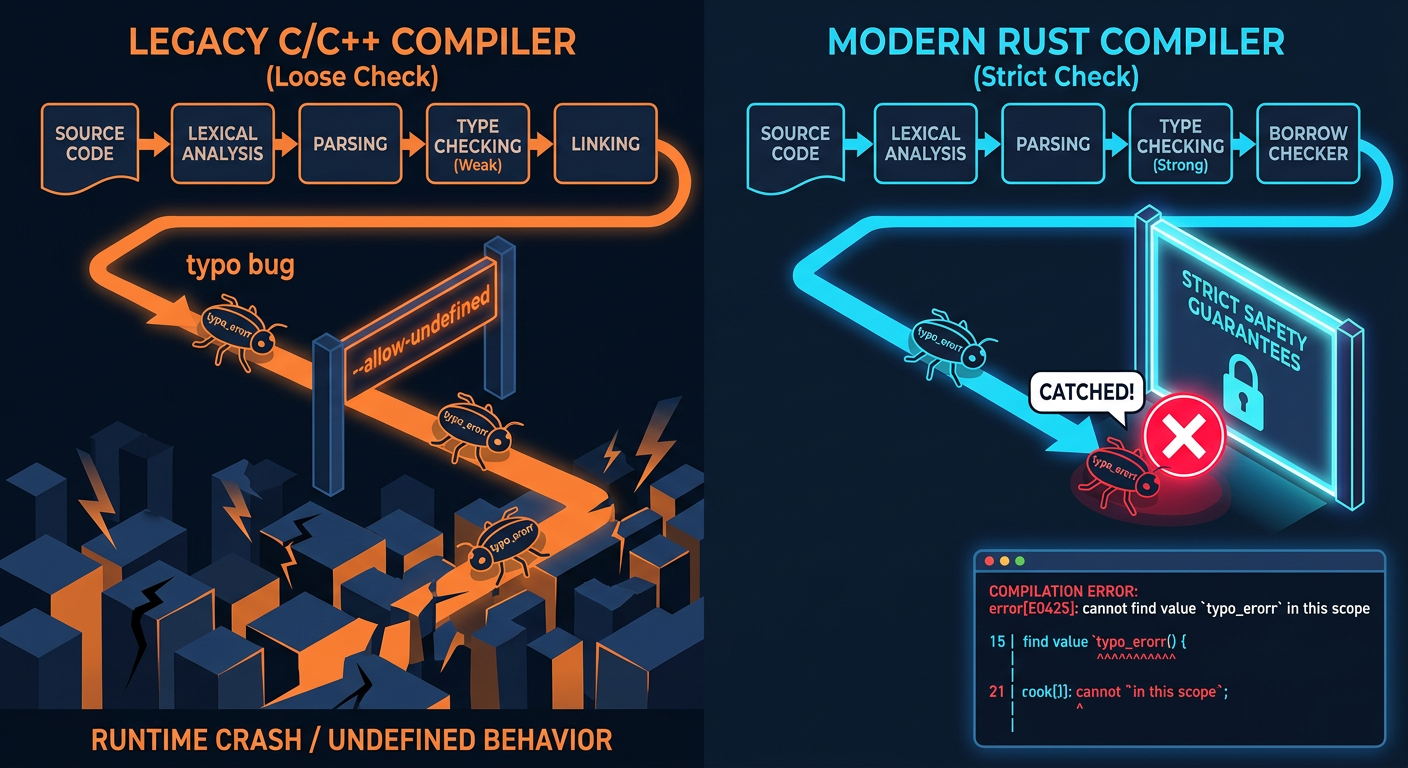
Securing the Pipeline
By throwing hard linker errors for undefined symbols, Rust now treats WebAssembly exactly like any other tier-1 native target.
If your codebase intentionally uses host-provided imports, you must now explicitly declare the target module using the #[link] attribute:
#[link(wasm_import_module = "my_custom_host")]
extern "C" {
    fn my_host_function();
}
If you are maintaining a massive legacy codebase and need an immediate escape hatch to restore the old behavior, you can manually instruct the compiler to pass the flag back via your cargo configuration or terminal:
RUSTFLAGS="-C link-arg=--allow-undefined" cargo build --target wasm32-unknown-unknown
The Road to Production-Ready Wasm
Removing --allow-undefined is a necessary rite of passage. As WebAssembly cements its role in enterprise edge architectures, serverless runtimes, and secure sandboxes, "works on my machine" compilation is no longer acceptable. By enforcing strict compile-time checks, Rust has made the entire Wasm ecosystem significantly safer, one linker error at a time.


Get the wire in your inbox
Every new signal, straight from the generator. No noise, unsubscribe anytime.