Vercel Launches Eve: The Filesystem-First Framework Redefining Production AI Agents
Vercel has open-sourced Eve, an Apache-2.0 framework that treats AI agents as structured directories on disk. Featuring durable execution, sandboxed code execution, and native MCP support, Eve aims to simplify deploying robust, production-grade agents in one click.

Vercel Launches Eve: The Filesystem-First Framework Redefining Production AI Agents
For the past few years, building production-grade AI agents has meant assembling a fragile web of custom-coded pipelines, manual state management, and bespoke API wrappers. At its Ship 2026 conference, Vercel declared war on this architectural complexity by open-sourcing Eve.
Released under the Apache-2.0 license, Eve is a filesystem-first framework designed to make building a durable, production-ready AI agent as intuitive as organizing files in a directory on disk.
The Folder-as-an-Agent Paradigm
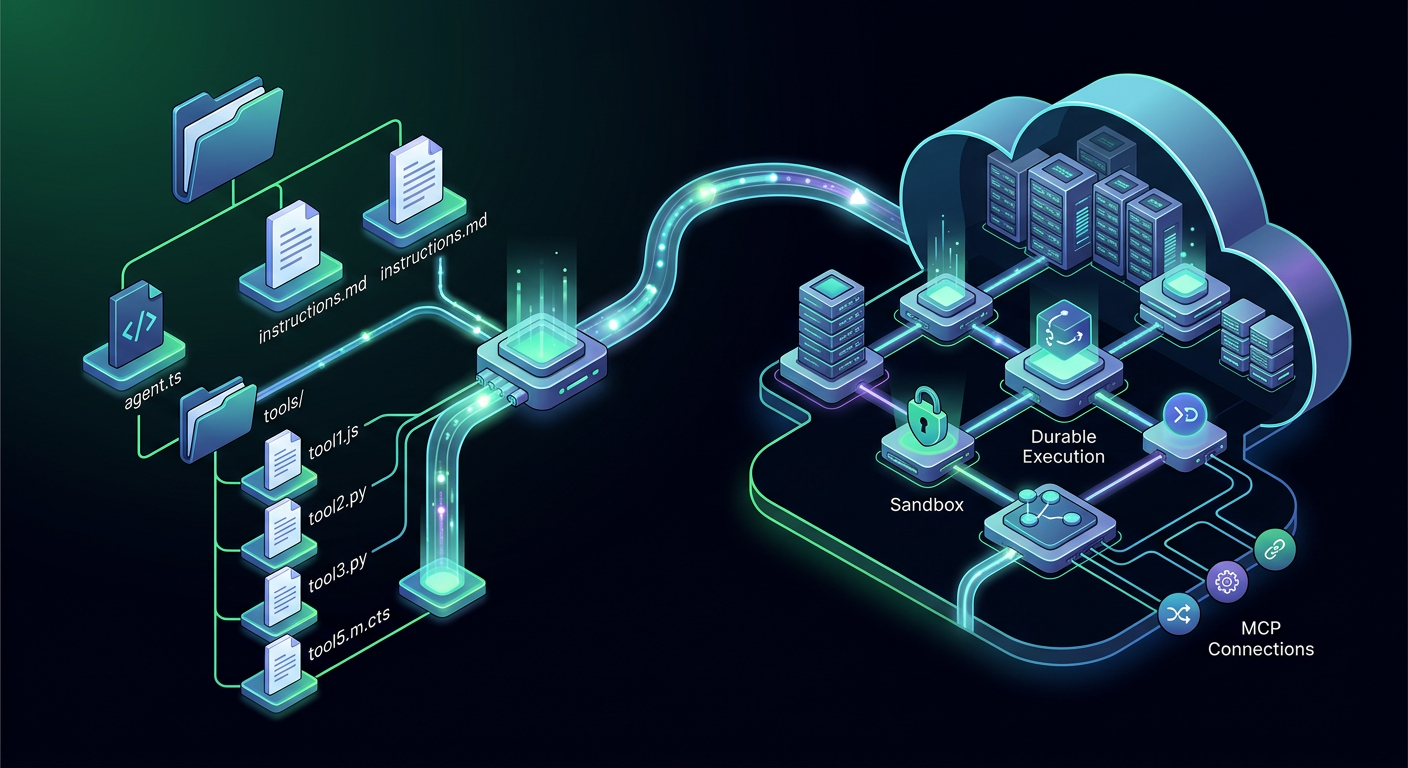
The core philosophy of Eve is simple: an agent is quite literally a folder. Rather than forcing developers to configure intricate graph state machines or chain custom callbacks in verbose files, Eve uses conventional directory structures to declare the agent's behavior and environment.
A standard Eve project layout maps specific directory paths straight to core agent capabilities:
agent/agent.ts: Defines the underlying LLM (such as Anthropic’s Claude or OpenAI's GPT models) and primary runtime configurations.agent/instructions.md: The always-on system prompt that dictates the agent's persona and foundational constraints.agent/tools/: A folder of TypeScript files where each file represents an action the model can take. Tools are defined with an explicit Zod input schema to guarantee that malformed model outputs never bypass execution safety.agent/skills/: Markdown procedures loaded on demand to guide the agent through multi-step playbooks.agent/channels/: Separately configures communication layers like Slack, Discord, GitHub, or custom HTTP APIs without changing core agent logic.agent/schedules/: Declares cron-like periodic tasks that trigger the agent to act autonomously.
Because Eve dynamically discovers and registers these components at build time, developers are completely spared from writing heavy registration boilerplate.
Production-Grade Plumbing out of the Box
What elevates Eve beyond simple prototyping is the underlying Vercel Agent Stack. By tying its cloud-native infrastructure directly to the directory framework, Vercel solves the three hardest problems of enterprise agent deployments:
- Durable Execution: Utilizing Vercel's Workflow engine, conversations are treated as durable state workflows. If a server restarts or a new deployment is pushed mid-task, the agent pauses and safely resumes from the exact state of its last completed step.
- Human-in-the-Loop (HITL) Approvals: Critical actions (like executing a payout or merging code) can require human oversight. The agent's execution state can freeze indefinitely without burning compute resources until an operator grants permission.
- Isolated Sandboxing: Agent-generated code executes inside secure, containerized environments. This utilizes local Docker adapters during development and serverless Vercel Sandboxes in production.
Embracing Model Context Protocol (MCP)
To unlock immediate connectivity, Eve supports the open Model Context Protocol (MCP) out of the box. This lets developers plug into pre-built industry tools and external datasets without writing custom glue code.
Deploying an Eve agent is as straightforward as running npx eve@latest init to scaffold a project locally, and calling vercel deploy to spin up a fully monitored, auto-scaling agent complete with OpenTelemetry tracing. With more than a hundred agents already running internally at Vercel, Eve is proving that the path to robust enterprise AI isn't through complex hand-coded pipelines—it's in the folders we write.


Get the wire in your inbox
Every new signal, straight from the generator. No noise, unsubscribe anytime.