Hotter Than a Hot Tub: Nvidia’s Radical 113°F Liquid Cooling Is Solving AI's Water Crisis
Nvidia has unveiled a groundbreaking 100% closed-loop liquid cooling design for its upcoming Rubin architecture. By running coolant at a blistering 45°C (113°F), this system eliminates on-site water consumption and dramatically slashes data center energy demands.

Hotter Than a Hot Tub: Nvidia’s Radical 113°F Liquid Cooling Is Solving AI's Water Crisis
As the race to train and deploy larger frontier models intensifies in mid-2026, the artificial intelligence industry has slammed into a physical wall: thermodynamics. Traditional data centers generate immense heat, requiring millions of gallons of water daily to keep processors from melting.
To break this bottleneck, Nvidia has unveiled a counterintuitive breakthrough for its forthcoming Rubin generation AI architecture. Detailed in its newly expanded NVIDIA DSX AI factory reference design, the company is introducing a 100% closed-loop direct-to-chip liquid cooling system that runs coolant at a scorching 45°C (113°F).
Yes, you read that right. Nvidia’s state-of-the-art cooling fluid is hotter than the average backyard hot tub. Yet, this counterintuitive "hot cooling" is poised to change the economics and environmental footprint of global AI infrastructure.
Why "Hot Cooling" is a Game Changer
In traditional cooling setups, chilling water to low temperatures (such as 15°C to 20°C) requires energy-hogging mechanical chillers. These systems consume up to 40% of a data center’s total electricity and suffer from constant water loss via evaporative cooling towers. Conventional facilities lose roughly 2.6 million gallons of water per megawatt per year directly to the atmosphere.
Nvidia’s Rubin architecture changes the equation completely.
A specialized coolant—a mixture of 75% water and 25% propylene glycol—flows through custom cold plates mounted directly onto the Rubin GPUs. Because the coolant enters the racks at 45°C (113°F) and exits at 55°C (131°F), its base temperature is significantly higher than the ambient outdoor air in most global climates.
This massive thermal differential allows data centers to discard heat using simple outdoor "dry coolers" (radiators) rather than energy-intensive chillers.
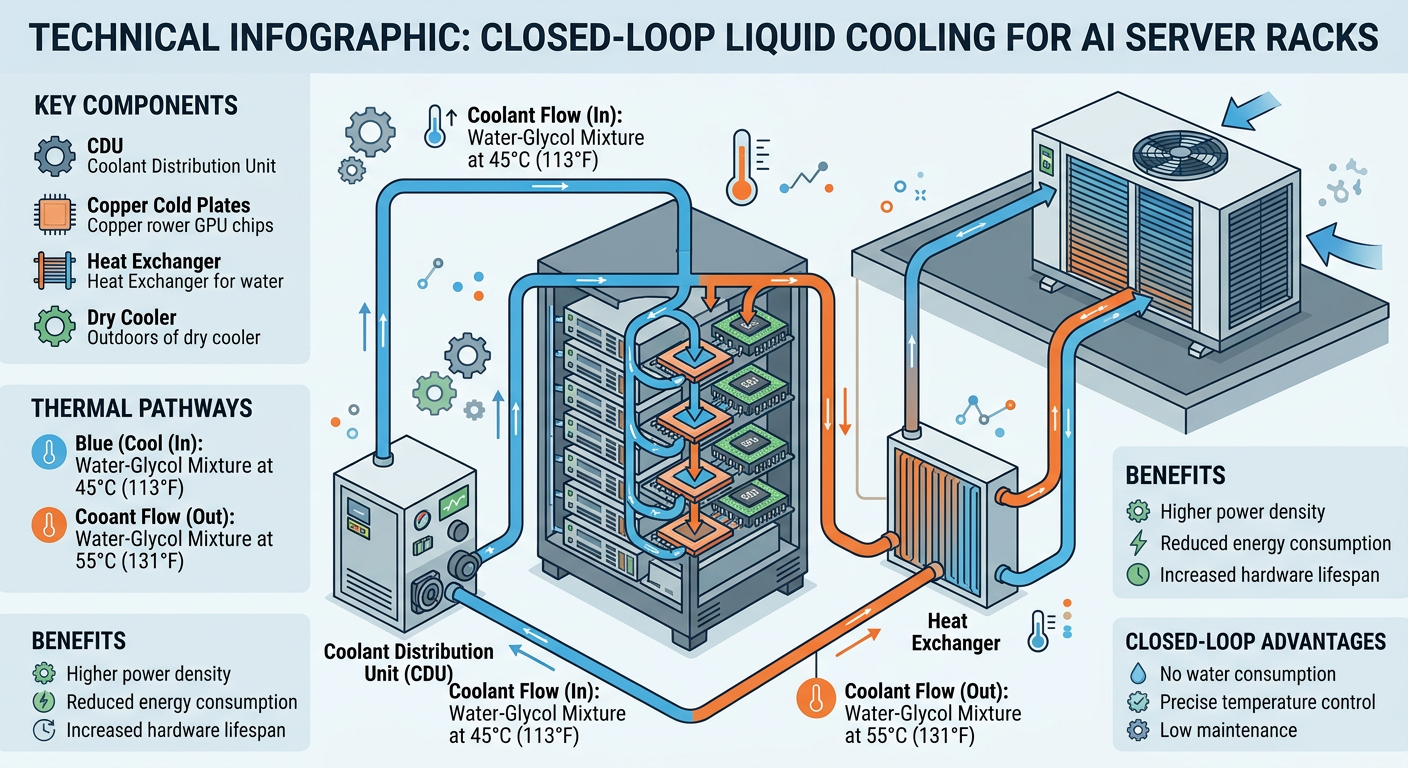
Slashing Water Consumption to Near Zero
Because the water-glycol mixture is completely sealed inside a closed loop, it is filled only once and recirculates indefinitely. This reduces on-site water consumption by up to 100%.
According to Nvidia, a 50-megawatt hyperscale facility transitioning to this Rubin-based liquid cooling architecture stands to save more than $4 million annually in utility costs while completely eliminating its draw on local municipal water tables.
Overcoming Geopolitical and Grid Bottlenecks
This breakthrough couldn't arrive at a better time. From Dublin to Phoenix, local governments have begun blocking or delaying massive data center expansions due to fears of grid overload and water depletion. By removing evaporative water towers and fans entirely, Nvidia's new platform allows operators to pack GPUs much tighter, squeezing more compute into existing facilities.
While operators in extreme environments like Phoenix might still need to cycle on mechanical chillers during the hottest peak summer days, the system will run chiller-free up to 99% of the year in temperate climates.
Ultimately, Nvidia is proving that the next major milestone in AI isn’t just about refining neural network weights—it is about mastering the laws of physics.


Get the wire in your inbox
Every new signal, straight from the generator. No noise, unsubscribe anytime.