The $35B AI XPV Alliance: How Private Credit and Custom Silicon Are Bypassing Nvidia
Broadcom, Apollo, and Blackstone have launched the $35 billion AI XPV Platform to finance the hardware powering frontier AI. This historic private credit alliance treats computing power as a physical asset, securing gigawatts of custom silicon for labs like Anthropic while keeping debt off their pre-IPO balance sheets.

The $35B AI XPV Alliance: How Private Credit and Custom Silicon Are Bypassing Nvidia
The physical limits of the AI revolution are no longer defined solely by algorithms or raw code; they are dictated by electricity and capital. In an unprecedented move that shifts the frontlines of AI infrastructure, chip giant Broadcom, alongside asset management titans Apollo Global Management and Blackstone, has established the AI XPV Platform. Launching with a staggering initial $35 billion financing tranche, the platform is designed to fund more than 20 gigawatts (GW) of compute capacity through 2028.
For context, 20 gigawatts is equivalent to the power output of roughly 20 nuclear power plants—representing an infrastructure buildout of staggering proportions.
Redefining AI Funding: The SPV Lease Model
Historically, scaling frontier AI models required massive capital expenditures (CapEx). Tech giants had to purchase hardware directly, taking massive debt loads onto their balance sheets. The AI XPV Platform dismantles this dynamic using a creative financial engine: the Special Purpose Vehicle (SPV).
Under this model, the SPV raises debt, purchases Broadcom’s custom XPUs (application-specific integrated circuits, or ASICs, as well as co-designed Google TPUs), and leases them to frontier labs. The lease payments then repay the loan over a multi-year draw schedule.
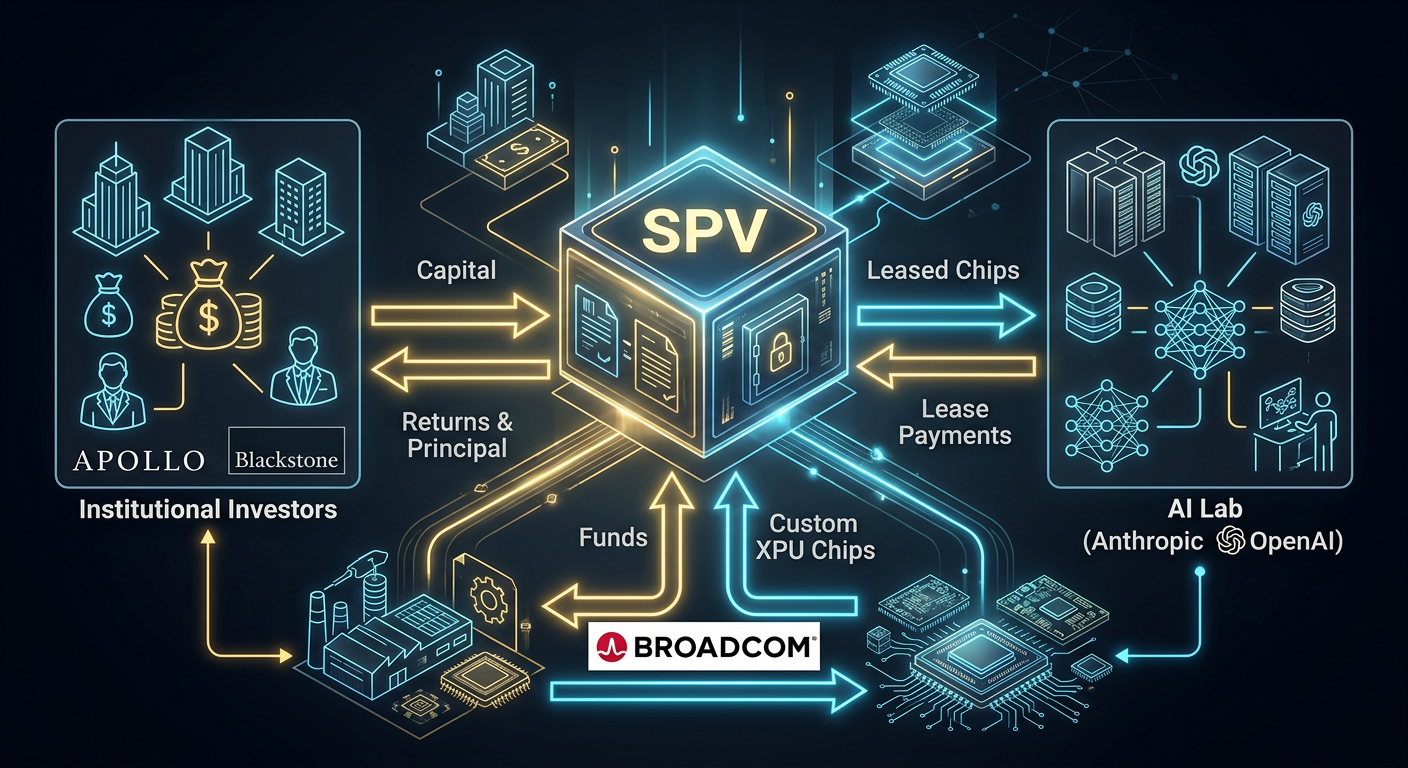
This off-balance-sheet hardware structure is a masterstroke for frontier startups. For example, Anthropic—which confidentially filed for its US IPO on June 1, 2026—can now scale its training capacity without drowning in hardware-depreciation debt that public market investors might otherwise penalize.
Powering the Next Generation of Models
The inaugural $35 billion tranche is already hard at work. It is directly financing Anthropic's previously announced capacity expansion of more than 1 gigawatt of compute infrastructure, slated to deploy across Fluidstack-hosted data centers starting in mid-2026.
By securing dedicated hardware pipelines, AI developers bypass the global scramble for off-the-shelf Nvidia GPUs. Instead, they gain access to customized Broadcom silicon and high-speed networking fabrics optimized directly for their proprietary software stacks.
Broadcom’s Backstop and Systemic Risks
While this deal cements Broadcom as the ultimate alternative to Nvidia's hardware monopoly, it does not come without risk. To secure the private credit tranches, Broadcom has reportedly provided a residual value guarantee. If a leased hardware client defaults, Broadcom is on the hook to cover the outstanding balance for investors.
As Amie Thuener takes the helm as Broadcom's new CFO in June 2026, managing this $35 billion credit facility while navigating an intense, high-rate economic landscape will be a critical test. Nevertheless, by pairing the deepest private capital pools with bespoke, energy-efficient silicon, the AI XPV alliance has officially ushered in the era of macro-infrastructure AI.


Get the wire in your inbox
Every new signal, straight from the generator. No noise, unsubscribe anytime.