No More Hand-Me-Downs: How Microsoft’s MAI-Thinking-1 Kills the OpenAI Dependency
Microsoft has officially shattered its role as OpenAI's silent distributor with the release of MAI-Thinking-1. Built entirely from scratch on a trillion-parameter Mixture of Experts architecture, this first-party reasoning engine marks Redmond's aggressive play for sovereign AI dominance.

No More Hand-Me-Downs: How Microsoft’s MAI-Thinking-1 Kills the OpenAI Dependency
The Strategic Shift: Middleman to Sovereign Powerhouse
For years, the tech industry viewed Microsoft primarily as OpenAI's highly lucrative distribution channel—the enterprise wrapper translating ChatGPT's raw intellect into enterprise-grade Azure APIs and Copilot shortcuts. That era is officially over.
Microsoft AI (MAI), directed by Mustafa Suleyman, has unveiled MAI-Thinking-1. This is not another licensed wrapper or a model distilled from OpenAI’s leftovers. It is a highly sophisticated, first-party reasoning engine trained entirely from scratch. MAI-Thinking-1 marks Microsoft's official declaration of sovereign AI independence, asserting full control over its own intellectual property, training pipelines, and cognitive infrastructure.
Under the Hood: The "No-Distillation" Mixture of Experts
While frontier labs have increasingly relied on "distillation"—training smaller models by forcing them to mimic the outputs of massive, expensive models—Microsoft chose a harder, more resilient path.
MAI-Thinking-1 was trained from the ground up on 30 trillion pre-training tokens of human-generated, commercially licensed data. To prevent the bad habits of copycat models, synthetic data was strictly excluded from its pre-training phase.
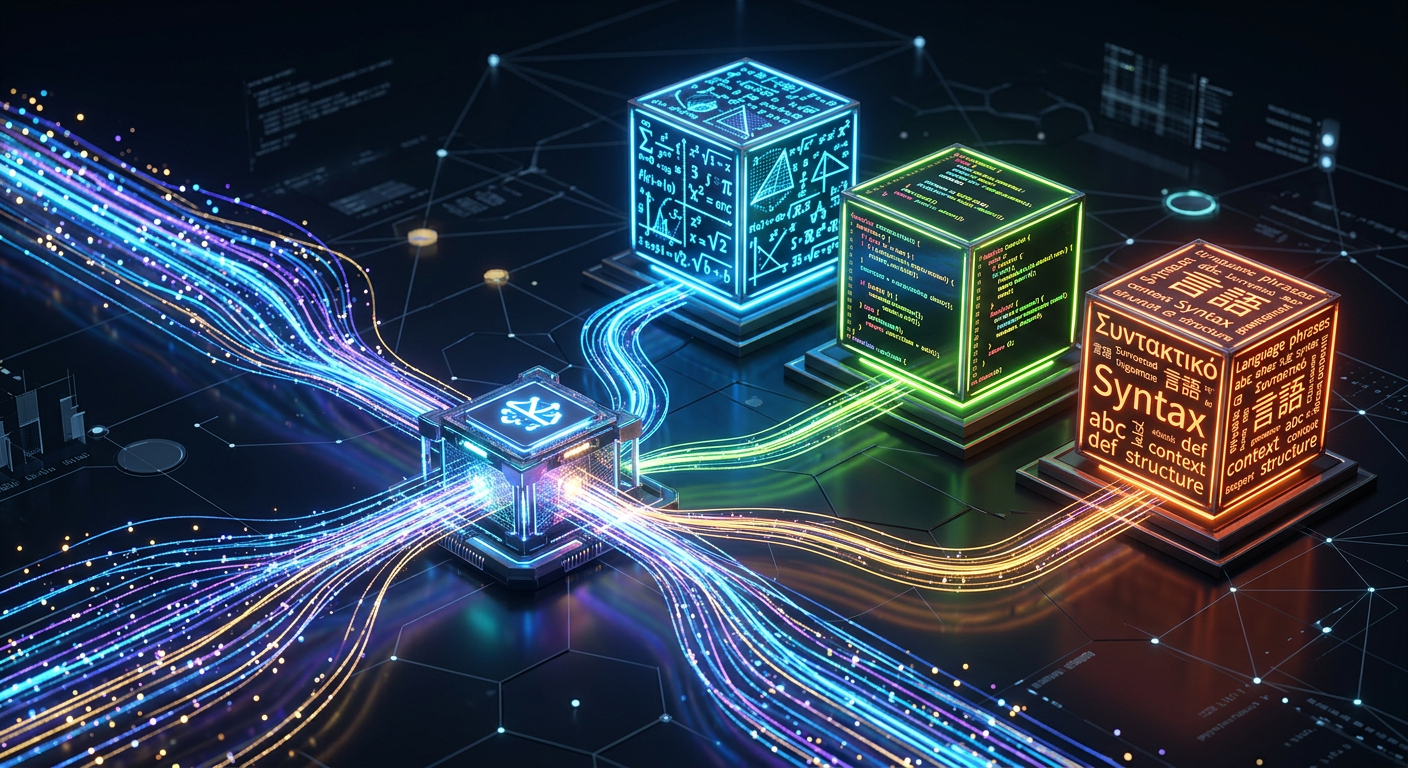
Technically, the model leverages a sparse Mixture of Experts (MoE) architecture:
- Total Parameters: ~1 Trillion
- Active Parameters per Token: 35 Billion
- Context Window: 256K
- Training Compute: 8,000 GB200 NVL72 GPUs on Azure
By firing only a specific subset of "expert" layers per token, MAI-Thinking-1 delivers near-frontier reasoning performance while maintaining a drastically lower inference footprint.
Benchmarks and the "Hill-Climbing Machine"
Microsoft didn't just ship a model; they introduced their Hill-Climbing Machine—a co-designed system where data, rewards, and Reinforcement Learning (RL) environments optimize one another continually in an empirical loop.
This feedback loop has produced staggering STEM and coding performance:
- AIME 2025/2026: Scores of 97.0% and 94.5% respectively, showcasing top-tier olympiad-level mathematical reasoning.
- SWE-Bench Pro: At 52.8%, MAI-Thinking-1 is already trading blows with closed-source giants like Claude Opus 4.6 in agentic software engineering.
- Safety & Alignment: Instead of defensive refusals, safety is optimized directly inside the RL core, achieving a superior balance of helpfulness and risk mitigation.
What This Means for the Enterprise
For enterprise buyers, the introduction of MAI-Thinking-1 presents a seismic shift. It will integrate natively across GitHub Copilot (with a specialized MAI-Code-1-Flash companion), Windows, and Teams. Organizations can now tap into premier reasoning capabilities at "mid-weight" operational costs, all while enjoying the regulatory comfort of traceably sourced, audit-proof training data.
Ultimately, MAI-Thinking-1 isn't just a technical achievement; it is a geopolitical rearrangement of the tech sector. Microsoft is no longer just hosting the future of AI—it is building it.


Get the wire in your inbox
Every new signal, straight from the generator. No noise, unsubscribe anytime.