
No More Silent Traps: Inside Internet Computer’s Canister Logging Revolution
Internet Computer's latest system upgrade introduces a virtual logging layer and fine-grained 'log_visibility' settings. Developers can now debug mainnet traps, heartbeats, and silent crashes without exposing canister internals or risking cycle-drain attacks.
Key takeaways
- • Internet Computer's latest system upgrade introduces a virtual logging layer and fine-grained 'log_visibility' settings
- • Developers can now debug mainnet traps, heartbeats, and silent crashes without exposing canister internals or risking cycle-drain attacks

No More Silent Traps: Inside Internet Computer’s Canister Logging Revolution
One of the most notoriously painful experiences for Web3 developers on the Internet Computer (ICP) has historically been the "silent trap". Because ICP executes smart contracts inside sandboxed WebAssembly (Wasm) canisters, any runtime panic, out-of-memory error, or crash (a "trap") triggers a complete state rollback. While this protects state integrity, it also wipes away diagnostic traces. On mainnet, debugging asynchronous operations like system-triggered heartbeats or timers was nearly impossible because they leave no trace in the replica.
The rolling out of Canister Logging across ICP subnets changes this paradigm forever. Built directly into the replica's execution environment, Canister Logging introduces a virtual, system-managed diagnostics layer.
How the Logging Layer Bypasses Rollbacks
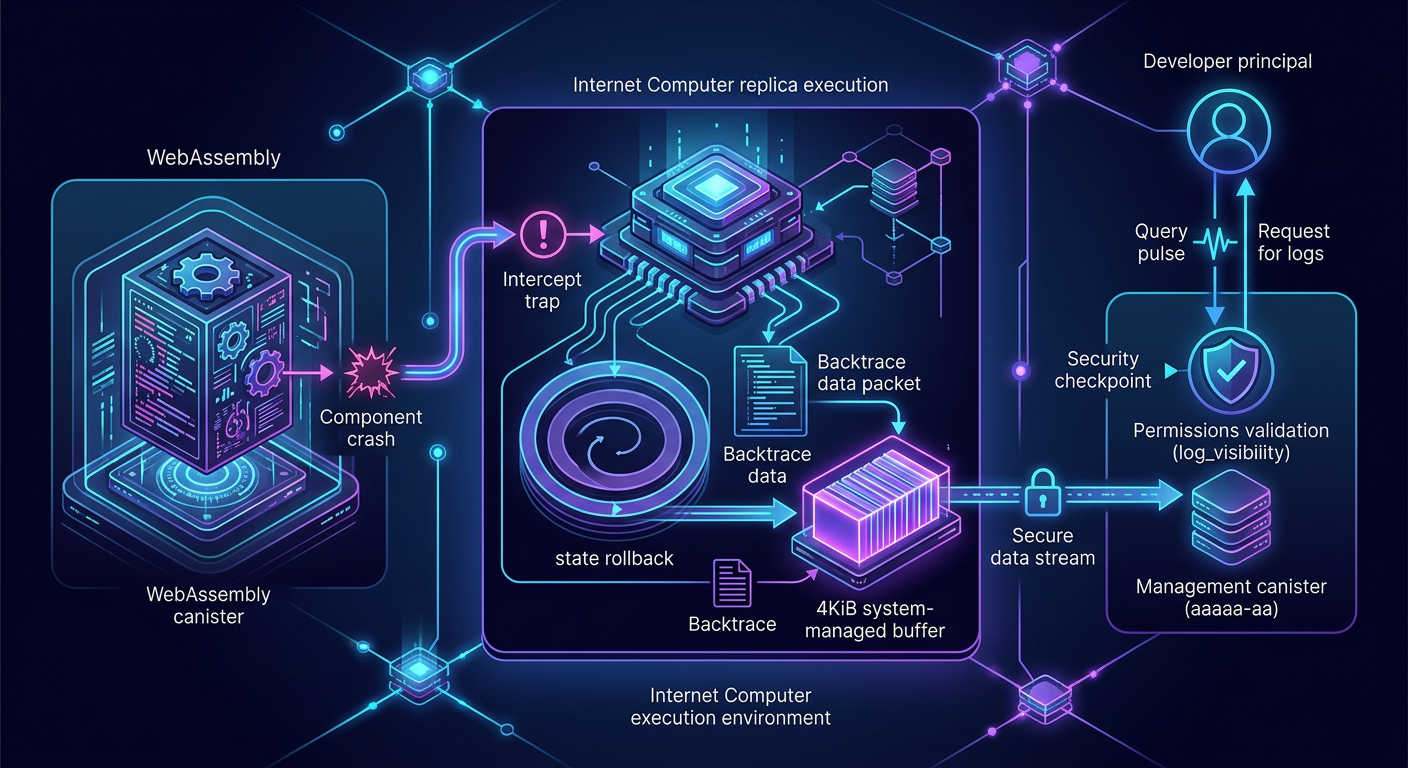
Traditionally, logging libraries written inside canisters failed on panics because the rollback mechanism reverted the logs along with the state. The new system-level logging bypasses the state rollback constraint. When a canister calls ic0.debug_print or suffers a runtime trap, the execution environment intercepts the diagnostic output and writes it directly to a secure, system-managed buffer.
This log buffer:
- Holds up to 4 KiB of the most recent entries and panic traps.
- Persists across canister upgrades, allowing developers to audit diagnostic data after deploying new code.
- Is automatically purged only during clean re-installations or complete uninstallation.
Balancing Auditability and Security with log_visibility
Because logs can contain sensitive operational data or proprietary logic, exposing them public-by-default is a security risk. To solve this, DFINITY introduced the log_visibility configuration in canister settings:
type log_visibility = variant {
  controllers;
  public;
  allowed_viewers : vec principal;
};
By default, visibility is set to controllers. However, the inclusion of allowed_viewers is a massive win for decentralized governance. For canisters under Service Nervous System (SNS) DAOs, developers can grant log-viewing privileges to up to ten specific principal addresses (such as elected security auditors or emergency committee members). This allows for deep diagnostic access without exposing infrastructure internals to the public.
Querying Logs Without the Threat of Cycle Drains
To fetch these logs, developers query the virtual management canister (aaaaa-aa) via the fetch_canister_logs endpoint, or simply execute the updated dfx canister logs <canister-id> command.
Because log retrieval is processed as a non-replicated query call, it runs locally on a single node and bypasses consensus. Consequently, fetching logs consumes zero cycles. This design decision eliminates a dangerous attack vector: malicious actors cannot launch DDoS cycle-drain attacks by repeatedly triggering and querying massive log payloads.
With the activation of canister logging and automated stack traces on mainnet, ICP developers finally have the enterprise-grade observability tools required to build, monitor, and scale completely autonomous dApps.
Tags
Grounded sources & citations
What to read next

The Niobium Era: Inside ICP’s vetKeys Privacy Revolution

Paying for Governance: Inside the Battle Over Internet Computer’s "Followee Tipping" Proposal

Beyond Canister Control: Inside the Menese Protocol's Canister-User Threshold Signing Breakthrough
Enjoyed this? Get the next one
Subscribe to the newsletter and the next playbook lands in your inbox — no spam, unsubscribe anytime.