Rabbithole: Rebuilding the Encrypted Cloud with True Sovereign Canisters on the Internet Computer
Discover Rabbithole, an innovative personal storage vault that hands complete ownership of smart contract canisters back to the user. Leveraging vetKeys and Chain Fusion, it pioneers a trustless, self-hosted alternative to traditional cloud storage.

Rabbithole: Rebuilding the Encrypted Cloud with True Sovereign Canisters on the Internet Computer
For years, the promise of decentralized storage has hovered on the horizon, yet most web3 storage applications still operate like web2 platforms: you log into an account hosted on someone else’s infrastructure.
A newly rebuilt project called Rabbithole is turning this model on its head by introducing a sovereign, encrypted file vault built on the Internet Computer (IC) [c]. It doesn't just store your files—it hands you the keys, the frontend, and the underlying smart contract itself.
What Makes Rabbithole "Sovereign"?
The core architecture of Rabbithole is remarkably elegant. Instead of hosting user data on a central server or shared smart contract, every user gets their own personal storage canister on the Internet Computer [c].
Once your vault is set up, Rabbithole takes a step back: it removes itself from your storage canister's controllers [c].
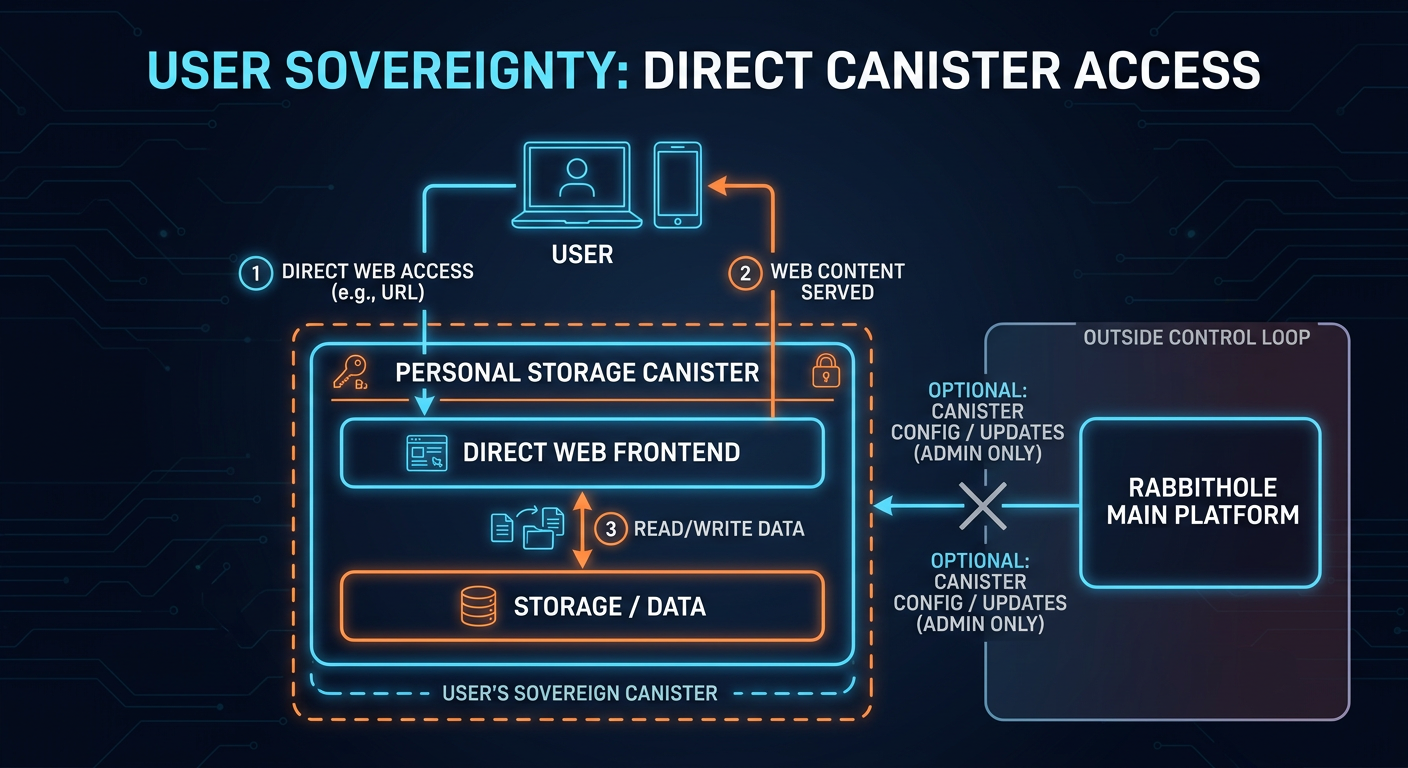
From that point forward, you are the sole controller of the canister [c]. The vault serves its own frontend directly to your browser via your unique canister URL (https://<canister-id>.icp.net) [c]. You can inspect it, fund it with cycles, take snapshots, and update it directly—completely bypassing the main Rabbithole platform [c].
The Tech Stack: Deep Integration with the Internet Computer
Rabbithole's creator rebuilt the platform to leverage the full, modern capabilities of the Internet Computer ecosystem [c]:
- vetKeys Cryptography: File-key derivation is performed in the browser using the IC's native vetKeys framework, keeping encryption keys entirely client-side [c].
- Direct Frontends & Identity: Users authenticate using Internet Identity with target-scoped delegations to access their direct storage UI securely [c].
- Stable Memory: The storage canister uses Motoko's advanced Stable Memory libraries to keep file records, access grants, and metadata safe across canister upgrades [c].
- Chain Fusion Payments: To make funding accessible, Rabbithole utilizes Threshold ECDSA and Schnorr signatures [c]. This allows users to pay and top up their vaults using assets across multiple chains [c]:
- Internet Computer: ICP, ckUSDC, ckUSDT, ckETH [c]
- Base: ETH, USDC, USDT [c]
- Solana: SOL, USDC, USDT [c]
A Journey of Trust and Iteration
This is the third version of Rabbithole built by its developer, a journey driven by the personal realization that decentralized storage apps often fail the trust test [c].
An early 2019 version built on Blockstack broke when underlying wallet APIs changed, forcing the developer to manually recover their own files from raw code [c]. A 2023 prototype on the IC struggled with the ecosystem's early limitations, relying on complex indexing and a shared frontend [c].
Today’s release is the culmination of a mature IC ecosystem, leveraging robust Motoko libraries, on-chain Blob Storage, and secure cross-chain RPCs [c].
Monetization and the Roadmap Ahead
Giving users complete control over their infrastructure presents an interesting business challenge: since users do not need Rabbithole's main website after setup, monetization must be thoughtfully structured [c].
Rabbithole features a generous Starter Vault with storage limits designed for personal use [c]. A Pro subscription unlocks features that rely on the central application canister, such as managed cycles top-ups, a shared access directory with verified emails, and automated canister updates via GitHub-based releases [c].
With future roadmap plans exploring WebSockets, in-app email verification, and a granular Blob Storage management page, Rabbithole is paving a viable, practical path toward true digital sovereignty [c].


Get the wire in your inbox
Every new signal, straight from the generator. No noise, unsubscribe anytime.