Rosetta 2’s Last Stand: How macOS 27 Golden Gate Kills the Intel Mac
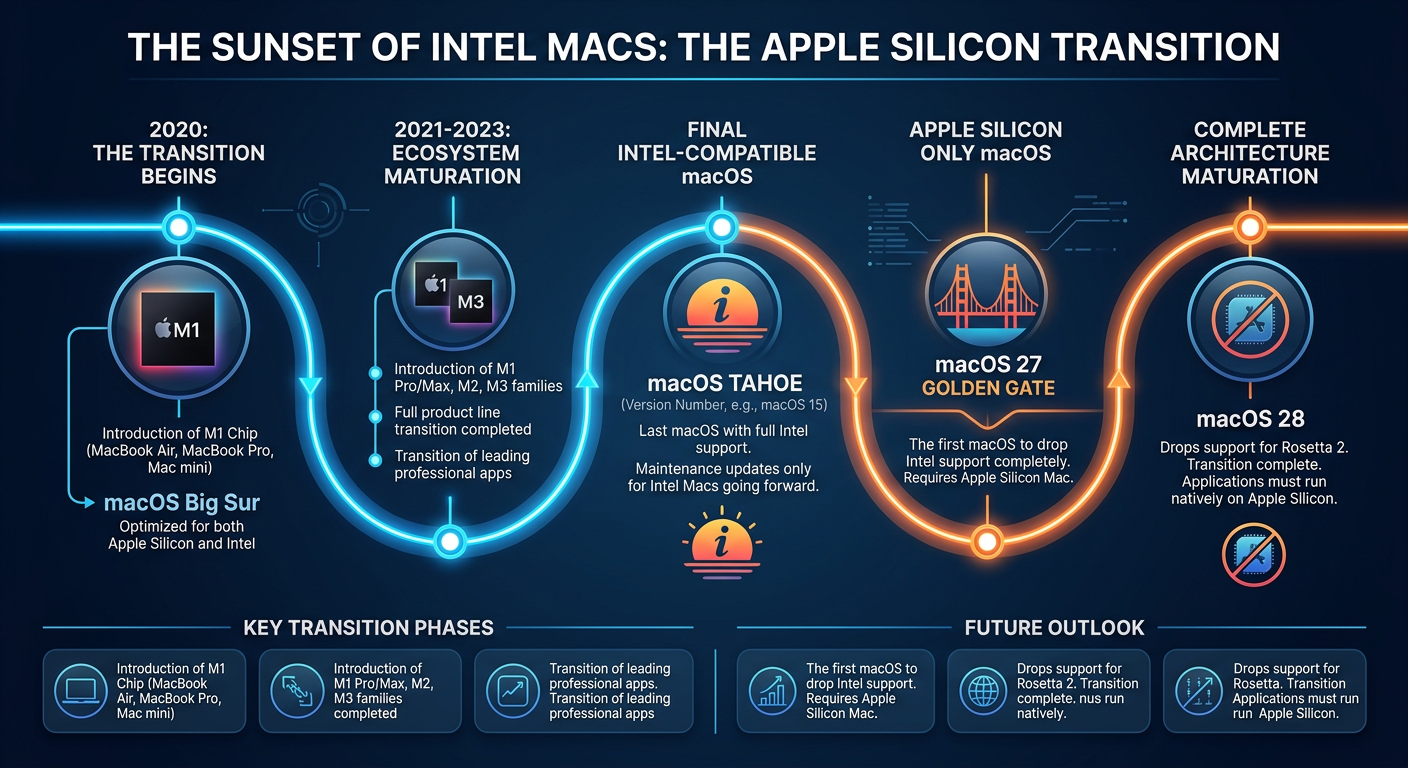
Apple's newly unveiled macOS 27 Golden Gate has officially severed ties with the Intel architecture, requiring an M1 chip or newer to run. Furthermore, the update marks the final resting place for Rosetta 2, starting the official countdown for legacy x86_64 apps.

Rosetta 2’s Last Stand: How macOS 27 Golden Gate Kills the Intel Mac
When Apple first announced its transition to custom silicon in late 2020, it kicked off a ticking clock for Intel-based hardware. Six years later, the final nail has been driven into the coffin. Hidden within the developer documentation for the newly unveiled macOS 27 Golden Gate, Apple has officially declared that Intel Macs are dead, and legacy x86_64 software is officially on borrowed time.
The Apple Silicon Cutoff: Left Behind at Tahoe
With macOS 27 Golden Gate, Apple has restricted installation exclusively to Macs powered by its own M-series processors. This makes macOS 26 Tahoe the definitive end of the road for the last surviving Intel-based machines.
If you are still running any of the following models, you will not be able to upgrade to Golden Gate this fall:
- 13-inch MacBook Pro (2020, Four Thunderbolt 3 Ports)
- 16-inch MacBook Pro (2019)
- 27-inch iMac (2020)
- Mac Pro (2019)
While these legacy machines will continue to receive security patches for up to three years, they are entirely shut out from macOS 27's software updates and next-generation features.
Rosetta 2's Last Stand
The hardware cutoff is only half of the story. For Apple Silicon owners, macOS 27 is also a critical milestone: it is the final version of macOS with full Rosetta 2 functionality.
Rosetta 2—the background translation layer enabling Apple Silicon to run older apps compiled for Intel chips—will be severely scaled back or entirely removed starting with macOS 28 in 2027. To ease users into this transition, Apple has turned off the automatic installation of Rosetta 2 in Golden Gate and introduced a highly visible warning dashboard.
Under System Settings > About, a new "Intel-Based Apps" tab now scans your system and displays a list of active Intel-only binaries. It serves as a stern warning: these apps will not launch on macOS 28 next year.
Collateral Damage: Boot Camp and AFP Are Dead
Because macOS 27 no longer compiles or structures itself to accommodate Intel CPUs, Boot Camp has been completely removed. For users who still utilized native Windows partitioning on older hardware, the partition tool is gone for good.
Additionally, Apple has officially stripped away support for the legacy Apple Filing Protocol (AFP)—a standard dating back to System 6. This officially breaks network-attached storage compatibility for vintage backup drives like the AirPort Time Capsule.
If your workflow relies on legacy Intel plugins, now is the time to find Apple Silicon native alternatives or prepare your migration before macOS 28 breaks them for good.


Get the wire in your inbox
Every new signal, straight from the generator. No noise, unsubscribe anytime.