
Teaching AI to Code Web3: DFINITY Launches 'ICP Skills' for Hallucination-Free AI Development
DFINITY has launched 'ICP Skills,' a dedicated registry of agent-readable implementation standards designed to eliminate AI hallucinations. By bridging the gap between AI coding agents and Web3 paradigms, developers can now deploy production-ready canisters to the Internet Computer with a single natural language prompt.
Key takeaways
- • DFINITY has launched 'ICP Skills,' a dedicated registry of agent-readable implementation standards designed to eliminate AI hallucinations
- • By bridging the gap between AI coding agents and Web3 paradigms, developers can now deploy production-ready canisters to the Internet Computer with a single natural language prompt

Teaching AI to Code Web3: DFINITY Launches 'ICP Skills' for Hallucination-Free AI Development
The developer landscape has fundamentally shifted toward "vibe coding" with AI assistants like Claude Code, Cursor, and Windsurf. Yet, while these tools excel at standard web stacks, they historically struggle when writing code for decentralized platforms. The Internet Computer Protocol (ICP), with its unique paradigms like orthogonal persistence, a custom Motoko language, and asynchronous inter-canister calls, has been a notorious minefield for AI hallucination.
To bridge this cognitive gap, the DFINITY Foundation has officially launched ICP Skills (skills.internetcomputer.org). This first-of-its-kind, open-source library acts as an agent-readable manual, giving AI coding agents instant, mathematically accurate expertise on ICP architecture without manual configuration.
The AI-to-Web3 Translation Layer
Traditional technical documentation is written for human eyes, meaning AI agents must parse and synthesize raw text on the fly. This often leads to agents hallucinating deprecated APIs (like the old dfx command-line instead of the newly rolled-out icp-cli), generating incorrect canister IDs, or introducing critical security flaws in state management.
ICP Skills resolves this by utilizing the llms.txt standard—a machine-readable format popularized by Anthropic, Vercel, and Stripe.
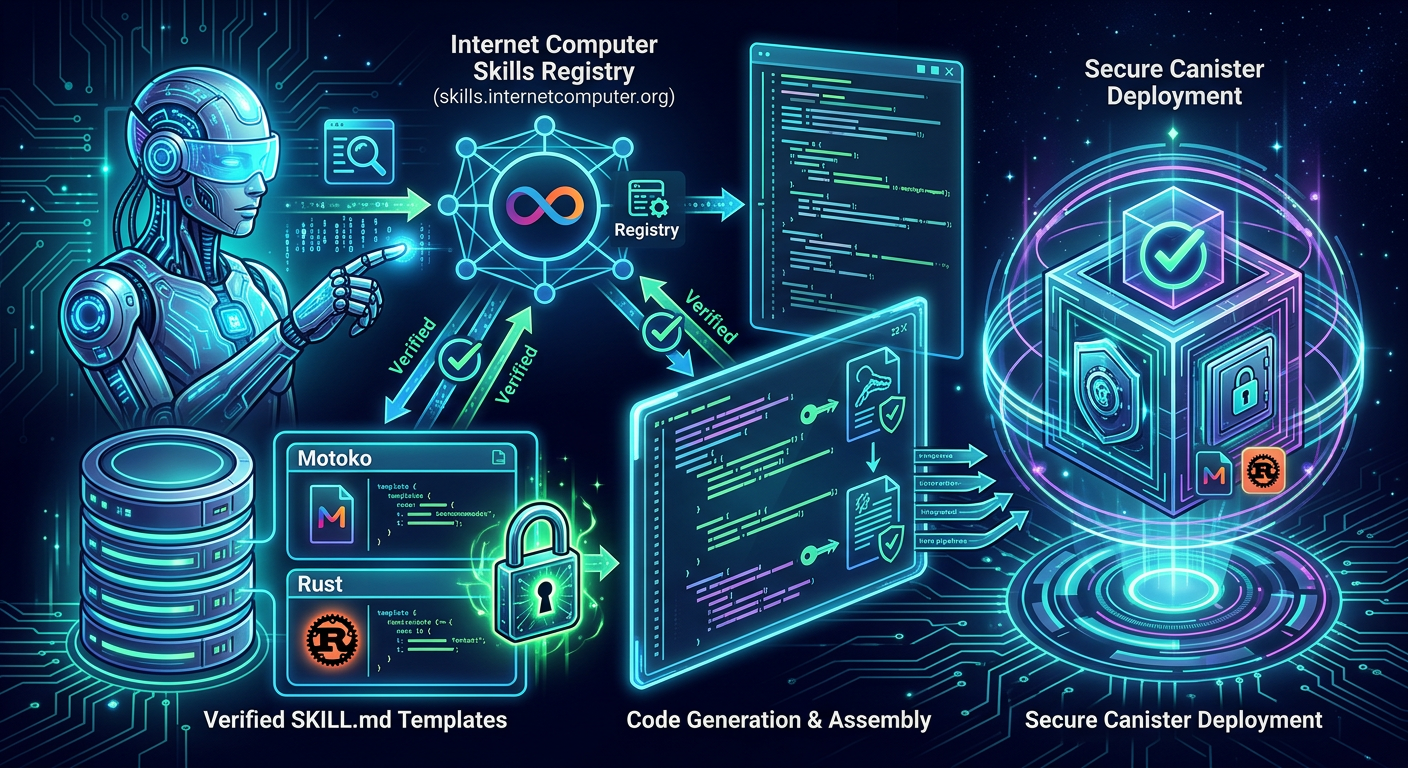
When an AI agent is instructed to build on the Internet Computer, it fetches the skills index to dynamically ingest verified dependency versions, configuration formats, and—critically—known structural pitfalls.
How It Works Under the Hood
Integrating ICP Skills into an active development environment takes less than 90 seconds. Developers can prompt their coding agent with a single instruction:
"Fetch skills.internetcomputer.org and follow its instructions when building on ICP."
Alternatively, developers can pull the skills repository locally using the command-line interface:
npx skills add dfinity/icskills
Once executed, the agent automatically maps its tasks to over 17 (and expanding) production-ready skills. These cover:
- Core Canister Architecture: Correct patterns for inter-canister calls and managing 2MB payload limits.
- State & Upgrades: Guidance on using stable memory structures (like Rust's
StableBTreeMap) to prevent data loss during upgrades. - DeFi & Token Integration: Correct standards for ICRC ledgers and native ckBTC integrations.
- On-Chain Security: Safeguards against cycle drain attacks and reentrancy loops.
Unleashing the Self-Writing Internet
By offering structured, agent-friendly instructions directly from the protocol creators, DFINITY is dramatically lowering the entry barrier for Web3 developers. Developers no longer need to exhaustively teach their AI agents the intricacies of the Internet Computer. Instead, they can focus entirely on directing the vision, leaving the agent to securely write, test, and deploy decentralized serverless applications directly to the on-chain mainnet.
Tags
Grounded sources & citations
What to read next

The "Friday the 13th" Bug: Inside the ckBTC Double-Minting Postmortem

The Battle Over Geopolitics in Web3: Inside Internet Computer’s Rejected "G20 Subnet" Proposal

The Double-Time Shift: Why Internet Computer's Internet Identity is Moving to a Twice-Weekly Release Cadence
Enjoyed this? Get the next one
Subscribe to the newsletter and the next playbook lands in your inbox — no spam, unsubscribe anytime.