The Composition Layer Arrives: What OpenVM 2.0’s Deferrals Mean for zkVM Builders
OpenVM 2.0.0 introduces “deferrals,” a mechanism intended to compose specialized ZK circuits with general-purpose zkVM computation. The important change is architectural: builders can aim to keep expensive primitives in tailored circuits while using a zkVM for the surrounding logic.
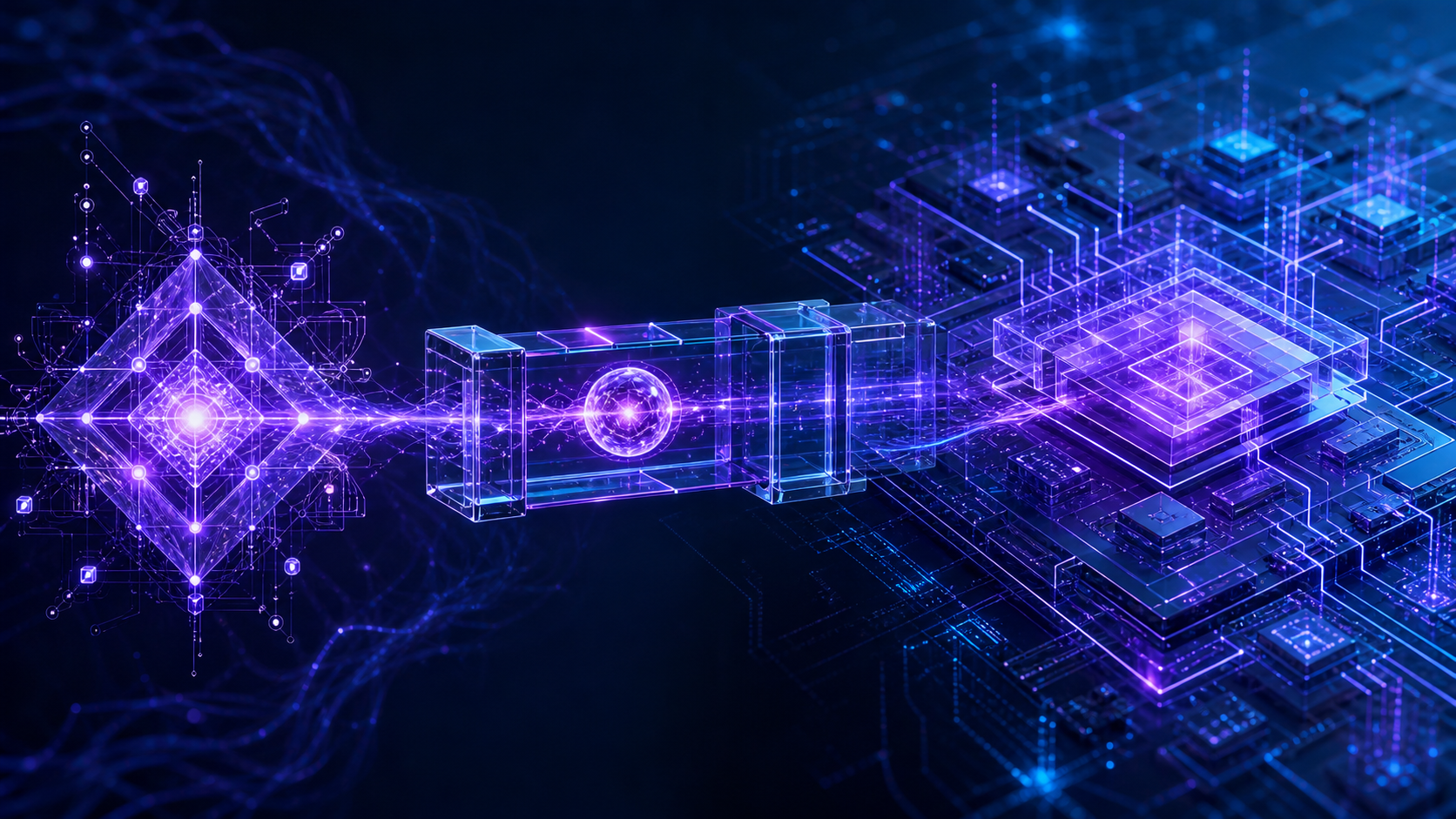
A bridge between specialized circuits and general computation
OpenVM’s July 10 production release is more than a prover-speed update. Its key developer-facing addition is “deferrals”: a framework intended to let an OpenVM guest program verify a ZK proof produced by a specialized circuit, then compose that result with general-purpose computation inside an OpenVM proof.
The v2.0.0 release notes make the implementation scope more concrete. They introduce the SWIRL proof system in the STARK backend, a recursive verifier circuit, a continuation-aggregation pipeline, and a deferral framework that includes a verify-stark path for guest programs. In practical terms, this gives builders a route to combine a purpose-built proof with Rust-oriented zkVM logic instead of forcing every part of an application into one proving style.
Why that matters
Different parts of a ZK application have different performance profiles. A narrowly defined operation may justify a custom circuit; state handling, policy checks, data preparation, and output processing may be easier to express as ordinary program logic. Deferrals are OpenVM’s attempt to make those choices composable.
OpenVM’s own rollup example is proof aggregation: chunk proofs can be verified by an OpenVM program and folded into a single proof for final on-chain verification. The announcement also identifies verified AI inference as a future use case, where an efficient specialized circuit could prove inference while the zkVM handles surrounding business logic. That is a design direction, not evidence that a complete verified-AI product has shipped.
The release’s framing is therefore significant: zkVMs need not compete with every specialized circuit. They can become the coordination layer that checks and joins proofs from specialized components.
Security and performance claims need careful boundaries
OpenVM says v2.0.0 completed an external zkSecurity audit covering SWIRL, aggregation and continuation circuits, deferrals, the Halo2 verifier, and changes to SHA-2 and Keccak extensions. It also says formal-verification coverage now includes the Keccak and SHA-2 extensions alongside the previously verified RV32IM extension.
The project reports that initial deferral overhead starts at one second for one proof and can fall to 300 milliseconds for 32 proofs. Separately, it reports Ethereum-block proving benchmarks over 7,200 mainnet blocks beginning at block 24,000,000, including a 6.3-second p99 on 16 RTX 5090 GPUs and a 9.8-second p99 on eight such GPUs.
Editorial caveat: OpenVM’s production-readiness statement applies to its core release. The separate openvm-eth benchmark repository says it is an active work in progress, unaudited, and not intended for production use. The reported proving latencies are OpenVM benchmark results on specified RTX 5090 GPU clusters and are not independently replicated here.
The practical takeaway
For ZK engineers, the immediate question is not whether every workload should move to OpenVM. It is whether a workload benefits from separating its most performance-sensitive proof into a specialized circuit while keeping the rest of the computation programmable. OpenVM 2.0 makes that hybrid architecture an explicit product surface—and its adoption will depend on how well the available proof paths, tooling, audits, and real deployment experience hold up.

Get the wire in your inbox
Every new signal, straight from the generator. No noise, unsubscribe anytime.