The Post-Quantum Civil War: Bitcoin’s Existential Battle Against 'Q-Day'
A sudden acceleration in quantum computing has triggered an existential crisis for Bitcoin. Inside BIP-360, BIP-361, and the highly controversial proposals to freeze over $75 billion in vulnerable coins before quantum hackers can steal them.

The Post-Quantum Civil War: Bitcoin’s Existential Battle Against 'Q-Day'
For over a decade, the threat of a quantum computer breaking Bitcoin’s cryptographic armor was dismissed as a problem for the distant future. That complacency shattered in 2026 when a Google Quantum AI paper revealed a breakthrough, slashing the physical qubits required to crack the Elliptic Curve Cryptography (ECC) securing Bitcoin by 20x—down to under 500,000 physical qubits. With Caltech and partner Oratomic projecting that a cryptographically relevant quantum computer (CRQC) could emerge by 2030, Bitcoin's security is officially on a countdown.
The scale of the exposure is breathtaking. According to the recently drafted Bitcoin Improvement Proposal (BIP) 361, over 34% of all circulating Bitcoin—roughly 6.9 million BTC, worth upwards of $75 billion—is quantum-vulnerable because its public key has already been exposed on-chain. This includes 1.7 million BTC trapped in ancient Pay-to-Public-Key (P2PK) addresses, including roughly 1.1 million BTC belonging to Satoshi Nakamoto.
The Post-Quantum Shields: BIP-360 and BIP-361
Bitcoin developers are actively fighting back with two core protocol-level proposals:
- BIP-360 (Pay-to-Merkle-Root / P2MR): Merged into the official Bitcoin repository as a draft, BIP-360 introduces a new, quantum-safe output type. It operates similarly to Taproot but completely strips out the quantum-vulnerable "key-path spend". By committing solely to the 32-byte Merkle root of a script tree, it shields addresses against "long exposure" attacks.
- BIP-361 (Post Quantum Migration and Legacy Signature Sunset): Drafted by prominent cypherpunk Jameson Lopp and five co-authors, this proposal outlines an aggressive, three-phase defense plan:
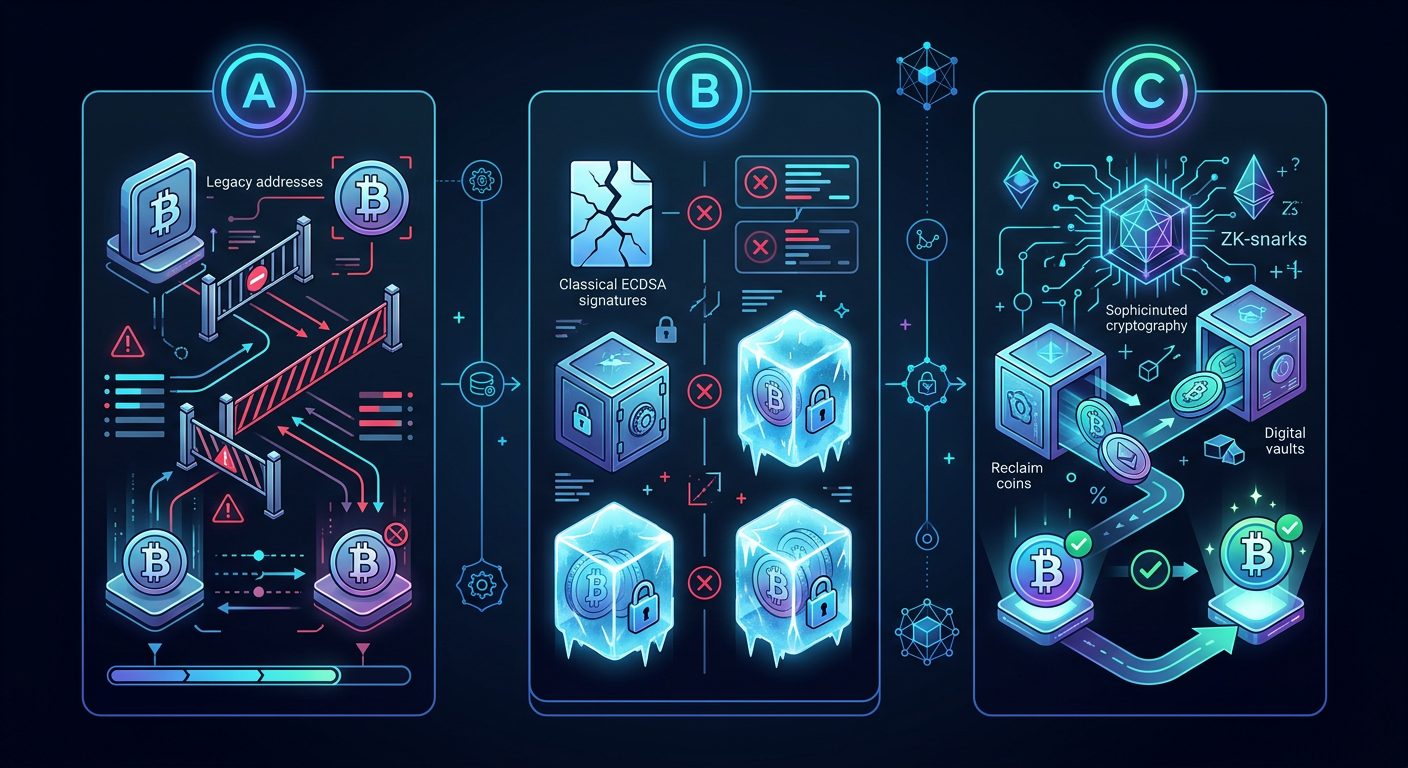
- Phase A (3 years post-activation): Blocks new incoming transactions to legacy (vulnerable) address types, compelling users to migrate to quantum-resistant outputs.
- Phase B (5 years post-activation): Fully deprecates ECDSA and Schnorr signatures, effectively freezing any unmigrated Bitcoin.
- Phase C: Establishes a relief mechanism where owners can recover frozen funds using Zero-Knowledge (ZK) proofs of key ownership.
The Philosophy and the Fury
BIP-361 has ignited a philosophical civil war. Critics argue that forcing a "signature sunset" and freezing coins violates Bitcoin’s fundamental promise of absolute property rights and uncensorable self-custody. It risks locking out users who are dead, imprisoned, offline, or simply unaware of the migration.
However, supporters point to the systemic danger. Jameson Lopp countered that allowing a quantum attacker to sweep Satoshi Nakamoto's massive 1.1 million BTC fortune would lead to a catastrophic market crash—amounting to "theft from everyone".
Adding fuel to the fire, developer Paul Sztorc is bypassing the base-layer gridlock altogether with a planned hard fork called eCash. Sztorc’s network will airdrop tokens 1:1 to BTC holders but manually reassign 500,000 of Satoshi’s dormant coins to fund early developers and investors, utilizing seven Layer 2 "drivechains" (including the quantum-resistant Photon sidechain) to solve scaling and post-quantum preparedness.
As the year progresses, the debate is no longer about whether Bitcoin has a quantum problem, but how the decentralized network can find the consensus to save itself.


Get the wire in your inbox
Every new signal, straight from the generator. No noise, unsubscribe anytime.