
Unmoving Memory: Inside Rust’s Radical In-Place Initialization and Field Projection Upgrades
The newly accepted 2026 Rust Project Goals (RFC 3935) lay the groundwork for solving two of the language's most enduring challenges: stack overflows on large allocations and the ergonomics of pinned, immovable data. Here is how in-place initialization and safe field projections are poised to redefine systems programming.
Key takeaways
- • The newly accepted 2026 Rust Project Goals (RFC 3935) lay the groundwork for solving two of the language's most enduring challenges: stack overflows on large allocations and the ergonomics of pinned, immovable data
- • Here is how in-place initialization and safe field projections are poised to redefine systems programming
Unmoving Memory: Inside Rust’s Radical In-Place Initialization and Field Projection Upgrades
While Rust’s safety guarantees are legendary, certain low-level aspects of its memory model have remained notoriously thorny. If you have ever attempted to allocate a massive array on the heap using Box::new([0u8; 10 * 1024 * 1024]), only to watch your program instantly crash with a stack overflow, you have hit one of Rust’s historical quirks: the stack-to-heap copy requirement.
Historically, Rust evaluates an expression on the stack first, then copies or moves it to its final destination. For most types, this is fine because Rust moves are trivially relocatable. However, for massive datasets, or self-referential types that must remain pinned in memory (such as asynchronous futures or Linux kernel drivers), stack-based intermediate allocation is either a performance hazard or a flat-out impossibility.
This is finally changing. With the official acceptance of the 2026 Rust Project Goals (RFC 3935), the language steering teams are executing a massive technical program themed "Beyond the &". At the heart of this push are two deeply integrated features: language-level In-Place Initialization and Safe Field Projections.
Bypassing the Stack with In-Place Initialization
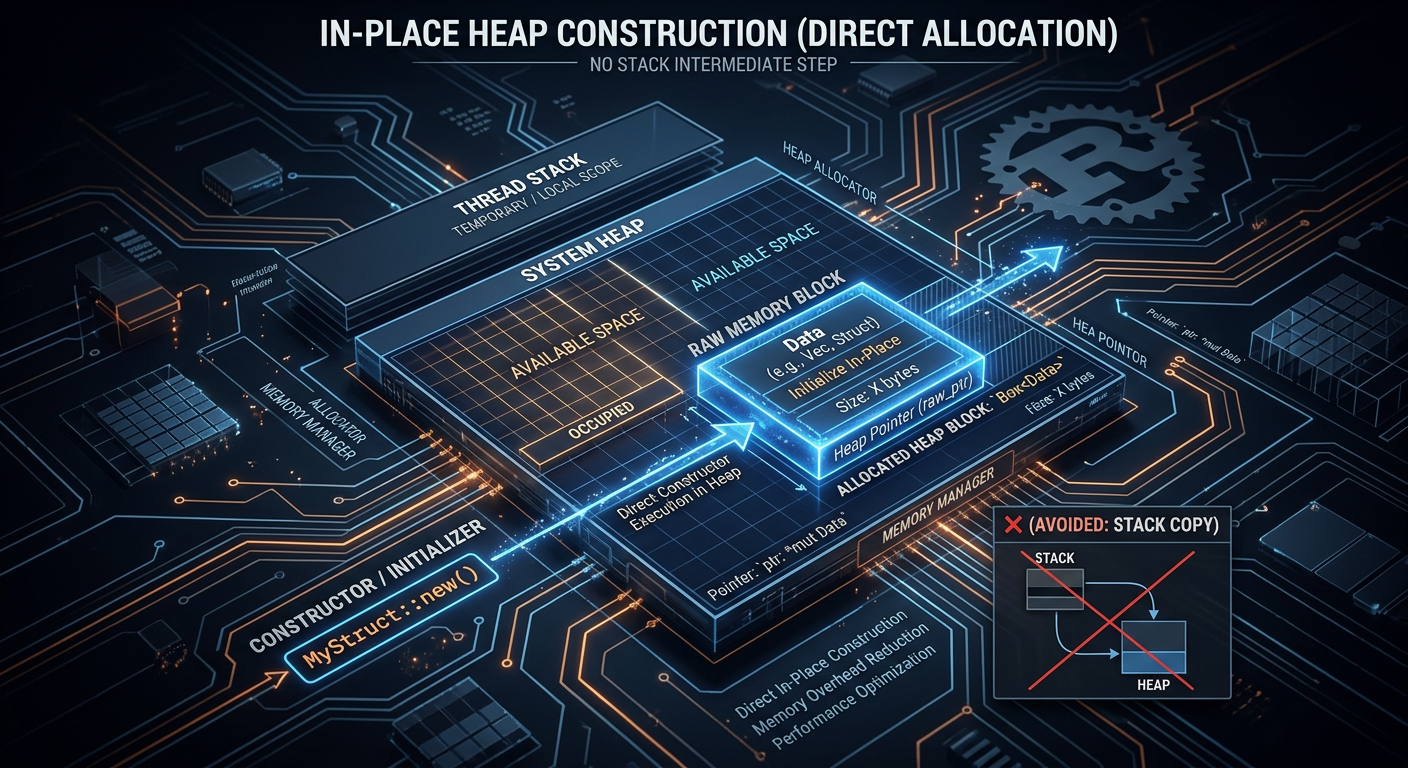
To conquer the stack-overflow hazard, Rust is experimenting with formal language-level Init<T> traits and init expressions. Instead of constructing a value on the stack and passing it, in-place initialization introduces the concept of "out-pointers".
Under this model, the caller allocates memory directly on the heap (or a custom pool) and passes a raw, uninitialized pointer to the constructor. The constructor then writes the struct's fields directly into that target memory location.

This completely eliminates the need for temporary stack space, enabling robust construction of multi-megabyte types and facilitating safe, fallible initializations.
Ergonomics Unlocked: Safe Field Projections
The second half of the puzzle addresses the painful boilerplate of custom pointers like Pin<&mut T>, NonNull<T>, or MaybeUninit<T>. If you have a pinned struct, accessing its fields typically requires unsafe code or complex macro-based crates like pin-init to project the pin from the parent struct down to the fields.
The 2026 goal seeks to stabilize a compiler-driven Field Projection mechanism. This allows developers to project a container pointer (e.g., Pin<&mut MyStruct>) directly into independent field-level pin pointers (Pin<&mut MyField>) safely, verifying that fields are projected disjointly and preventing the borrow checker from throwing spurious errors.
Driving Rust for Linux and C++ Interop
These upgrades are not merely academic; they are the primary catalysts to advance Rust for Linux (RfL) and C++ Interop into stable production.
Kernel-level programming demands strict control over memory layout. Immovable, pinned C-structs must be populated directly within pre-allocated kernel slabs. Similarly, C++ relies heavily on user-defined move constructors rather than trivial byte-copies. In-place construction gives Rust the vocabulary to invoke C++ constructors natively, transforming complex FFI boundaries into a unified, safe abstraction.
By formalizing these features, Rust is evolving beyond standard reference rules to provide unparalleled, safe control over physical memory.
Tags
Grounded sources & citations
What to read next

The Self-Auditing OS: Inside Ubuntu's Bold Rust-First Security and cargo-auditable Revolution

The 1.0 Maturity Era: How Zed and Iroh Are Redefining Rust-Native Infrastructure

The WebAssembly Divorce: Why Rust Finally Killed `--allow-undefined`
Enjoyed this? Get the next one
Subscribe to the newsletter and the next playbook lands in your inbox — no spam, unsubscribe anytime.