Beyond Blockchains: How Autheo’s Layer-0 "Living OS" is Curing Web3’s Fragmentation Crisis
Autheo is debuting a revolutionary Layer-0 Operating System with an integrated Layer-1 blockchain. Unveiled as the headlining sponsor for ETHToronto 2026, this infrastructure-first protocol natively unites identity, compute, storage, and AI orchestration to eliminate piecemeal dApp integration.

Beyond Blockchains: How Autheo’s Layer-0 "Living OS" is Curing Web3’s Fragmentation Crisis
For years, Web3 developers have been forced to act like digital mechanics, painstakingly stitching together disjointed infrastructure layers. To launch a single decentralized application, a developer historically had to tether together a Layer-1 consensus network, an external file storage protocol, a separate decentralized identity solution, and complex cross-chain bridges.
This piecemeal architecture hasn't just slowed down development—it has introduced critical security vulnerabilities and operational friction. Now, a major paradigm shift is underway.
At the upcoming ETHToronto 2026 (slated for July 22 during Canada Crypto Week), Autheo has been announced as the top headline sponsor, showcasing its highly anticipated Layer-0 Operating System with an integrated Layer-1 blockchain. Autheo's bold objective? To completely replace fragmented dApp infrastructure with a unified, "living" operating system.
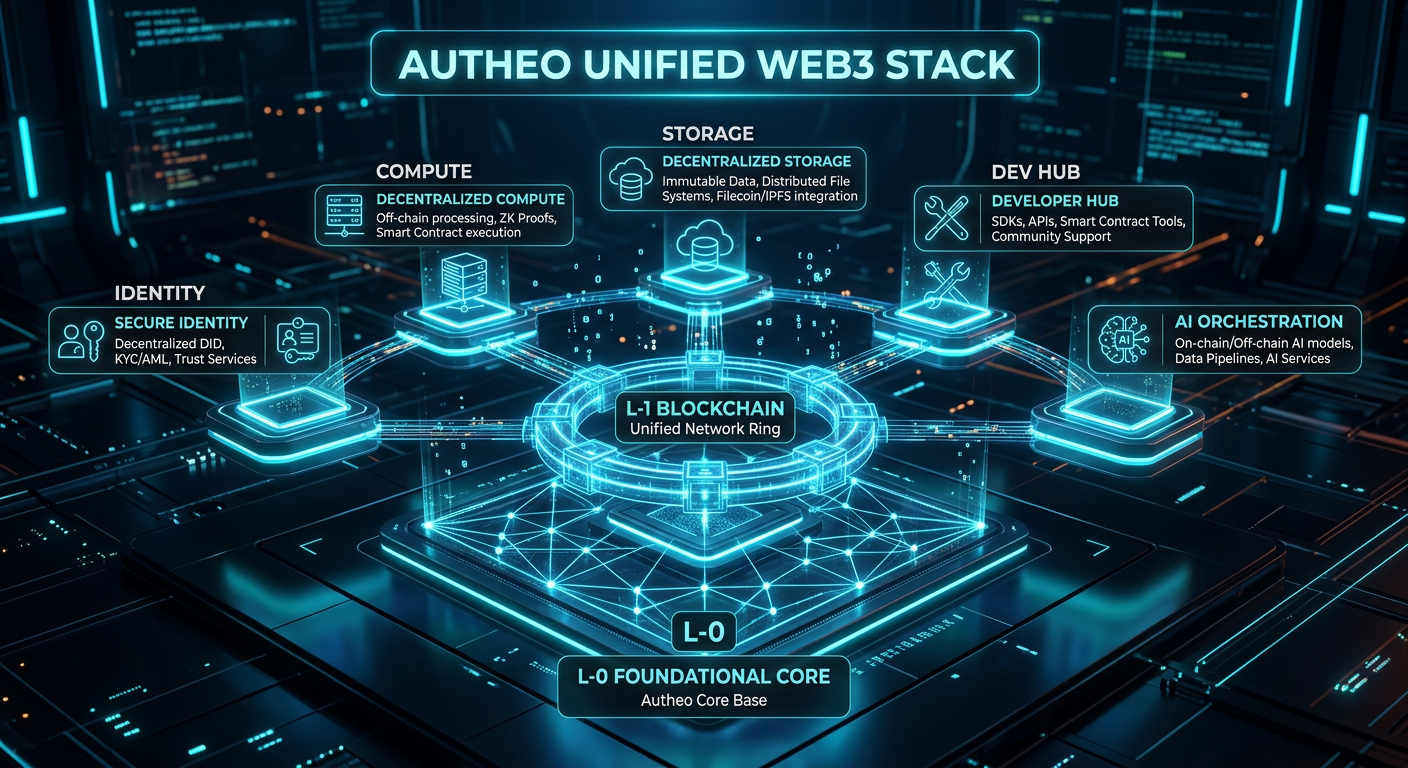
The Six Core Pillars of a Living Network
Rather than operating solely as another transactional ledger, Autheo operates as a Layer-0 coordination fabric that sits directly beneath its high-performance Cosmos-SDK Layer-1 blockchain. It natively embeds everything a developer needs directly into the runtime environment:
- TheoID: Post-quantum secure, self-sovereign authentication for people, digital assets, and automated agents.
- DCC (Decentralized Compute): On-demand, trustless computation layers that execute off-chain but validate seamlessly on-chain.
- ABW34 Persistent Storage: Built-in, high-efficiency decentralized storage that removes the need to manually connect external networks.
- THEO AI: Native AI orchestration that embeds autonomous AI agents directly into the smart contract execution environment.
- DevHub: A developer workspace allowing builders to deploy smart contracts utilizing Solidity, Move, Vyper, Rust, Go, or TypeScript in one environment.
- Unified Layer-0/L1 Execution: Full EVM compatibility coupled with native Inter-Blockchain Communication (IBC) to connect seamlessly to more than 200 Cosmos chains.
Why the Developer Experience is Shifting in 2026
"Builders and developers are the foundation of every major innovation in Web3," said Edward Johnson, Chief Product Officer of Autheo, ahead of the ETHToronto event. "We're proud to help bring together the community, creating the next generation of sovereign decentralized applications, infrastructure, and AI-powered technologies."
In mid-2026, the Web3 market has matured past speculative hype and toward solving real-world, legally complex, and expensive business problems. By packaging identity verification, geofencing, GDPR compliance, and decentralized storage directly into the base network architecture, Autheo is lowering the technical barrier for enterprise adoption. When a developer builds on Autheo, their dApps inherit these security and compliance layers by default, without requiring custom-written integration scripts.
As Web3 transitions from a world of isolated blockchain islands to a fully integrated, intelligent web, Autheo’s "Living OS" represents a massive step toward making the decentralized stack as cohesive, secure, and user-friendly as traditional Web2 operating systems.


Get the wire in your inbox
Every new signal, straight from the generator. No noise, unsubscribe anytime.