The Dawn of Walrus: How Mysten Labs’ New Protocol is Rewriting Web3 Storage
Mysten Labs' Walrus Protocol has emerged as a major infrastructure force in 2026. Driven by its innovative 'RedStuff' erasure coding and a $140M war chest, it introduces programmable, high-performance decentralized storage for the AI and Web3 eras.

The Dawn of Walrus: How Mysten Labs’ New Protocol is Rewriting Web3 Storage
For years, decentralized storage has been the persistent Achilles' heel of the Web3 ecosystem. While protocols like Filecoin have chased enterprise data deals and Arweave has offered permanent storage, developers have struggled with a harsh trade-off: pay astronomical premiums for data durability, or accept complex "pinning" structures that risk data loss if nodes drop offline.
In 2026, the landscape has fundamentally shifted. Armed with a massive $140 million fundraising round led by a16z Crypto, Standard Crypto, and Franklin Templeton, Walrus Protocol—developed by Mysten Labs—has emerged as a major, high-performance decentralized storage and data availability network.
By replacing passive, expensive data hosting with highly resilient, "programmable blobs," Walrus is positioning itself as the silent dependency that is powering the next generation of decentralized applications and AI workloads.
RedStuff: The Two-Dimensional Mathematical Breakthrough
At the heart of Walrus’s efficiency is RedStuff, a custom, two-dimensional erasure coding scheme that dramatically challenges the economics of distributed storage.
Traditional decentralized storage models rely on heavy replication—either storing full copies of files across dozens of nodes (which is robust but highly expensive) or using one-dimensional Reed-Solomon coding. RedStuff solves this by dividing unstructured data blobs into primary and secondary "slivers," mapping them across a dynamic matrix of storage nodes.
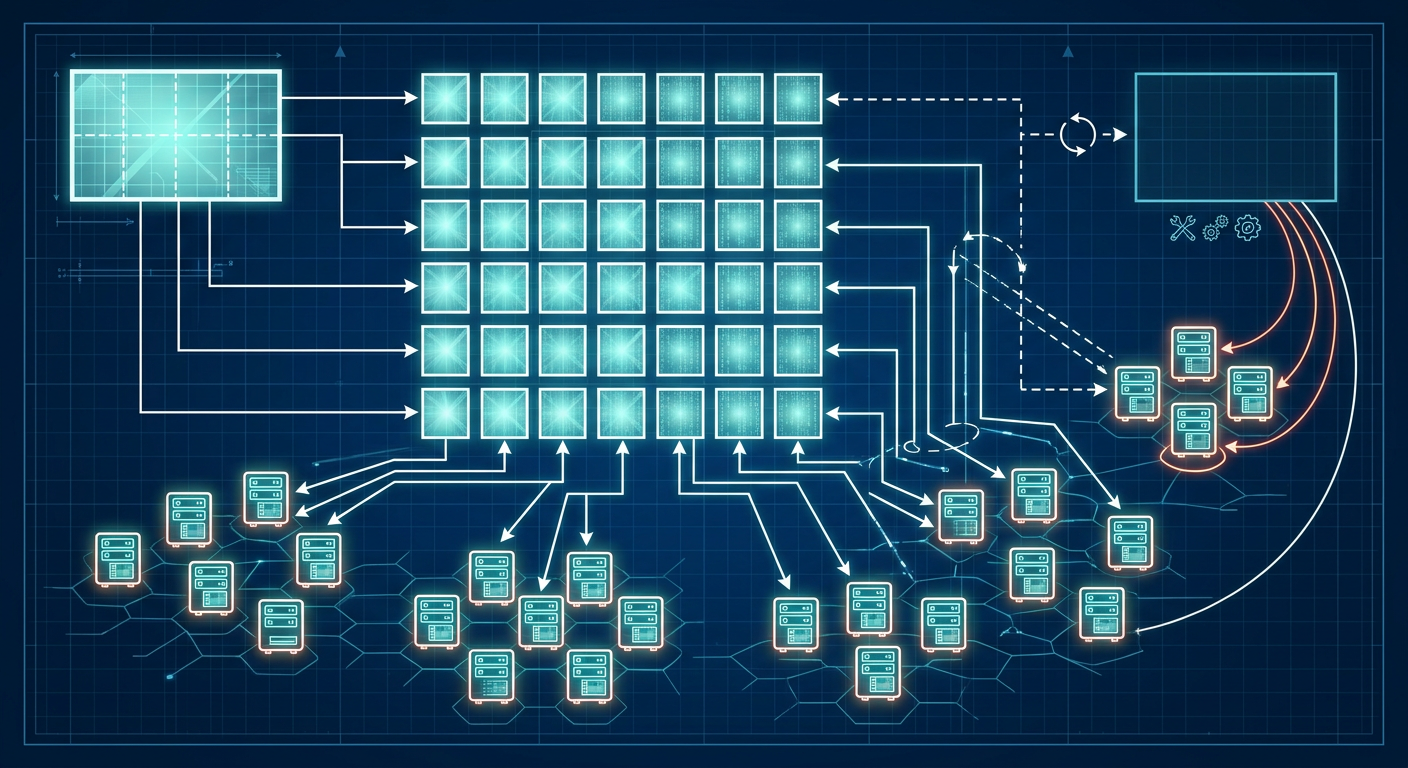
The result is staggering: Walrus achieves industry-leading data availability and fault tolerance with only a 4x to 5x replication factor. Crucially, if a node fails, the remaining nodes can reconstruct the missing data by downloading only the lost fragments. This reduces recovery bandwidth scaling to $O(\text{blob size}/n)$ rather than the heavy $O(\text{blob size})$ of older networks. In practice, Walrus can recover stored files even if up to two-thirds of the network's storage nodes crash or turn adversarial.
From Passive Files to "Programmable Blobs"
What truly separates Walrus from its predecessors is its integration with the Sui blockchain. On Walrus, stored files are not merely passive archives. Instead, every uploaded blob is registered on-chain as a native Sui Move object.
This unlocks programmable storage. Smart contracts can directly reference, verify, and execute logic based on stored data without relying on external, off-chain indexers. Whether it is updating dynamic metadata for an on-chain game, serving entire frontend interfaces natively via "Walrus Sites," or utilizing client-side threshold encryption through the Seal API, Walrus bridges the physical data layer and the blockchain's state layer seamlessly.
Powering the Decentralized AI Era
The timing of Walrus's 2026 maturity could not be better. As autonomous AI agents and decentralized machine learning models require vast amounts of data, they need a secure repository that offers both immense scale and verifiability.
Walrus has quickly become the go-to layer for storing immutable AI training datasets, model weights, and transparent inference logs. By certifying the provenance of datasets natively on-chain, Web3 AI protocols can operate with auditability and complete trust.
With major integrations already live—such as prominent Web3 media outlet Decrypt and top Sui NFT marketplace TradePort natively storing assets on the network—the era of passive, siloed data is officially over. Web3 has finally found its high-performance, programmable data layer.


Get the wire in your inbox
Every new signal, straight from the generator. No noise, unsubscribe anytime.