The Visa-to-Web3 Bridge: Alchemy and Turnkey Launch the Agentic Commerce Identity Layer
Web3 infrastructure is undergoing a massive shift to support autonomous AI. With Alchemy integrating its AgentCard with Visa Intelligent Commerce and Turnkey launching enclave-secured Agentic Payments, AI agents now have the secure identities and credit rails needed to independently transact in both crypto and fiat economies.

The Visa-to-Web3 Bridge: Alchemy and Turnkey Launch the Agentic Commerce Identity Layer
The missing link for AI agents has always been the wallet. If you give an AI agent a private key, you have handed it the keys to your digital kingdom. If you hand it a traditional credit card, you risk your entire bank account to an unaligned algorithm.
But in June 2026, the paradigm is shifting. Web3 infrastructure is quietly moving away from speculative tokenomics toward solving one of the most critical bottlenecks of the digital age: agentic identity and payments. Two major Web3 infrastructure milestones have just laid down the rails for AI agents to safely, legally, and autonomously buy goods and services on our behalf.
Alchemy’s AgentCard: The Visa Passport for AI
On June 18, 2026, Alchemy took a massive leap toward mainstream agentic commerce by integrating its AgentCard platform with Visa Intelligent Commerce.
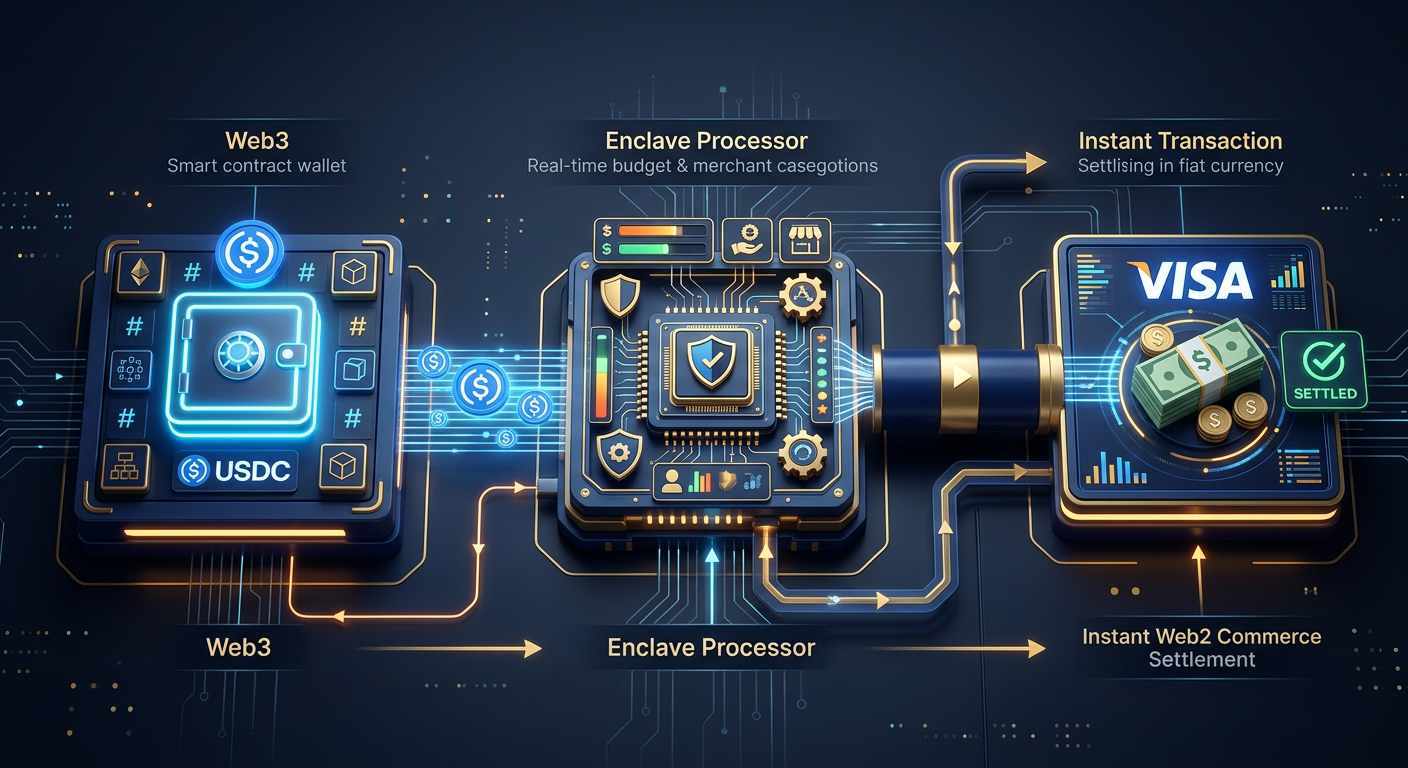
AgentCard functions as an all-in-one payment and identity stack for AI. Setup takes under a minute via a single API. Once deployed, any AI agent (built on models like OpenAI’s GPT or Anthropic’s Claude) is provisioned with a secure digital identity—complete with a Visa payment token, a dedicated email address (agentcard.email), a phone number, and a Web3 crypto wallet.
What makes AgentCard a true Web3 paradigm shift is its dual-layered settlement routing:
- The Web3 Capital Layer: The agent holds its funds in stablecoins (like USDC).
- The Web2 Merchant Layer: Using Visa’s network, the agent can spend these funds at over 150 million traditional merchants worldwide. The system handles the real-time conversion from crypto to fiat, allowing an agent to book a vacation, buy groceries, or pay for API keys while preserving credit card benefits and rewards for the human owner.
Importantly, developers can configure real-time spend limits, merchant category restrictions, and customizable budgets, ensuring the AI never goes rogue with its wallet.
Turnkey’s Agentic Payments: Enclave-Secured Signing
While Alchemy bridges the card networks, Turnkey is tackling raw, on-chain execution. On June 26, 2026, Turnkey launched Agentic Payments, a production-ready infrastructure layer designed to let agents transact natively on-chain without ever accessing their own raw private keys.
Turnkey’s solution moves key management entirely into secure enclaves (hardware-backed Trusted Execution Environments). The agent authenticates via an API key, and Turnkey processes the on-chain signature in a highly restricted, isolated environment.
Turnkey’s architecture delivers:
- Sub-100ms Latency: Enclave-native signing is up to 100x faster than traditional Multi-Party Computation (MPC), allowing agents to execute time-sensitive DeFi swaps and automated treasury management instantly.
- Gas Sponsorship: The infrastructure natively supports gas abstraction, meaning agents don't need to maintain separate gas tokens to interact with various blockchains.
Fintechs like Catena are already adopting Turnkey's framework to run autonomous agentic corporate banking.
The Big Picture: Software as Sovereign Economic Actors
We are transitioning from an internet where AI merely recommends what to buy, to one where AI has its own identity, credentials, and financial rails. By combining Web3’s trustless smart-wallet logic with legacy financial networks, the decentralized web is no longer just a parallel financial system—it is the operating system for the next generation of autonomous digital commerce.


Get the wire in your inbox
Every new signal, straight from the generator. No noise, unsubscribe anytime.