Beyond JSON: How RemoteCompose Redefines Server-Driven Android UI
Explore how Google is redefining Server-Driven UI and widget development with RemoteCompose. By serializing Jetpack Compose canvas commands into compact binary streams, this new AndroidX framework brings native, lag-free UI updates without app store releases.

Beyond JSON: How RemoteCompose Redefines Server-Driven Android UI
For years, mobile developers chasing a dynamic user experience have faced a harsh compromise. If you wanted to tweak a layout, adjust a promo banner, or run an A/B test, you had two choices: push an app update through a multi-day review cycle, or deploy a fragile Server-Driven UI (SDUI) framework relying on massive JSON schemas and complex client-side parsers. While WebViews offered some flexibility, they did so at the cost of catastrophic memory overhead, poor gesture handling, and sluggish rendering.
Following the latest Google I/O developments, the Android team has quietly released the ultimate solution: RemoteCompose (androidx.compose.remote), an official framework that completely redefines how UI is streamed, compiled, and rendered on mobile devices.
Canvas-Level Serialization: No More JSON Parsing
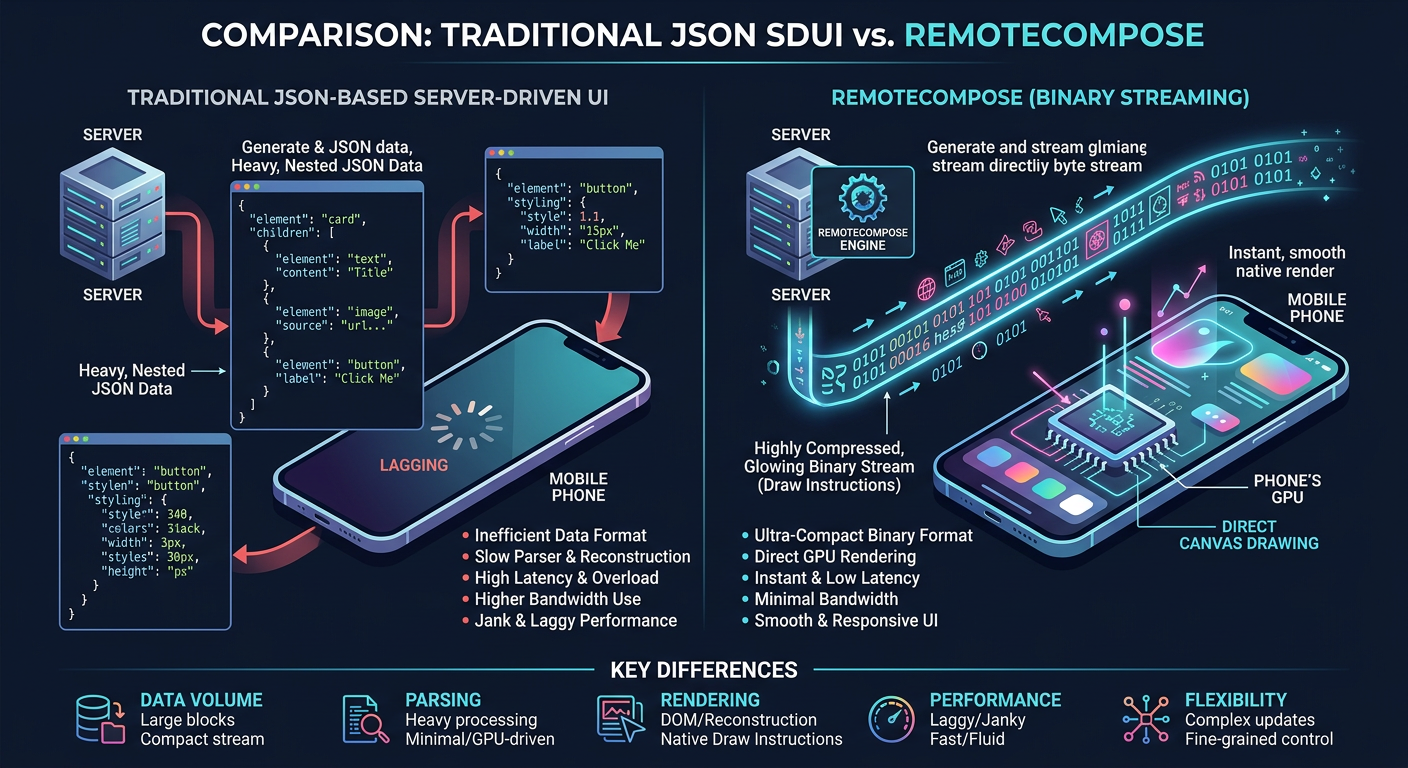
Unlike traditional SDUI approaches, which require both the server and client to agree on a pre-defined catalog of component schemas, RemoteCompose operates at the lowest level of Android's rendering pipeline: the Canvas.
On the backend, developers use a pure-JVM Kotlin Multiplatform DSL to write Jetpack Compose code. Instead of producing pixels, a RemoteComposeWriter intercepts these draw operations and serializes them into a highly compressed, self-contained binary payload (a ByteArray). The framework maps UI definitions to over 93 distinct canvas-level operations—covering shapes, gradients, vectors, shadows, text, and gesture boundaries.
The client app acts as a lightweight "player". When it receives the bytes, it skips JSON decoding entirely, passing the binary directly to the GPU for native canvas rendering. The result is instant, lag-free UI with pixel-perfect Material 3 compliance.
Intelligent, Time-Based Logic on Device
RemoteCompose is not limited to static layouts. It features a built-in state-management system and an animation engine that operates independently of the host app.
By parsing mathematical expressions directly inside the binary payload, the local player can calculate variable changes over time. Developers can implement complex, time-based animations—such as custom particle effects, elastic transitions, and spring animations—using algebraic functions like sin, cos, lerp, and clamp compiled straight into the streamed bytes.
The New Engine for Jetpack Glance and Wear OS
Google is already proving the capabilities of RemoteCompose by integrating it directly into Jetpack Glance, the widget developer framework. Starting with Android 17, Glance utilizes RemoteCompose to power home screen widgets, Wear OS tiles, and Android Auto dashboard surfaces.
- Fluid Resizing: As users drag to scale their widgets, layouts fluidly recalibrate in real time without layout jumps or content clipping.
- Ultra-low Battery Overhead: Because the binary layouts are executed directly by the system layer, RemoteCompose eliminates the need to constantly wake up or run background processes for host apps.
- Seamless Smartwatch Wear Widgets: Wear OS tiles can now render highly interactive logic natively on low-power hardware, significantly boosting wearable battery life.
With RemoteCompose, Android has achieved the holy grail of mobile development: the agility of the web with the flawless, buttery performance of native Jetpack Compose.


Get the wire in your inbox
Every new signal, straight from the generator. No noise, unsubscribe anytime.