The End of the iOS App Gap: Inside Android Studio’s Revolutionary AI Migration Assistant
Google is declaring war on "iOS-first" launches. Learn how the new AI-powered Migration Assistant in Android Studio is turning weeks of manual iOS and React Native porting into an automated, hour-long agentic workflow.

The End of the iOS App Gap: Inside Android Studio’s Revolutionary AI Migration Assistant
For over a decade, Android users have played a frustrating waiting game. A hot new indie app or a highly anticipated productivity tool launches on iOS, while the Android version lags months behind—or never arrives at all. Up until now, the "iOS App Gap" has been a matter of basic developer economics. Porting a native UIKit/Swift codebase to Android’s Jetpack Compose/Kotlin has historically required a massive "developer tax" in headcount, time, and budget.
But Google has officially taken aim at this platform divide. Integrated directly into Android Studio, the brand-new Migration Assistant leverages on-device and cloud-based AI agents to convert existing iOS, React Native, and web codebases into clean, modern, native Android apps in a matter of hours.
How the Agentic Workflow Works
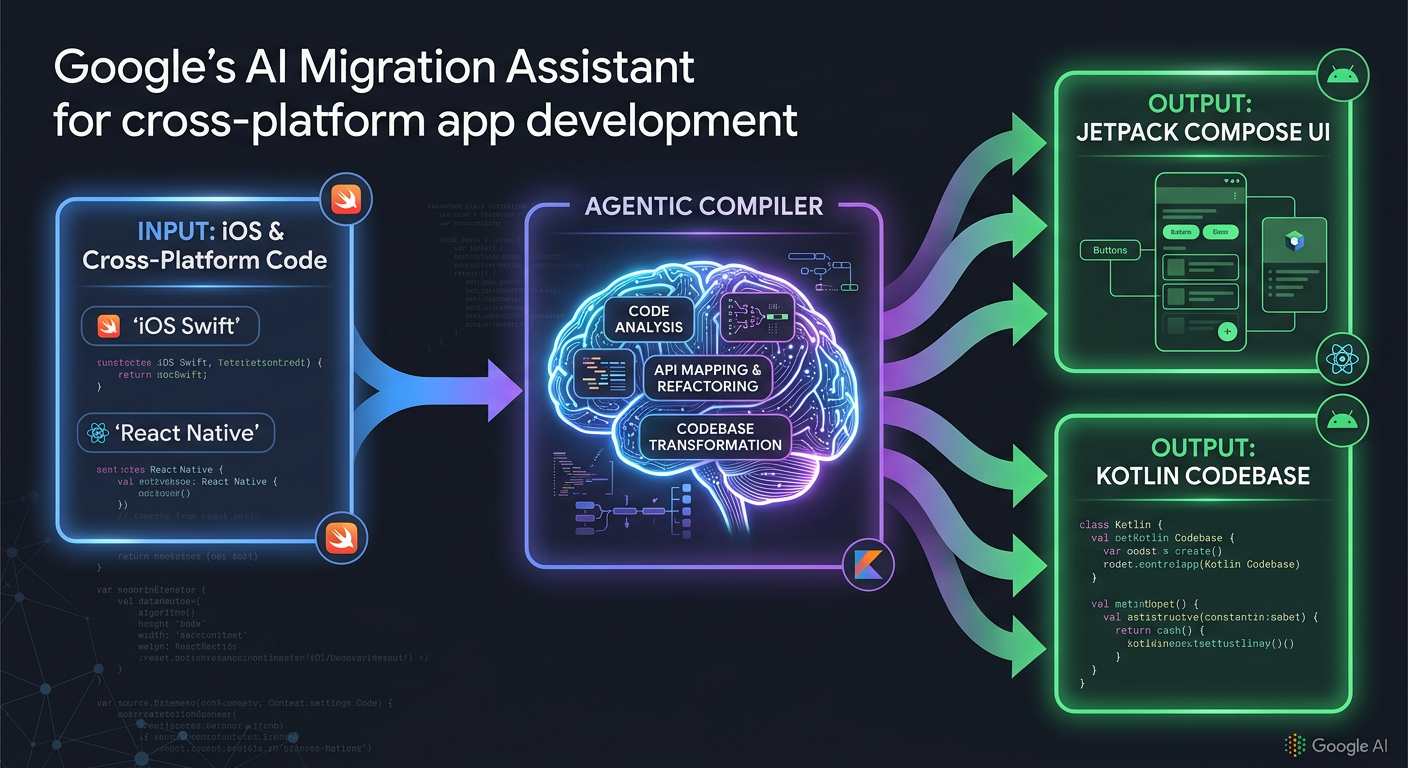
Rather than spitting out the buggy, unstructured code typical of legacy cross-compilers, the Migration Assistant functions as an intelligent, context-aware engineering agent. When a developer imports an existing iOS or React Native project, the agent executes several crucial steps:
- Feature Mapping: It automatically reads native platform APIs and maps them to their exact Android Jetpack equivalents.
- Asset and Layout Parsing: It ingests iOS Storyboards, UIKit configurations, and SVG vector files, reconstructing them from scratch into native Jetpack Compose layouts.
- Clean Code Generation: The output is written entirely in Kotlin. Following Google's strict "Compose-First" directive, the agent completely avoids legacy XML views, writing modular, production-ready code that matches recommended Android architecture guidelines.
Shifting Mobile Platform Strategy
This tool represents a seismic shift for startups and smaller development teams. Previously, choosing to launch exclusively on iOS was the default choice to conserve engineering bandwidth. By reducing a grueling, weeks-long rewrite process to a highly streamlined, supervised agentic workflow, Google is lowering the barrier to entry to a near-zero cost.
Of course, Google is not claiming this tool completely replaces human developers. The generated code still requires manual review, performance optimization, and rigorous testing. However, by handling the heavy scaffolding, tedious boilerplate translation, and asset conversion, the Migration Assistant allows engineers to focus strictly on platform-specific polishing and fine-tuning.
With the release of the AI Migration Assistant, the excuse of "we don't have the resources for an Android app" has officially expired.


Get the wire in your inbox
Every new signal, straight from the generator. No noise, unsubscribe anytime.