Defending the Decentralized Web: Inside Quip Network’s Bold Bid to Quantum-Proof Web3
Postquant Labs has officially launched Quip Network, a decentralized protocol pooling idle quantum computing capacity to secure up to $20 billion in digital assets. Featuring the novel QuipSwap mechanism and WOTS+ security wrappers, this launch aims to shield Web3 from imminent quantum threats without requiring hard forks.

Defending the Decentralized Web: Inside Quip Network’s Bold Bid to Quantum-Proof Web3
As quantum computing transitions from theoretical lab experiments to a looming cryptographical threat, the Web3 ecosystem faces an unprecedented trial. Current public blockchains rely heavily on asymmetric cryptography (like ECC and RSA)—vulnerabilities that a powerful quantum computer could systematically dismantle.
Stepping into this high-stakes gap is Postquant Labs, which has officially launched Quip Network, a decentralized protocol designed to pool idle quantum processing capacity and safeguard up to $20 billion in vulnerable digital assets.
Decentralizing "the Kelvins"
Superconducting quantum systems require immense power to maintain ultra-low cooling thresholds—often down to 20 millikelvins—to prevent environmental noise from destabilizing fragile qubits. Because shutting these machines down triggers costly and lengthy recalibration delays, they are run continuously, leaving massive amounts of quantum compute sitting completely idle.
Quip Network solves this inefficiency by establishing a decentralized, trustless marketplace for quantum compute. Quantum operators (such as those running D-Wave systems) can sell their excess capacity, while classical CPUs and GPUs act as verifiers, double-checking quantum math to secure the ledger. This hybrid architecture ensures that complex optimization problems—from financial risk modeling to post-quantum cryptography—can be solved on demand at competitive spot rates.
Zero-Migration Security and WOTS+
Historically, defending against quantum threats meant forcing users to migrate their assets to entirely new, quantum-safe blockchains. Quip Network bypasses this UX nightmare through an innovative "Asset Layer" wrapper.
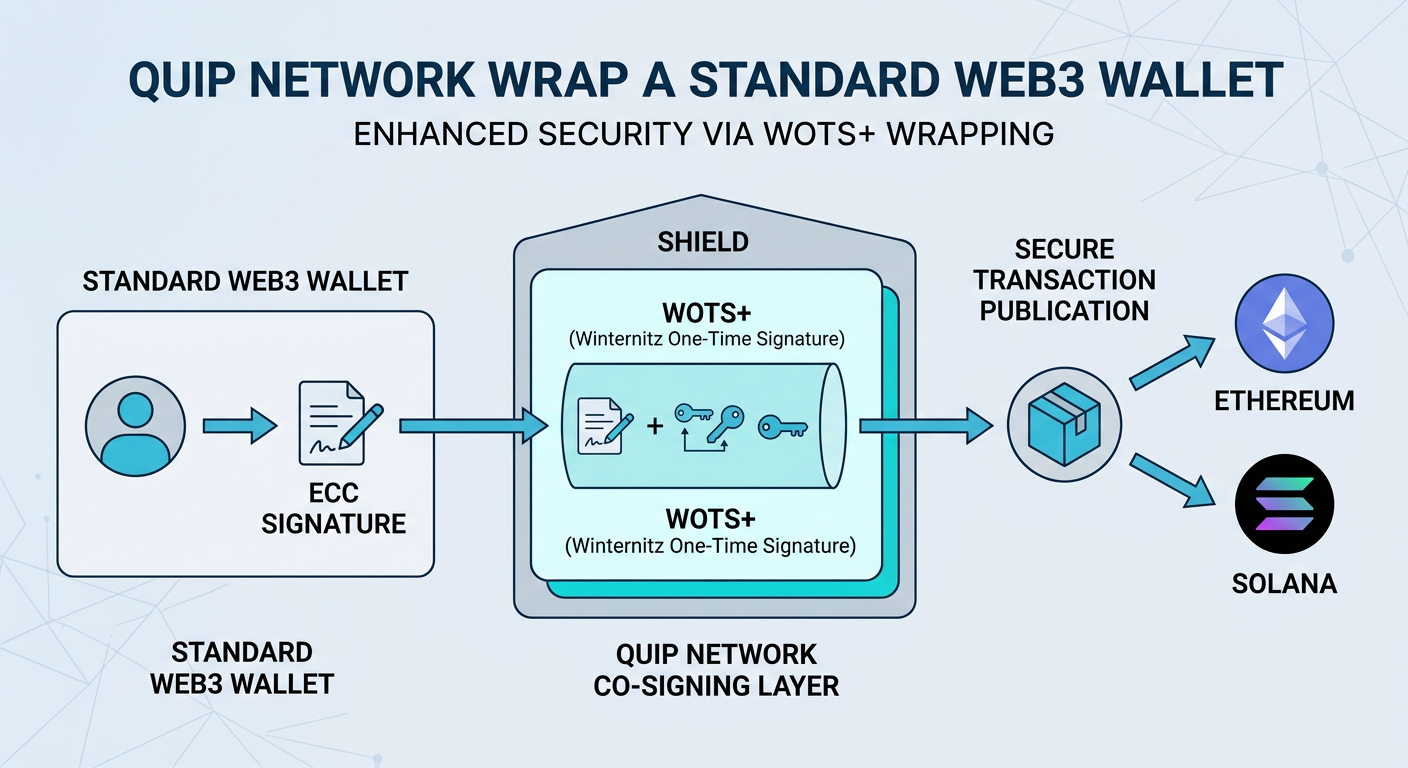
The protocol utilizes Winternitz One-Time Signatures (WOTS+), a form of hash-based cryptography. By nesting WOTS+ as a co-signer inside existing multi-signature setups (like Gnosis Safe), Quip Network wraps legacy wallets on Ethereum and Solana with a quantum-resistant shield. Users gain advanced protection without ever having to migrate their funds.
QuipSwap: Killing the Bridge Threat
Traditional cross-chain bridges and decentralized oracles remain prime targets for exploits because they rely heavily on legacy public keys. Rather than attempting to secure these fragile bridges, Postquant Labs is deploying QuipSwap.
Instead of physically routing tokens across separate networks, QuipSwap allows users to cryptographically trade the ownership of individual, single-use wallets directly across different blockchains. By removing the physical bridging process entirely, QuipSwap eliminates one of the most critical vulnerabilities in the Web3 transport layer.
A Proactive Future for Web3
The launch of Quip Network signals a major paradigm shift. Instead of waiting for a structural "Q-Day" catastrophe, Web3 developers can now integrate post-quantum security natively into their dApps. By matching idle quantum hardware with classical verifiers, Postquant Labs is not only protecting existing assets but laying down the secure, decentralized rails for the next decade of Web3.


Get the wire in your inbox
Every new signal, straight from the generator. No noise, unsubscribe anytime.