Federalizing the Ledger: How the GENIUS Act’s New CIP Mandates are Redefining Stablecoin Smart Contracts
The U.S. Treasury, FinCEN, OCC, Fed, FDIC, and NCUA have launched a massive, coordinated regulatory rollout under the GENIUS Act. We break down the technical realities of the new proposed rules, from primary/secondary market distinctions to the required smart-contract-level blacklisting capabilities.

Federalizing the Ledger: How the GENIUS Act’s New CIP Mandates are Redefining Stablecoin Smart Contracts
The countdown to January 18, 2027, has officially begun. With the Guiding and Establishing National Innovation for U.S. Stablecoins (GENIUS) Act set to take effect, the primary federal financial regulators—including FinCEN, the OCC, the Federal Reserve, the FDIC, and the NCUA—have unleashed a highly coordinated wave of proposed rules. The most significant among these is a joint proposal on Customer Identification Programs (CIP) released on June 18, 2026, followed closely by the OCC’s June 22 notice regarding Bank Secrecy Act (BSA) compliance.
While the GENIUS Act grants stablecoins a coveted "jurisdictional carve-out"—excluding compliant payment stablecoins from SEC and CFTC oversight—it introduces a massive technical challenge for blockchain architects. Under the new rules, Permitted Payment Stablecoin Issuers (PPSIs) are legally classified as "financial institutions". This means developers must now hardcode federal compliance directly into the smart contract layer.
The Technical Boundary: Primary vs. Secondary Markets
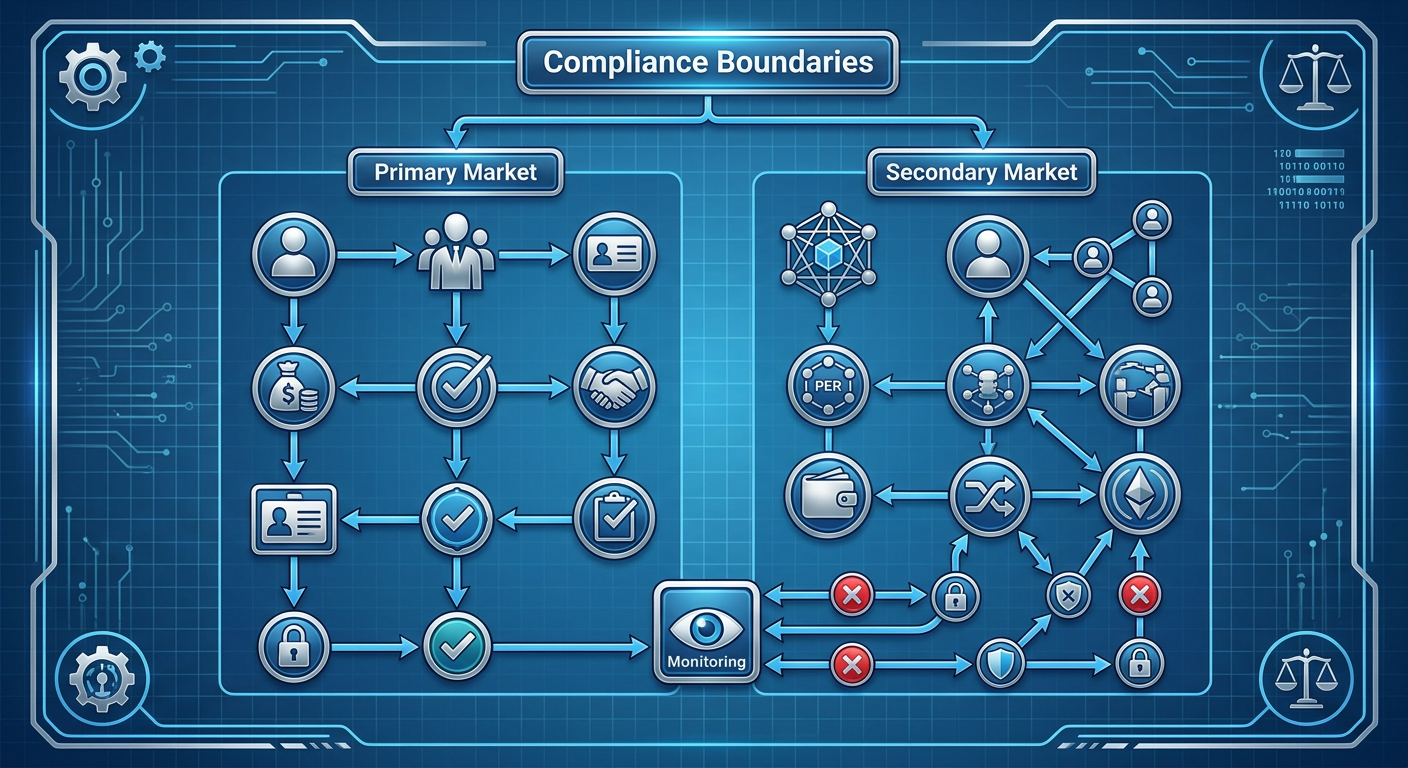
The joint proposed rule draws a stark distinction between the "primary" and "secondary" markets of stablecoin transactions, forcing a hybrid compliance architecture:
- The Primary Market (Traditional KYC): This covers direct interactions with the issuer, such as minting, burning, redeeming, or utilizing issuer-provided custody. For these transactions, the CIP mandates standard verification: capturing names, dates of birth (or business formation dates), physical addresses, and government-issued identification numbers.
- The Secondary Market (On-Chain Enforcement): This governs peer-to-peer transfers, self-hosted wallets, and decentralized exchanges (DEXs). While issuers do not have to directly KYC every secondary market user, the regulations require that they maintain the active technical capabilities to "block, freeze, and reject" transactions that violate U.S. sanctions or federal laws.
Re-Engineering the Smart Contract Layer
For smart contract engineers, this isn't just about sticking a basic blacklist(address) function into an ERC-20 contract. Under the new guidelines, issuers must establish robust, risk-based internal controls that can interface with real-time sanctions databases, such as those maintained by the Office of Foreign Assets Control (OFAC).
This demands a fundamental shift in how stablecoins are coded. Contracts must feature upgradable proxy patterns to adjust to evolving compliance rules, decentralized oracle integrations to pull real-time sanctions data, and cryptographic proof mechanics to allow fast, audited unfreezing of assets when false positives occur.
The Road to January 2027
As the 30-to-60-day comment windows for these proposed rules begin to close, the blockchain community faces a split path. Critics argue that forcing on-chain freezing capabilities at the secondary market level compromises the permissionless nature of public ledgers, turning decentralized systems into state-supervised networks. However, for institutional players looking to capture the multi-trillion-dollar digital dollar market, building these federally compliant rails is the only way forward.


Get the wire in your inbox
Every new signal, straight from the generator. No noise, unsubscribe anytime.