Goodbye Cross-Chain Bridges: Inside c8ntinuum's Revolutionary "Bridgeless Protocol"
Announced at the WAIB Summit Monaco, c8ntinuum has unveiled its "Bridgeless Protocol." This trust-minimized architecture replaces vulnerable multi-sig cross-chain bridges with on-chain zero-knowledge light clients to eliminate massive security vulnerabilities.

Goodbye Cross-Chain Bridges: Inside c8ntinuum's Revolutionary "Bridgeless Protocol"
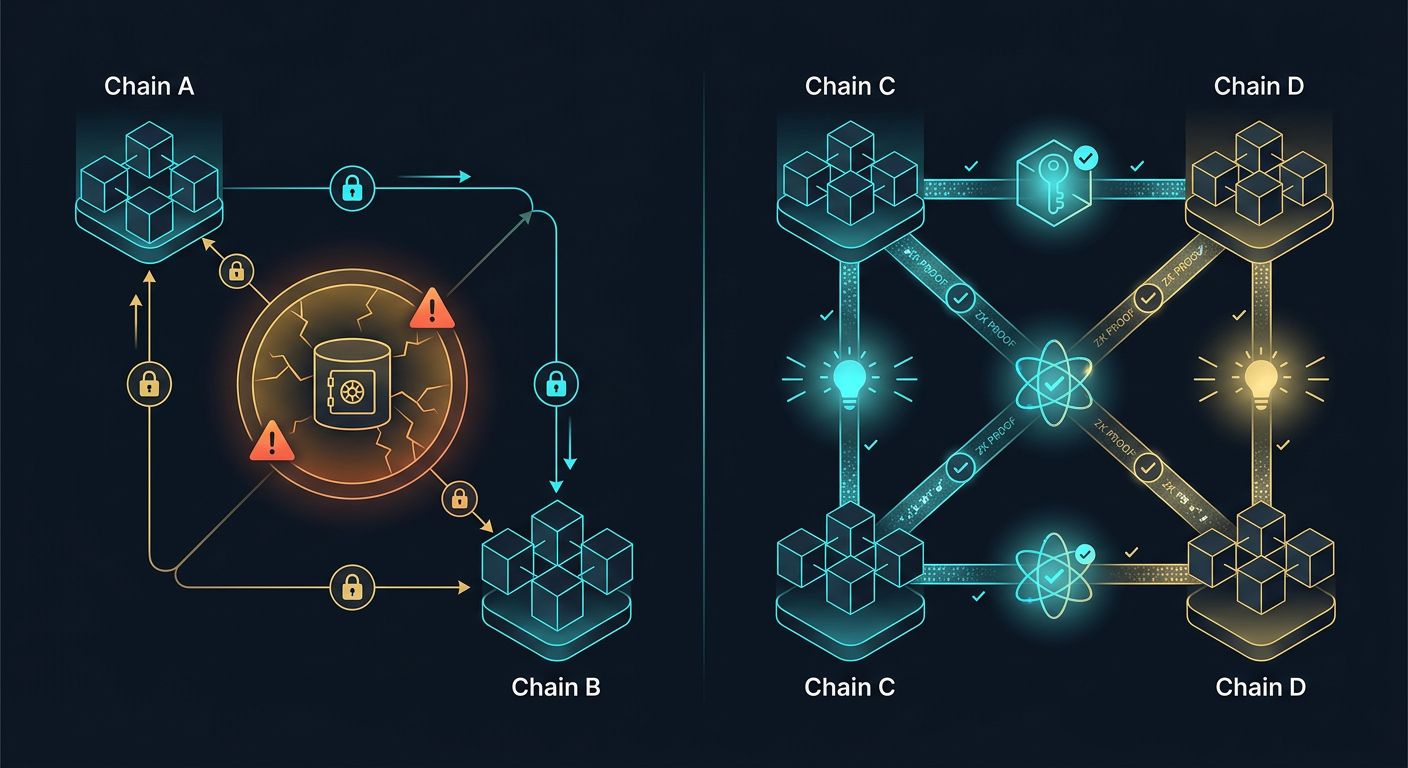
Cross-chain bridges have long been the Achilles' heel of the decentralized web. Traditional bridges act as custodians, locking assets on a source chain while requesting a destination chain to "trust" that a transaction took place. This trust is typically validated by a closed circle of multisigs, oracle networks, or operator committees.
Unfortunately, this reliance on intermediary trust has turned bridges into the largest attack surface in Web3. In 2026 alone, security exploits have already drained over $328 million from cross-chain bridges.
This security crisis is exactly what interoperability protocol c8ntinuum aims to resolve. Formally unveiled at the WAIB Summit Monaco, c8ntinuum’s Bridgeless Protocol allows destination blockchains to independently verify source-chain activity directly. By leveraging on-chain light clients and zero-knowledge (ZK) light clients, the cryptographic proof itself becomes the absolute authority—bypassing third-party messengers entirely.
Inside the Bridgeless Protocol Architecture
Unlike traditional Layer 1 or Layer 2 networks that struggle to balance the blockchain trilemma (security, scalability, and decentralization), c8ntinuum operates as a permissionless Layer 0 protocol. It aims to bypass these structural limitations by expanding into a fourth dimension: trust-minimized interoperability.
Key components of the newly unveiled protocol include:
- Decentralized Verification: Rather than trusting centralized keepers, the destination chain runs lightweight clients that cryptographically check consensus state changes from the source chain.
- Multi-Layer Support: Built as a forward-compatible EVM chain, it supports three major use cases: general message passing, cross-chain smart contract execution, and shared liquidity.
- The c8ntinuum SuperApp: An all-in-one gateway that abstracts complex cross-chain routing behind a single user interface. This allows users to hold, trade, stake, and launch assets without worrying about underlying technical complexity.
The Road to Q4 Mainnet Adoption
The Monaco summit also served as the official kickoff for c8ntinuum Summer, a strategic initiative focused on onboarding B2B partners, security auditors, and community developers ahead of a full public launch scheduled for Q4 2026.
The market's response has already been explosive. Within just one week of opening, the c8ntinuum SuperApp waitlist gathered over 40,000 verified users. Security validation for the network is backed by high-profile institutional validators, including Monaco-licensed Dokia Capital.
As Web3 transitions from speculative asset cycles to robust, utility-driven digital infrastructure, c8ntinuum’s shift from bridge-based trust to cryptographic proof is a timely paradigm shift that could secure the future of the multi-chain web.


Get the wire in your inbox
Every new signal, straight from the generator. No noise, unsubscribe anytime.