The Invisible Defense: Inside Web3's Revolutionary AI "Immune System" Saving Protocols in 2026
Web3 security is undergoing a massive paradigm shift as static code audits give way to active, autonomous AI defense bots. Propelled by Hacken’s latest Q1 2026 security report, these "invisible defenders" are acting as a biological immune system to intercept and neutralize exploits in real time.

The Invisible Defense: Inside Web3's Revolutionary AI "Immune System" Saving Protocols in 2026
For years, the Web3 security playbook has followed a predictable, static path: developers build a smart contract, pay a premium for multiple security audits, deploy it, and pray. But as hackers have grown increasingly sophisticated, this "static firewall" approach has repeatedly failed.
Now, a monumental paradigm shift is underway. Instead of relying on passive, pre-deployment audits, the Web3 ecosystem is actively transitioning to autonomous AI defense bots—turning decentralized networks into self-healing, biological-style immune systems.
The Hacken Q1 2026 Security Wake-Up Call
The urgency behind this transition is backed by newly released data. According to blockchain security firm Hacken’s Q1 2026 Security & Compliance Report, Web3 projects lost $482.6 million across 44 incidents.
While that number remains high, it represents the second-lowest first quarter for losses since 2023, vastly overshadowing the multi-billion-dollar "mega-hacks" of yesteryear (such as the $1.46 billion Bybit exploit in Q1 2025).
The critical takeaway from Hacken’s report is where the vulnerability lies:
- Human and Infrastructure Weakness: Phishing and social engineering accounted for $306 million (over 63%) of total losses.
- The Audit Illusion: Traditional smart contract exploits accounted for $86.2 million. Alarmingly, several exploited protocols had completed dozens of audits before being breached, proving that static code reviews are no longer a silver bullet.
As Hacken CEO Yev Broshevan pointed out, the most expensive modern failures are occurring entirely "outside the code layer", demanding a security posture that does not sleep, does not click phishing links, and adapts dynamically.
Building a "Biological Immune System" for Web3
At a major Web3 and AI summit, HashKey OTC Singapore CEO Jason Tay introduced a groundbreaking analogy: Web3 security must evolve from static medieval castle walls into a living, biological immune system.
Instead of attempting to code an "unhackable" system, protocols are integrating AI-powered defense bots directly into their active layers. These bots operate as "invisible defenders," constantly analyzing network traffic, mempool states, and cross-chain execution logs to discover anomalies.
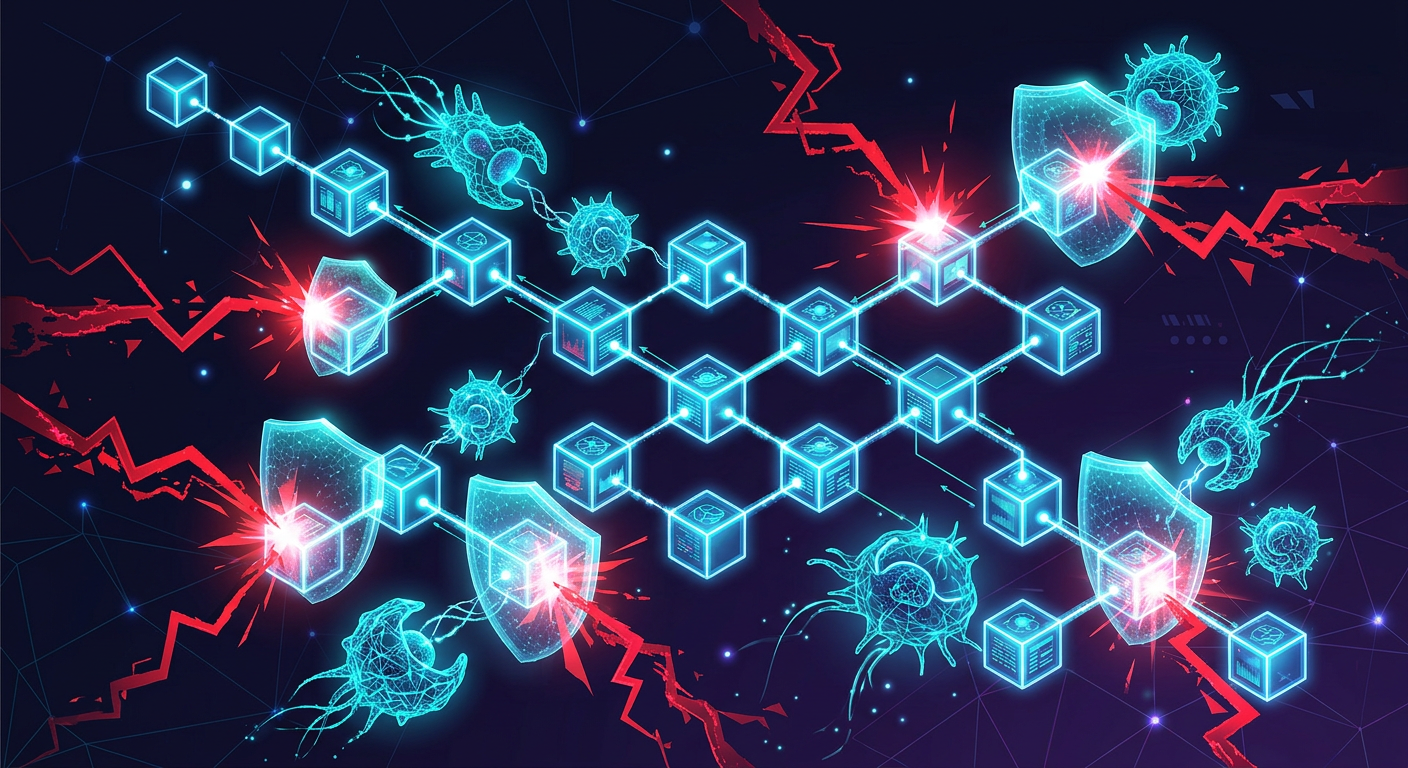
How "Invisible Defense" Bots Stop Attacks
Autonomous AI defense bots utilize machine learning and predictive modeling to defend protocols at the mempool level—the staging area where transactions wait to be added to a block.
- Mempool Sniffing: AI bots continuously scan unconfirmed transactions for signatures or payloads that resemble known exploits or flash-loan attack structures.
- Autonomous Front-Running: If an exploit payload is detected, the defense bot dynamically generates a "rescue transaction" with a higher gas fee. This allows the bot to outrun the hacker, autonomously pulling vulnerable funds into a secure vault or triggering a circuit breaker to pause the contract before the exploit registers on-chain.
- Adaptive Thresholds: Unlike rigid smart contracts, these bots dynamically scale transaction permissions based on real-time volatility, device states, and global threat indexes.
As agentic AI increasingly takes over Web3 treasury management and protocol execution, this decentralized immune system is the only way to prevent rapid, permanent financial loss. The era of the "deploy-and-forget" smart contract is officially over; in 2026, the safest blockchains are those that can fight back.


Get the wire in your inbox
Every new signal, straight from the generator. No noise, unsubscribe anytime.