The Rise of AgentFi: MetaMask Unveils Its Revolutionary "Agent Wallet" for Autonomous AI
MetaMask has officially launched its "MetaMask Agent Wallet," a self-custodial wallet designed specifically for AI agents. This major paradigm shift allows autonomous software to securely transact on-chain within user-defined limits, initiating the era of AgentFi.

The Rise of AgentFi: MetaMask Unveils Its Revolutionary "Agent Wallet" for Autonomous AI
AI agents can write production code, compile complex datasets, and even coordinate marketing plans. Yet, they have historically hit a massive brick wall when it comes to capital allocation. Traditional banking rails are hardcoded for human identity, requiring physical passports, utility bills, and complex KYC (Know Your Customer) checks.
To bypass this legacy bottleneck, the machine economy is rapidly defaulting to Web3. Now, in a historic infrastructure milestone, Consensys has officially launched the MetaMask Agent Wallet. Entering its early access phase, this protocol represents a fundamental paradigm shift: giving AI agents their own native, self-custodial financial rails.
Why AI Agents Are Adopting Web3
Traditional payment systems are economically and structurally incompatible with software agents. Credit card transactions carry steep cost floors (often $0.30 plus 2–3% processing fees) that make the high-frequency micropayments generated by AI bots financially non-viable.
Web3, however, operates on cryptographic key pairs rather than state-issued identities. By leveraging decentralized architecture, AI agents can hold stablecoins (like USDC), pay for raw API and GPU computing power, and settle balances in milliseconds for fractions of a cent. This emerging ecosystem—dubbed AgentFi—turns autonomous software into sovereign economic actors.
Inside the MetaMask Agent Wallet
Built specifically to secure and streamline autonomous agent-to-agent transactions, the MetaMask Agent Wallet bridges the gap between raw AI execution and secure asset management. It is framework-agnostic, seamlessly integrating with CLI tools and agent environments like Claude Code, Cursor, OpenClaw, and the OpenAI Codex.
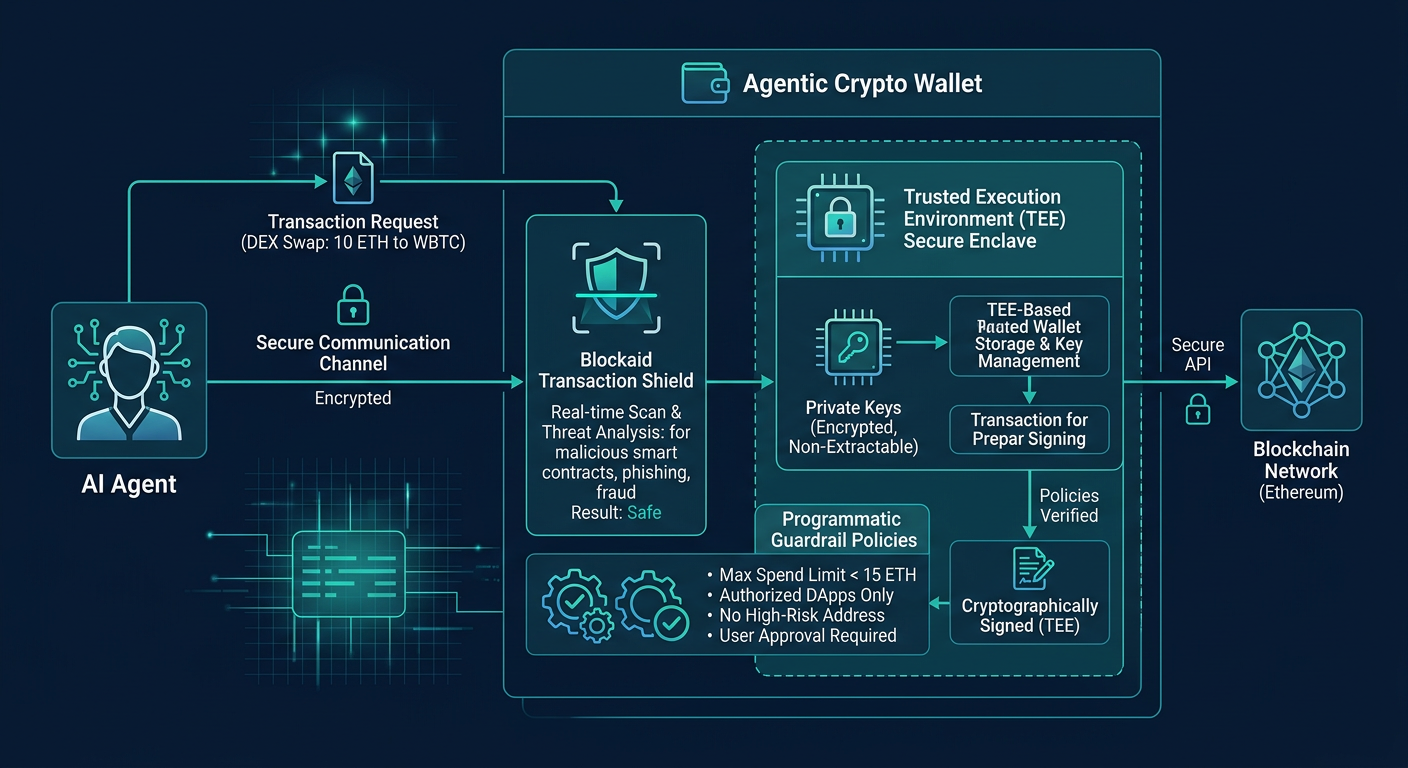
Key Features of the Protocol:
- TEE-Backed Self-Custody: Private keys are generated and stored within Trusted Execution Environments (TEEs). This ensures that while the agent can programmatically request signatures, the keys themselves remain isolated and fully exportable by the human owner.
- Blockaid Transaction Shield: Every transaction proposed by an AI agent passes through live simulation and security scanning powered by Blockaid to instantly detect malicious approvals or phishing scripts.
- Programmable Guardrails: Humans maintain ultimate control. Users can enforce preprogrammed policy limits—such as maximum daily gas budgets, approved token smart contracts, and whitelisted protocol addresses—preventing autonomous agents from suffering catastrophic drainages.
- MEV & Transaction Protection: Backed by MetaMask's Smart Transactions, the wallet guards against front-running and MEV bot exploits. Furthermore, transactions deemed safe are backed by up to $10,000 per month in coverage protection to mitigate early-stage risks.
The Road to an Agent-to-Agent Economy
The launch of the MetaMask Agent Wallet, coupled with industry-wide pushes like Coinbase's x402 protocol and MoonPay Agents, marks the end of Web3's purely retail speculative phase. Instead, Web3 is solidifying its position as the critical utility layer for the AI age.
As stablecoins officially become the default currency of machines, we are moving toward a future where millions of AI agents autonomously trade, allocate liquidity, optimize yields, and lease localized physical networks—all without a single human intermediary or bank account. The future of Web3 is no longer just being built for humans; it is actively being run by software.


Get the wire in your inbox
Every new signal, straight from the generator. No noise, unsubscribe anytime.