Beyond T+2: How Chainlink's 'Project Pangea' and a $10T Banking Alliance Are Redefining Global FX
Chainlink has partnered with major European and South Korean banking consortia representing $10 trillion in assets to launch Project Pangea. The initiative leverages Chainlink's CCIP and a dedicated L1 network to enable real-time, T+0 atomic FX settlement.

Beyond T+2: How Chainlink's 'Project Pangea' and a $10T Banking Alliance Are Redefining Global FX
The global foreign exchange (FX) market operates at an astronomical scale, processing trillions of dollars daily. Yet, beneath the hood of this modern financial colossus lies a legacy system: the T+2 settlement model. For decades, institutions have accepted a two-day delay to clear cross-border currency trades, absorbing massive counterparty risks and locking up billions in intraday liquidity.
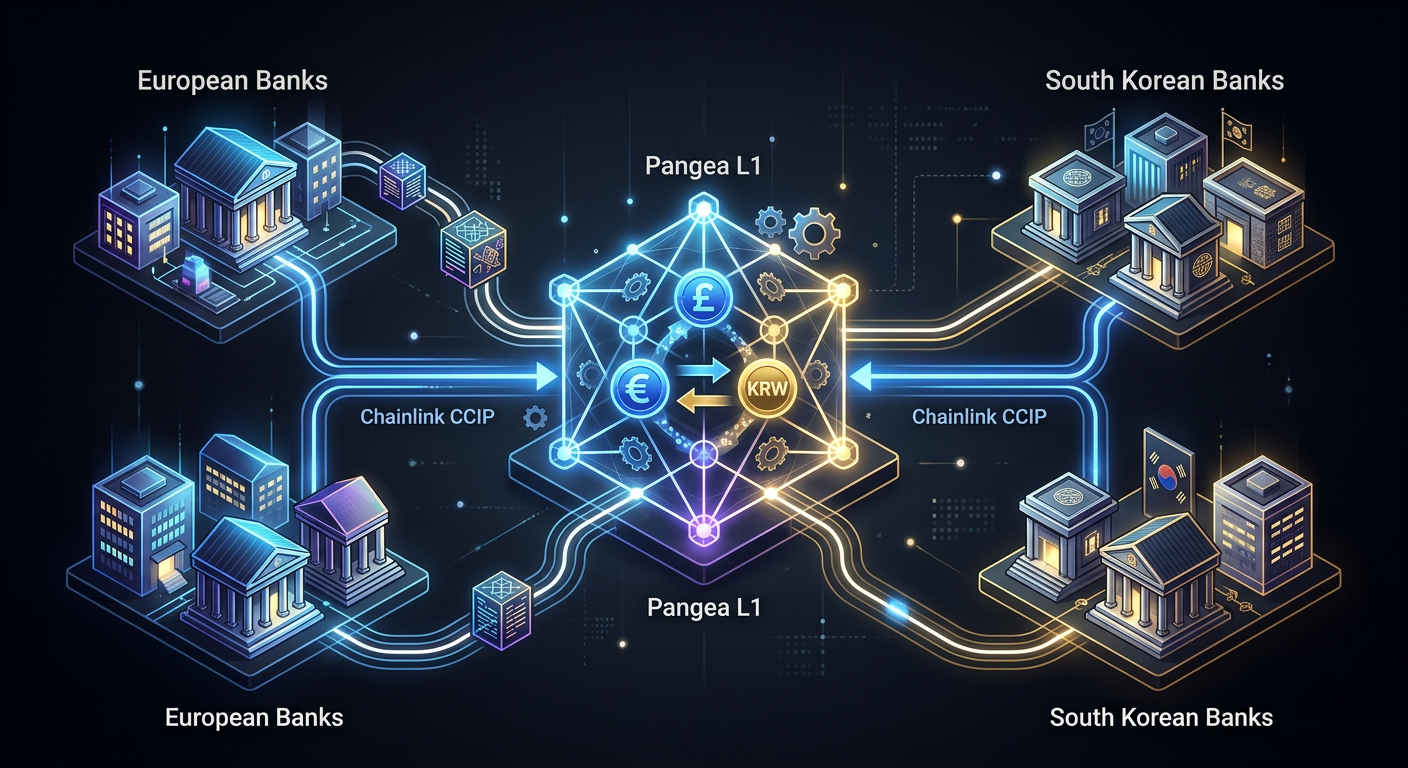
That standard is officially on the chopping block. Chainlink, alongside FairSquareLab and two massive banking consortia—Europe’s Qivalis (representing 37 banks) and South Korea’s Unified Korea Alliance (UniKA)—has officially launched Project Pangea. Collectively representing more than 50 financial institutions and over $10 trillion in assets under management (AUM), this cooperative task force is building a high-speed, Web3-native infrastructure to achieve instant, T+0 atomic FX settlement.
Bridging the Legacy-to-Onchain Gap
Rather than forcing financial institutions to rip out their existing setups, Project Pangea meets banks where they are. The framework acts as a translation layer, using existing Swift rails and ISO 20022 messaging standards to orchestrate transactions.
Here is how the underlying Web3 architecture powers this transition:
- The Interoperability Layer: Chainlink’s Cross-Chain Interoperability Protocol (CCIP) securely transfers regulated Euro (EUR) and South Korean Won (KRW) stablecoins across disparate blockchain networks.
- The Settlement Rail: Trades execute on FairSquareLab’s Pangea L1, a neutral, settlement-dedicated layer-1 blockchain.
- Oracle-Driven Pricing: Chainlink Data Streams feed real-time, low-latency FX market data directly to the Pangea L1. Crucially, oracle updates are guaranteed to execute before any other transaction in a block, preventing arbitrage or price slippage during high-volume interbank swaps.
The Power of the Atomic Swap
At the heart of Project Pangea is the concept of a Payment-versus-Payment (PvP) atomic swap. In traditional FX, one bank might send its currency and have to wait hours—or days—for the matching currency to arrive. With an atomic swap, both legs of the trade settle simultaneously on-chain. If one transaction fails, the entire swap is aborted.
This completely eliminates settlement and counterparty risks. It also drastically reduces intraday liquidity costs, freeing up capital that banks previously had to hold in reserve as a safety buffer.
A Paradigm Shift for Web3 Utility
Project Pangea marks a decisive moment in Web3’s maturation. The narrative of 2026 is no longer about retail speculation; it is about enterprise-grade utility. By seamlessly integrating Swift messaging with Chainlink's cross-chain standards, Project Pangea proves that blockchain infrastructure is ready to serve as the new back-end for global finance.


Get the wire in your inbox
Every new signal, straight from the generator. No noise, unsubscribe anytime.