The Post-Quantum Dawn: How Android 17 Out-Engineers the Impending Quantum Apocalypse
With the official release of Android 17, Google has quietly initiated a major architectural shift: post-quantum cryptography. By integrating ML-DSA and APK Signature Scheme v3.2, Android becomes the first mobile OS natively fortified against the looming threat of quantum decryption.

The Post-Quantum Dawn: How Android 17 Out-Engineers the Impending Quantum Apocalypse
While mainstream tech news is buzzing with Android 17’s new multitasking app bubbles and consumer-facing AI features, Google has quietly executed the most critical cryptographic upgrade in mobile history. With the official release of Android 17, Google has launched the "first phase" of Android’s transition to post-quantum cryptography (PQC).
This isn't a response to an active threat today, but a preemptive strike against "Harvest Now, Decrypt Later." State actors and sophisticated cybercriminals are actively hoarding encrypted digital keys and sensitive data today, waiting for the day quantum computers become powerful enough to tear through classical RSA and Elliptic Curve Cryptography (ECC). Android 17 aims to make that stolen data useless before that day ever arrives.
The NIST Standard: Lattice-Based Cryptography
At the core of this upgrade is ML-DSA (Module-Lattice-Based Digital Signature Algorithm), the newly finalized cryptographic standard recommended by the National Institute of Standards and Technology (NIST). ML-DSA relies on complex, high-dimensional geometric structures called lattices. While quantum computers can easily reverse-engineer classical mathematical formulas, lattice problems remain virtually impossible for both classical and quantum systems to solve.
Shoving Lattices Into the Secure Hardware (TEE)
Implementing lattice-based cryptography is a massive engineering feat. ML-DSA requires substantially larger cryptographic keys and memory footprints than traditional ECC. Google’s engineers successfully optimized these algorithms to run inside the severely resource-constrained Trusted Execution Environment (TEE) of modern smartphones—the dedicated, isolated hardware chip that handles your biometric data and lock screen PINs.
The Three Pillars of Android 17's Quantum Defenses
Google isn’t just patching apps; it is rewriting the entire chain of trust from the silicon up:
- Android Verified Boot (AVB): Android 17 integrates ML-DSA directly into the bootloader. This ensures that malware cannot bypass start-up integrity checks by using a quantum-forged digital signature to masquerade as official system firmware.
- The Android Keystore: Developers can now generate quantum-safe keys (ML-DSA-65 and ML-DSA-87) inside secure hardware using standard JCA APIs. This isolates post-quantum key material entirely from the main, vulnerable operating system.
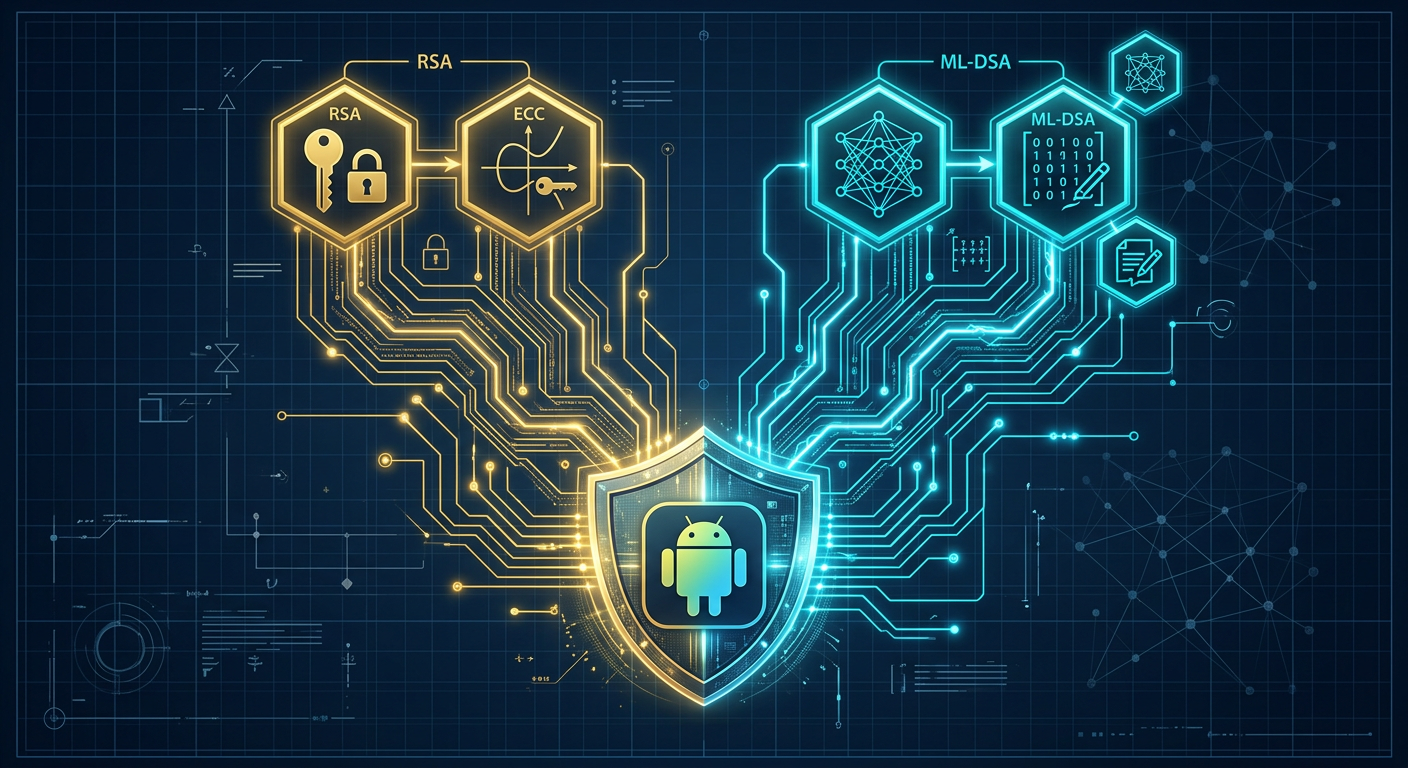
- APK Signature Scheme v3.2: Google has introduced a hybrid app-signing mechanism. By pairing traditional signatures (RSA/ECC) with ML-DSA, Android 17 guarantees that apps are protected against quantum manipulation, while maintaining full backward compatibility with older devices.
By transforming the Android Keystore and Verified Boot into quantum-resistant fortresses, Google has set a new gold standard for mobile security. While consumers focus on the flashing lights of new AI features, Android 17’s invisible post-quantum shield is quietly securing the next decade of digital life.


Get the wire in your inbox
Every new signal, straight from the generator. No noise, unsubscribe anytime.